How Are Your Presentation Skills? The Camera Doesn’t Lie

How good are you at presenting in front of a group? Are you sure?

salespeople can get better at speaking
Photo by Africa Studio/Adobe Stock

During my days as an account executive, my radio station did a trade deal with a public speaking trainer. Our team spent a full day working on presentation skills.

As part of the exercise, the trainer had each salesperson stand in front of the room and give a short presentation, which he recorded on video.

It was a humbling experience. I had thought I was a pretty decent presenter and public speaker – not great, but pretty good. Boy, was I wrong.

In the words of guitarist Bob Brozman,

Recording devices are God’s way of telling you that you suck.

As I watched myself on the monitor, I was mortified to see that I spent most of my five-minute presentation looking at my feet.  I did not make eye contact or any sort of connection with my audience.

[shareable text=”If you’re wondering whether your presentations are compelling put one on camera. The camera doesn’t lie.”]If you’re wondering whether your presentations are as compelling as you think they are, put one on camera. The camera doesn’t lie.[/shareable]

The following week I joined a local Toastmasters club and began working on my public speaking chops.

I was reminded of this by sales trainer Paul Castain’s  blog post, “The Three Minute a Day Phone Workout.” Castain recommends leaving voicemails for yourself so that you know what you are sounding like when you leave a message for a customer.

You can take Castain’s idea a step further. Presenting in a group is one of the most important sales skills you can develop. Why not record yourself on video giving a presentation?

If you have a smart phone, you have most of the equipment you need.

You can have someone hold the phone/camera, or set your phone up on an inexpensive tripod (this is the one I use) in your station conference room. Press Record, and start presenting. It’ll be helpful to have a trusted colleague in the room so that you can check on your eye contact.

Afterwards, take a break to clear your head and then watch the video. Take notes about what you observe.

  • Did you speak clearly?
  • Were you making eye contact?
  • Were there a lot of “um’s”, “uh’s”, “likes”, and “y’knows”?

Watch the video by yourself once, and then have your colleague watch it with you. Did you both notice the same things?

If you’re wondering whether your presentations are as compelling as you think they are, put one on camera. The camera doesn’t lie.

[reminder]What’s the best sales presentation you’ve ever seen? What made it so good?[/reminder]

Find a Toastmasters club in your area: http://www.toastmasters.org/Find-a-Club

Is Your Voice Mail Greeting Costing You Sales?

There was a time in the not-too-distant past when people didn’t give out their cell phone numbers.

bad voice mail messages cost sales
photo by nandyphotos/adobe stock

Those days are over: these days, email signatures and business cards only have cell numbers on them. I’ve encountered (and have written about in the past) account executives who don’t even check their landline voicemail anymore.

If you have only your cell number on your cards and email signature, it’s official – you want customers to call you on your cell phone. So let me ask you this:

Have you ever called your own cell phone?

Take a moment to borrow a phone and call your own right now. Whatever you hear when your voicemail picks up is what your clients hear.

Is it just a series of numbers?

Way too often, this is what I hear when I call an account executive (and sometimes a sales manager): a robotic voice that says something like, “You’ve reached five… oh… three… eight… one… nine… eight… oh… three… three. The person you are calling is not available. Please leave a message after the tone.”

If that’s what your clients hear, your cell phone is costing you money well beyond your monthly bill.

Your customers have no idea if they’ve called the right number! Are they leaving a message for you, or somebody else at a completely different business?

Faced with that uncertainty, some of them will hang up without saying anything. Their next call may be to your competition.

If you want your customers to call you on that cell phone, take a moment to record a personal greeting. It doesn’t have to be fancy – just give your name, and the name of your company, and ask callers to leave a message. They know how to do the rest.

Sometimes the greeting is fine, but there’s another issue: If you don’t regularly clean out your messages, the robotic voice comes on and says, “The voice mailbox is full and cannot accept messages right now. Please call again later.”

Unless they really want to talk to you, they won’t call again later. They are disgruntled, and are likely to take their business elsewhere in search of gruntling.

Call your cell phone, listen to the greeting, and try to leave a message. It doesn’t hurt to pretend to be your own customer every once in a while.

You’re Not Talking to the Decision-Maker

Not long ago, I learned that the President of a credit union couldn’t make a $12,000 decision.

sales don't happen when the client can't buy
Photo by Art3D/dpc

Prior to the first meeting the AE was convinced he had the right guy — he was the freakin’ President of the CU. But when I asked the Prez about the decision-making process at the initial needs analysis, he mentioned an 11-member Board of Directors.

Warning sign.

I asked if any board members could come to our subsequent presentation, and the answer was no. Not to worry, said the President… I’ve got a lot of sway with them.

Wrong.

It was a small market and a small credit union with a small advertising budget, so our ask was modest — $1000 a month for 12 months. The President shook his head. “The board would never agree to spend that kind of money for a year. I can’t even ask them for that.”

Qualifying the prospect is crucial to the sales process — and making sure you’re talking to someone who can pull the trigger is a big part of that. Jeffrey Gitomer puts it this way:

The number of sales you make will be in direct proportion to the number of actual decision-makers you sit in front of. The problem with most salespeople (not you of course) is that they are sitting in front of someone who has to ask their mommy or daddy if they can buy it or not.


Here are some strong indicators that you’re not in front of the real decision-maker:

  • The Board: As above. If the board can veto it, you’re contact isn’t the decision-maker. Period.
  • The Family Business: The young couple says they run the store, and Dad’s retired now. But they still go to Dad for advice. Dad’s still the decision-maker, and don’t let anyone tell you otherwise.
  • The General Manager: “I make the decisions on this stuff. But I always like to run things by the owner.” The GM will make the decisions… as long as the owner lets him. In this scenario, you need to get to the owner.
  • I Keep Trying to Tell Them: The Marketing Director is absolutely sold on the need to advertise, and she loves, loves, LOVES your station. But every time she goes to the home office for money, those idiots turn her down, and she just shakes her head. Maybe this time will be different, but don’t count on it.
  • If Carl Lets Us Do It: I had this one last year in the Midwest — five people in the room. General Manager, Marketing Director, Sales Manager, and a couple of department heads. They all loved our idea, and they wanted to do it, if Carl would give them the green light. Who wasn’t at the meeting? Carl. We’re still waiting for that green light.


All of the people in the examples above are influencers, not decision-makers. They can block a sale and keep it from going forward. They can run it up the ladder. But none of them can say yes.

It is not necessarily a waste of time to meet with influencers, but your chances of closing the sale go way up if you know who the boss is, and make your case directly to the boss.

 What It Means
To Have The Boss At The Meeting

A Sales Presentation Story

Two years ago in Mississippi, I presented an advertising plan to an insurance company. In the conference room we had four company executives. The CEO had been at the needs analysis meeting; although he was going to be out of town the day of the presentation, he wanted to be part of the conversation, so we set up a web conference so that he could see it.

For the first 45 minutes of the meeting, he was silent — in fact, I wondered if he was still even on the call.

When we asked for the order, the four executives in the room each expressed an opinion. One of them hated my idea, and the other three just didn’t like it.

It looked like a goner until it was the CEO’s turn to speak. His voice came out of the speakerphone:

“I like it, and we’re gonna do it. Let’s get it going.”


15 minutes later we were on our way back to the TV station with a sale and a signed contract. That one “yes” overruled four “nos”.

Don’t let influencers fool you. Asking the right questions can put you in front of the right person… and that may be the difference between “No” and “Yes”.


[reminder]What question do you ask to make sure you’re in front of the right person?[/reminder]


Want a Free Book on How to Create and Manage a TV Sales Force?

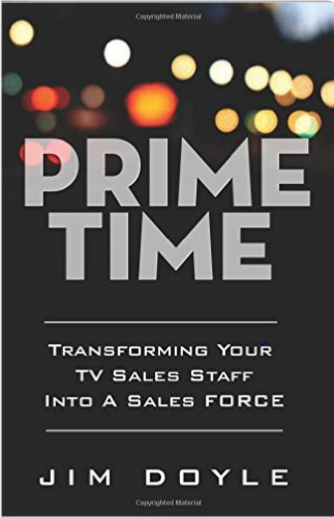
I’m giving away three copies of Jim Doyle’s great new book Prime Time: Transforming Your TV Sales Staff Into A Sales FORCE.


Great TV Sales Management Book

If you’re a television sales manager, a DOS, or a General Manager — or if you’re an Account Executive who’s thinking about going into management — this book is an excellent guide.

Here’s how you can get yours, in three steps:

  1. Go to TV Sales Cafe. You can do that by clicking here.
  2. Sign in if you’re a member. Sign up if you’re not — membership is free.
  3. Add a new discussion in the Discussion Forum.

TV Sales Cafe is a networking site where television and digital sales professionals can connect, ask questions, and share ideas. It’s off to a great start, but these things always need more members and more discussions.

This here contest is a little jump start for it.

First three people to add a brand-new discussion to the Discussion Forum get a copy of the book. I even pay for within-the-US postage!


How Jargon Is Killing Your Sales

Plain talk makes sales. Fancy talk makes you sound lame. – Jeffrey Gitomer

Do you use jargon in your sales presentations? Words that, while understood by your industry colleagues, mean nothing to your customers? Jargon can knock a sale off course without your even knowing it.

sales jargon kills sales
photo by creative soul/dpc

I recently watched a salesperson present some online marketing ideas to an insurance agency. One of the items in the proposal was labeled “PPC”, and the salesperson referred to “PPC” several times during his remarks.

Finally, the exasperated client raised his hand to stop the presentation and said, “What the heck is PPC?'”

Only then did the AE explain that it stood for “Pay Per Click” — the text ads on Google (advertisers only pay Google when someone clicks on the ad).

We were lucky the client asked. In many cases, customers are afraid to say anything because they don’t want to look stupid. The result can be a lost sale — people won’t buy what they don’t understand.

[shareable]If they don’t understand it, they won’t buy it.[/shareable]

It’s time to clean jargon out of your vocabulary.  Your “inside” expressions — the ones you use every day with co-workers and advertising agencies — do not belong in the sales materials and you share with your direct customers .

Here are some terms your co-workers understand but your customers may not:

  • Demo — the furniture store owner doesn’t have a demo. She has customers.
  • DMA — the PI attorney doesn’t know what your DMA is, and doesn’t care. He might be interested in how far your signal goes, or what counties you’re carried in.
  • 8a-10a” — the real estate agent you’re calling on doesn’t get to the office at 8a — she arrives at 8am, or 8 in the morning.
  • SEO — the insurance broker has no idea what “SEO” is, but he wants to show up higher when people are searching online.
  • PPC or SEM — same as the above. Talk about the text ads people click on when they go to Google.

Sales expert Jill Konrath put it this way:

“Our goal should always be to ensure clear communications. That means we need to speak like we’re talking to normal human beings. Sometimes that’s harder than it sounds. But, by keeping things simple, we all benefit.”

Whether you’re talking to customers online, on paper or in person, ditch the jargon. Your sales numbers will be glad you did.