Why “Find Us On Facebook” Is a Sales Killer

“Don’t make the mistake of thinking you’re Facebook’s customer, you’re not – you’re the product,” Bruce SchneierPuppy and kitten and guinea pig Dollarphotoclub_67306538

photo by aleksandr/dpc

In the rush to use social media, advertisers are cramming the Facebook logo everywhere.

They  post it at the end of television commercials next to their own logo. They put in print ads and on billboards; “Find us on Facebook!” is included in radio commercials.

It’s even on store signage, directed at customers who have already found the store in real life.

This is a bad idea.

On the surface, it seems like a good one. After all, millions log onto Facebook at least regularly — why not let them know that the store’s got a page?

Why “Find Us On Facebook” Can Backfire

When your customers go to Facebook, you have no control over what they do next. If they are going to look for you online, you want them on your own site, not on Facebook.

I once heard Dan Kennedy, during a teleseminar, explain the fundamental difference between a store’s website and its Facebook page.

When shoppers land on your web page, he said, it is as if they have walked into your store. You have control over where they go and what they do. You can show them your merchandise, engage them in an online chat, and move them down a funnel that ultimately results in a sale.

As long as they are on your website, they see what you want them to see.

Inviting them to find you on Facebook, Kennedy pointed out, is like walking them out your back door into a carnival in the parking lot. There’s a puppy doing tricks on one side, crazy political speeches happening on the other side.

You have a booth at the carnival. So do all your competitors.

A customer could go to Facebook to look for you, and spend the afternoon watching cat videos instead.

What if they “Like” you on Facebook? Doesn’t that give you a chance to communicate with them on their news feeds?

Not much — Facebook’s changed their algorithm so that the vast majority of your business page fans will never see your updates unless you pay them. Organically, Adweek reports, a page will reach about 2.6% of its fans with a post.

There’s nothing outrageous about this — Facebook’s a business, they have put lot of money, time, and study into building this platform. It’s not your platform, it’s theirs.

“Owners make rules, not tenants. And Facebook owns the lot.” — Michael Hyatt

You aren’t the customer… you’re the product.

This doesn’t mean you shouldn’t have a Facebook page or a social media strategy. Your customers are likely to spend time on Facebook, and there’s nothing wrong with having a presence when they look for you.

Your mass media advertising — radio, television, transit or outdoor, direct mail, etc — should drive your prospects to an environment you control. That’s your website, not your Facebook page.

Send them to your store, not the carnival.

[reminder]

A Beautiful Ad That Didn’t Work… and An Ugly One That Did

“They kind of forgot to sell the car.”

The Dog Strikes Back_ 2012 Volkswagen Game Day Commercial

Remember this commercial from the 2012 Super Bowl? Watch the ad and then answer the one-question quiz below.

Volkswagen, like many advertisers that year, released the ad on the Internet a week early to get people talking. The reviews in the media after the game were extremely positive.

The ad ranked #2 on the USA Today Ad Meter. Shirley Brady of Brandchannel called it “Another big win for Volkswagen” in the Washington Post, and predicted greater recall for the featured model than VW had accomplished the previous year in the same slot.

Here’s the quiz:  without going back and watching it again, which model is the ad about?

I’ll Give You a Hint: It Was The Beetle

A few days after the game, I met with a Volkswagen dealer in Hawaii. I asked him what he thought of the ad.

He wasn’t impressed.

He told me that several days before the Super Bowl, Volkswagen had sent out an email blast offering Volkwagen owners special incentives to come in and test-drive a Beetle. The dealership also sent out its own email to its database making the same offer.

“How many people have responded to the offer?” I asked.”So far… zero,” replied the dealer.

I asked him if anyone had mentioned the ad in the showroom that day. “If you mean any customers… no. I think Volkswagen kind of forgot to sell the car.”

If the advertiser’s aim was to entertain, the ad was a success. But if they wanted to generate customer interest in the new Beetle, that dealer’s evidence pointed to failure.

What about sales overall? In February, 2012 Volkswagen sold 1,303 Beetles. An ad in the 2012 Super Bowl cost $3.5 million. Setting aside production costs and any other advertising VW did for the car, this works out to $2686 per Beetle sold.

If you think about it, there’s generally no correlation between how much something cost to make and how interesting it is. — Seth Godin

If the ad works, it is a great ad no matter how many rules are broken or how bad it may look, smell or taste. If the ad is not working, it is wretchedly bad no matter how clever the production. — Don FitzgibbonsThe Guru’s Rules for Local Advertising

Here’s The Ugly Ad that Worked

This one’s from a group of fast food restaurants in the Southeast. All it did was work.

https://youtu.be/H5x1CGUHbgE

This commercial would not do well on the USA Today ad meter.  But that’s not how the advertiser kept score.

This ad had one job — to move more hot dogs during the middle of the week. It performed magnificently, delivering an almost-immediate double-digit lift in hot dog sales on Tuesday, Wednesday, and Thursday.

The restaurants gave up some margin on the hot dogs and made plenty back on all the fries, sodas and custard people bought with their dogs.

ph/dpcoto by Simone van den Berg

You can go after awards if you want, but don’t forget to sell the product.

[reminder]


How to Give Yourself a Quick and Easy Raise

“There are two reasons why customers don’t buy more product from you:


sales skills: make more money byn upselling
Photo by thinglass/dpc

A few days ago I got an email from Terry Douglas, who reads my “Sales Doctor” column in Paint Dealer/Paint Contractor Magazine. Terry sells a product called Envirobrush — a paint brush with replaceable bristles.

He lamented the lack of upselling at the dealer level:

Many dealers are missing out on profitable sales because they do not try to sell sundry items. Many years ago I had a paint store with a talented lady who paid her wages on the extra profit earned by her sales of paint sundries.

It reminded me of a story from my distant past — a sales lesson I never forgot:

My First Upsell: A Sales Skills Acquisition Story

Long ago and far away, I worked for a record store — Everybody’s Records, Tapes, and Video, to be exact. My long-haired, bearded colleagues and I stood behind the counter and rang up sales on the cash register when people approached. Occasionally, we directed customers to the Grateful Dead section.

It didn’t pay well, but we didn’t work all that hard, either.

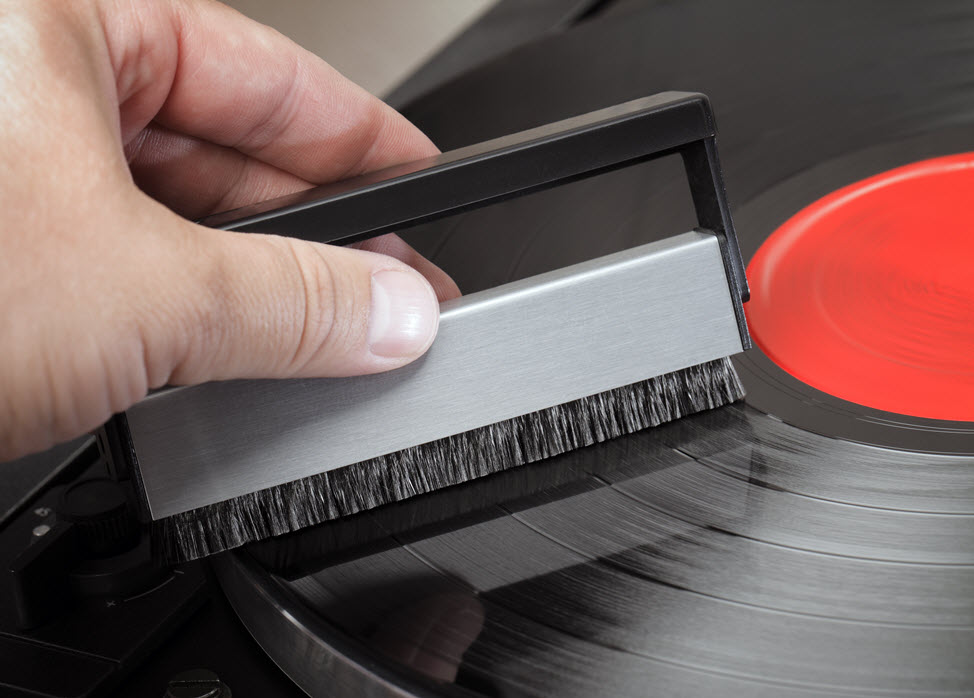
One day our manager told us that Corporate wanted us to sell more accessories — in particular, record cleaners. A record cleaner, for you youngsters, was a brush that would clean the dirt off a record before we played it.

record brush for upselling
Photo from Stocksnapper /dpc

Corporate wanted us to offer a record cleaner to each customer as they made their purchase.

Our initial reaction was negative — we weren’t going to let THE MAN tell us how to act behind the counter. But I got curious, and wondered what would happen if I tried it.

One day a woman walked up and laid an Al Jarreau album on the counter. I steeled myself, and spoke.

Me: Do you need a record cleaner to go with that?

Her: What’s a record cleaner?

I took one out of the box and showed her how it worked. She bought it, more than doubling the $7.99 transaction.

She bought it! 

I was so excited I asked the next patron. He declined. The one after that told me to shut up and bag his album. But the next one bought one.

Over time, I learned that one out of every four or five customers would buy a record cleaner — but only if I asked.

Terry Douglas of EnviroBrush concurs. People buy his product when someone shows it to them… sometimes even if they don’t have an immediate need.

Dealers report that when a customer replies that they do not require a paint brush with their paint purchase about 50% buy when shown the Envirobrush.  We even have consumers buying even when they are not painting yet.

If you sell on commission, the fastest way to give yourself a raise is by selling more to the folks who are already buying from you. You’ve already sold them on you, and on your station — all you have to do is convince them to buy one more thing.

When I sold radio, I  found that many customers — not all, but many — would consider an additional purchase priced at around 10% of what they’d just agreed to buy.

How can this work for you? A $5,000 per month radio or television schedule could easily be supplemented by an additional $500 per month digital plan.

If the relationship  is  already “tradigital” — your client is already using your traditional and online tools — you might enhance the plan by adding one more show to the mix.

“After all the toil and trouble to get to the target market, we do nothing more to leverage it. Here you are, finally, one-to-one with your target market and you do nothing more with it. In that call you have any number of opportunities to maximize the relationship.” Jim Domanski, Add-On Selling: How to Squeeze Every Last Ounce of Sales Potential From Your Calls

There’s money to  be made in add-on selling, but only if you ask.

Can you ask?

Will you?

[reminder]


The Most Powerful Confirmation Tool You’ve Never Tried

Why don’t customers show up on time for meetings?

sales skills: handwritten notes make meetings happen
photo by Gajus/dpc


Over the past week, I’ve spent nearly 90 minutes waiting for clients who weren’t at their offices or stores when we arrived.

  • One forgot about the meeting and stayed home from work.
  • One wrote 10:00 on his calendar when we thought it was at 9:30.
  • One told us he had been waiting for us at the appointed day and time — a week earlier.

The account executives who had arranged the meetings were frustrated and embarrassed. They’d all been in touch with their clients in the days leading up the the appointment — some by email, some by phone.

All had, at my request, called the clients on the phone the day before or the day of to confirm the meeting.

It wasn’t enough.

Sales Skills:
It’s Time to Bring Back a 19th Century Tool

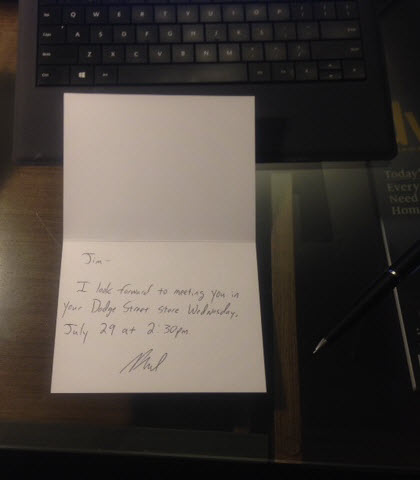
Those of us who remember selling in the 90’s or earlier were taught to send handwritten thank-you notes after meetings. I learned through experience that a handwritten note before a meeting increased the odds that the meeting took place.

It’s time to bring the handwritten note back.

The format is simple: one sentence that includes the date, time, and location of the meeting. It goes into an envelope with a stamp.

handwritten note to confirm a sales meeting
Photo by “Doctor” Phil Bernstein

Email is an ineffective way to confirm a meeting. Your prospects get dozens, and sometimes hundreds, of emails every day. They can’t read them all, and they don’t.

A phone message left with a gatekeeper has a 50/50 chance of being delivered.

As for voice mail… don’t get me started. An increasing number of otherwise-responsible businesspeople don’t bother listening to theirs.

The handwritten note beats email because it’ll be the only one your client gets that day. Unlike voice mail or email, your note will be noticed… and opened.

It gets past the gatekeeper and lands right on your prospect’s desk.

Three Tips To Get Maximum Power From Your Note

1. Send the note at least two days before the meeting. Even in town, it’ll take that long for the Postal Service to deliver it.

2. Always include a business card — in case your client has a conflict, the card gives her an easy way to contact you to reschedule.

3. Handwriting the address and putting a real stamp on the envelope makes it look more personal, and increases the chance it’ll get opened quickly.

It’s harder than ever to get your prospect’s attention and time these days. The handwritten note may be a 19th-century technology, but it’ll make a meeting happen in the 21st century.


[reminder]

Why Rotators Are Not Your Friend

The most expensive ads you can buy are the cheap ones that don’t work.

advertising is like hammering a nail into a board
Photo courtesy of BillionPhotos.com/dpc

I often meet with business owners who are new to broadcast advertising. Many times their first experience with radio or TV is with some sort of rotator package.

Often it’s their last experience as well, because the rotators didn’t work.

Rotators are also known as “Run of Schedule”, or ROS. They are commercials that are not guaranteed to run at any particular time — the station decides when they air, from 5 in the morning until 12 midnight, seven days a week. In return for giving the station maximum flexibility to schedule the ads, the client gets a significant discount on the price of each commercial.

The mind of your prospective customer is like a seasoned piece of hardwood. Your message is like a nail. The rhythmic strokes of the hammer represent the number of times your message — your unique selling proposition — is heard by the prospect.

Your goal is to drive the nail through the board and then clench it on the other side. Messages that are clenched are remembered for a lifetime. Tap, tap goes the hammer. But during the night the claw pulls the nail back out of its little hole! The following day you find nothing more than a faint indentation in the board. The nail is no longer in it. Your message is forgotten.

Using the hole you started the previous day, you position the nail again. Tap, tap goes the hammer. But again falls the veil of darkness, eyes close, and the claw does its work once more. Day after day, this scene is repeated; but ever so slowly, the hole gets deeper.”  — Roy Williams, from The Wizard of Ads: Turning Words into Magic and Dreamers into Millionaires

Rotators seem like a terrific way to put your toe in the water and try a medium out — use the whole station, get a huge reach, and save money on the rate.

So why don’t they work?

It goes back to Roy Williams and the hardwood. Let’s say that at the same dollar amount, you have two options

  • 10 commercials in the morning news.
  • Or you could buy 25 rotators. They might run any time Monday through Sunday, 5am until midnight.

In the morning news, you hammer the nail ten times into the same hole.

With the rotator package, you smack the nail twenty-five times, but in between each whack you take the nail out and move it somewhere else on the board.

The first option drives the nail in deeper. Much deeper. Even though each whack costs more money, the return on investment is much better.

“Concentration is the key to all economic success.”Peter Drucker

Rotators can be helpful when added to a concentrated schedule of commercials. By themselves, they’re a drop in the ocean.

Whatever medium you choose, pick frequency over reach.

[reminder]