Customer Service Done Right: Soluna Grill Makes The Save

I wrote the other day about how companies handle a situation when something goes wrong — my newsletter company’s shrug still rankles. So it’s only fair to commend a local eatery who got it right.

Last night my wife and had dinner at Portland’s Soluna Grill. We were seated quickly, and a waitress came by with menus. But she didn’t come back to take our orders. We saw her moving back and forth from the kitchen, delivering food and checking in on other tables. But as the clock continued to tick and our hunger grew, she never made a move in our direction.

Finally I caught her attention, motioned her over, and told her we were ready to order. At this point, she was Soluna Grill’s marketing department — a small slice of neighborhood word-of-mouth (and although she didn’t know it, the immense power of Portland’s Finest Advertising Blog) was her responsibility.

This is where things got good. She immediately apologized, told us that she’d gotten mixed up on table assignments, and said, “I’m on the case now. What can I get you?” Minutes later, she was back with our wine, and informed us that drinks would be on the house.

From that moment on, the service was flawless, the food was superb (stay for dessert — Soluna’s Chocolate Bourbon Croissant Bread Pudding is a mind-blower). And, true to her word, there was a discount on the final bill that more than covered our drinks.

Here’s what she got right after something went wrong:

1. She immediately took responsibility for the problem, and for fixing it: “I’m sorry, it was my fault. I’m on the case now.”

2. She volunteered compensation. I don’t know whether she had to get management approval, or whether she was empowered to comp the drinks on her own. The ten minutes we’d lost seemed pretty minor to us, and we weren’t going to ask for anything — but it felt awfully good when she offered.

3. Once she made the offer, she followed through and made sure it was reflected on the bill.

4. Once she said she was on the case, she was on the case.


Her actions meant that instead of being focused on a snafu early in the experience, we could rave to our friends about the rest of the experience — the excellent seafood stew, the perfectly-cooked halibut… and that Chocolate Bourbon Croissant Bread Pudding.

Whatever it says on the organizational chart, your front-line employees are your Marketing Department. Mistakes happen. People are human. And customers will forgive an occasional stumble if you empower your employees to take responsibility and make amends quickly.

______________________________________________________________________________________________________

Got a question? Wanna argue? Email Phil Bernstein here.

Sign up for Phil Bernstein’s free advertising and marketing e-newsletter here.

Become a Phil Bernstein Portland’s Advertising Expert Facebook Fan here
What to Do When “Stuff Happens”

Nobody’s perfect, and customers generally don’t expect perfection.

Servers go down. Files get deleted, or misplaced. Messages are missed. Mistakes are made. As long as the snafus aren’t chronic, a good client will generally tolerate a problem once in a while. More important than whether something goes wrong is how you handle it.

The subject is on my mind because the Phil on Advertising E-Newsletter didn’t go out at its scheduled time this morning. One of the things that I like best about the company that distributes my newsletter is that I can write it in advance, schedule it to go out at a specific time in the future, and forget about it.

For nearly four years, the system has worked beautifully. But at 9:10 this morning, when Phil on Advertising was scheduled to land in Inboxes around the country, there was only silence. I checked again at 9:15 — nothing. 9:25 am… nada.

So I called the company — who will go nameless here because they’ve done a good job over the years — and asked the guy who answered to check it.

Him: “Oh. Yeah. We’ve been having this problem all week. We have to send everything out manually.”

Me: “So… could you send MINE out manually?”

Him: “Yeah, I’ll check with my I.T. guy and see if he can do it.”

A half hour later the newsletter was out (you can subscribe here), and I was still shaking my head. They knew they had a problem before I called. They knew that their customers would have newsletters to go out — after all, that’s what they do. And yet, “Phil on Advertising” would still be sitting in the Outbox if I hadn’t taken it upon myself to check it and call.

What do you do when stuff happens? Here are a few things that will increase the odds that your customers will stay with you.

1. Call your customers before they find out, and tell them. “Here’s what went wrong, and here’s what we’re doing to fix it.” Not necessarily a pleasant conversation, but much more pleasant than the conversation you’ll have when the client finds out on his own. In my case, an email in advance from the newsletter company would have given me a chance to warn them that I had an issue ready to go.

2. If you need some temporary help from the client to make sure everything runs smoothly, ask for it. Most will be happy to oblige. If my newsletter company had told me that for the next few days, they would have no way of knowing what would be going out, I’d have gladly called them and told them when to send mine.

3. Volunteer to compensate the customer for any inconvenience. The compensation doesn’t necessarily have to be anything big — the key is that you offer before the customer asks.

4. Apologize and let your clients know what steps you’ve taken to make sure it won’t happen again.

Marketing Consultant Paul Weyland once remarked that in the age of the Internet, you either need to make a disgruntled customer happy, or kill him and bury him in the backyard. The steps above will help ensure that you don’t have to start digging anytime soon.

______________________________________________________________________________________________________

Got a question? Wanna argue? Email Phil Bernstein here.

Sign up for Phil Bernstein’s free advertising and marketing e-newsletter here.

Become a Phil Bernstein Portland’s Advertising Expert Facebook Fan here

An Interesting Way to Pitch Extended Warranties

At a leather furniture store I worked with in my radio days, the general manager had this posted in his office:

YOU DON’T HAVE TO LIKE THE FURNITURE. YOU JUST HAVE TO SELL THE FURNITURE.

According to The Consumerist, that philosophy was recently taken to the next level by a sales clerk in Staples. Is this how they teach it in the new-hire training class?

________________________________________________________________________________________________________

Check out Phil Bernstein’s Facebook Fan Page — and become a Fan – here

Click this link to subscribe to Portland’s Finest Advertising and Marketing Blog.

Got a question? Call Phil Bernstein, America’s Attention-Rental Expert, at 503-477-4933.

What It Takes

The retail and airline industries are not, in general, known as bastions of great customer service. A constant onslaught of books on customer service, motivational speakers and consultants have had limited success in convincing stores and airlines to get better.

So, what will convince them? A couple of stories in this morning’s New York Times offer a clue. According to the Times, it takes:

I feel better now — don’t you?

________________________________________________________________________________________________________

Check out Phil Bernstein’s Facebook Fan Page — and become a Fan – here

Click this link to subscribe to Portland’s Finest Advertising and Marketing Blog.

Got a question? Call Phil Bernstein, America’s Attention-Rental Expert, at 503-477-4933.

How to Waste Your Direct Mail Budget… And Anger Your Customers

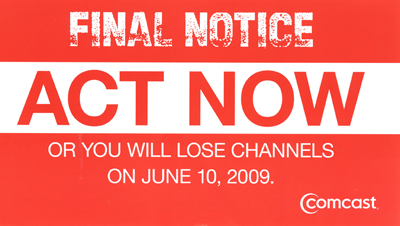
comcastflier

This is the third piece of increasingly shrill mail we’ve received from Comcast in the last few weeks. The previous two envelopes had this on the outside:

IMPORTANT! ACTION REQUIRED TO ENSURE UNINTERRUPTED ACCESS TO ALL YOUR CHANNELS.

The gist of the message inside was that in order to continue receiving all of the channels we’ve been paying for, we needed to get a digital converter box from Comcast. We’d been under the impression that we had the proper box, so we’d ignored the first two notices.

This new one, however, seemed pretty sure of itself — “ACT NOW OR YOU WILL LOSE CHANNELS” is not at all ambiguous. So my wife called Comcast to make arrangements.

“Oh”, said the perky customer service rep who answered. “You’ve already got the converter box. We send these notices to everyone!”

I spend a significant portion of my workday trying to convince local companies to spend money on advertising and marketing. For the past six months or so, just about everyone I’ve encountered is looking very carefully at every penny they spend.

Not Comcast.

They own the mailing list, and should be able to determine which customers were going to have a problem and which ones already had the proper equipment. When my wife called, it took the phone rep a couple of seconds to figure it out.

Instead, they appear happy to waste large sums of money designing, printing, and mailing multiple, and unnecessary, threatening letters to its subscribers.

Since my monthly check helps pay for this misguided marketing effort, I’m having trouble sharing their joy.

_______________________________________________________________________________________________________

Check out Phil Bernstein’s Facebook Fan Page — and become a Fan – here

Click here to learn the shocking truth about Phil Bernstein

Click this link to subscribe to Portland’s Finest Advertising and Marketing Blog.

Request your free copy of Phil Bernstein’s white paper, The Seven Deadly Advertising Mistakes and How to Fix Them here.

Got a question? Call Phil Bernstein, Portland’s Advertising Expert, at 503-323-6553.