
The Most Powerful Confirmation Tool You’ve Never Tried

Why don’t customers show up on time for meetings?
sales skills: handwritten notes make meetings happen
photo by Gajus/dpc


Over the past week, I’ve spent nearly 90 minutes waiting for clients who weren’t at their offices or stores when we arrived.

  • One forgot about the meeting and stayed home from work.
  • One wrote 10:00 on his calendar when we thought it was at 9:30.
  • One told us he had been waiting for us at the appointed day and time — a week earlier.

The account executives who had arranged the meetings were frustrated and embarrassed. They’d all been in touch with their clients in the days leading up the the appointment — some by email, some by phone.

All had, at my request, called the clients on the phone the day before or the day of to confirm the meeting.

It wasn’t enough.

Sales Skills:
It’s Time to Bring Back a 19th Century Tool

Those of us who remember selling in the 90’s or earlier were taught to send handwritten thank-you notes after meetings. I learned through experience that a handwritten note before a meeting increased the odds that the meeting took place.

It’s time to bring the handwritten note back.

The format is simple: one sentence that includes the date, time, and location of the meeting. It goes into an envelope with a stamp.
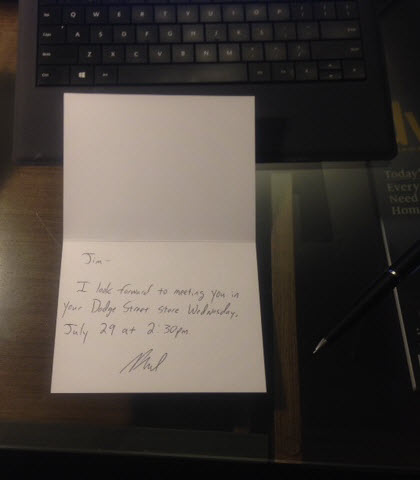
handwritten note to confirm a sales meeting
Photo by “Doctor” Phil Bernstein

Email is an ineffective way to confirm a meeting. Your prospects get dozens, and sometimes hundreds, of emails every day. They can’t read them all, and they don’t.

A phone message left with a gatekeeper has a 50/50 chance of being delivered.

As for voice mail… don’t get me started. An increasing number of otherwise-responsible businesspeople don’t bother listening to theirs.

The handwritten note beats email because it’ll be the only one your client gets that day. Unlike voice mail or email, your note will be noticed… and opened.

It gets past the gatekeeper and lands right on your prospect’s desk.

Three Tips To Get Maximum Power From Your Note

1. Send the note at least two days before the meeting. Even in town, it’ll take that long for the Postal Service to deliver it.

2. Always include a business card — in case your client has a conflict, the card gives her an easy way to contact you to reschedule.

3. Handwriting the address and putting a real stamp on the envelope makes it look more personal, and increases the chance it’ll get opened quickly.

It’s harder than ever to get your prospect’s attention and time these days. The handwritten note may be a 19th-century technology, but it’ll make a meeting happen in the 21st century.


[reminder]

Why Rotators Are Not Your Friend

The most expensive ads you can buy are the cheap ones that don’t work.

advertising is like hammering a nail into a board
Photo courtesy of BillionPhotos.com/dpc

I often meet with business owners who are new to broadcast advertising. Many times their first experience with radio or TV is with some sort of rotator package.

Often it’s their last experience as well, because the rotators didn’t work.

Rotators are also known as “Run of Schedule”, or ROS. They are commercials that are not guaranteed to run at any particular time — the station decides when they air, from 5 in the morning until 12 midnight, seven days a week. In return for giving the station maximum flexibility to schedule the ads, the client gets a significant discount on the price of each commercial.

The mind of your prospective customer is like a seasoned piece of hardwood. Your message is like a nail. The rhythmic strokes of the hammer represent the number of times your message — your unique selling proposition — is heard by the prospect.

Your goal is to drive the nail through the board and then clench it on the other side. Messages that are clenched are remembered for a lifetime. Tap, tap goes the hammer. But during the night the claw pulls the nail back out of its little hole! The following day you find nothing more than a faint indentation in the board. The nail is no longer in it. Your message is forgotten.

Using the hole you started the previous day, you position the nail again. Tap, tap goes the hammer. But again falls the veil of darkness, eyes close, and the claw does its work once more. Day after day, this scene is repeated; but ever so slowly, the hole gets deeper.”  — Roy Williams, from The Wizard of Ads: Turning Words into Magic and Dreamers into Millionaires

Rotators seem like a terrific way to put your toe in the water and try a medium out — use the whole station, get a huge reach, and save money on the rate.

So why don’t they work?

It goes back to Roy Williams and the hardwood. Let’s say that at the same dollar amount, you have two options

  • 10 commercials in the morning news.
  • Or you could buy 25 rotators. They might run any time Monday through Sunday, 5am until midnight.

In the morning news, you hammer the nail ten times into the same hole.

With the rotator package, you smack the nail twenty-five times, but in between each whack you take the nail out and move it somewhere else on the board.

The first option drives the nail in deeper. Much deeper. Even though each whack costs more money, the return on investment is much better.

“Concentration is the key to all economic success.”Peter Drucker

Rotators can be helpful when added to a concentrated schedule of commercials. By themselves, they’re a drop in the ocean.

Whatever medium you choose, pick frequency over reach.

[reminder]

How Media Sellers Can Profit From Supreme Court Rulings

Last month, the United States Supreme Court made same-sex marriage legal throughout the United States. If you sell advertising, there’s money in this.

Gay marriage is a media sales opportunity
Photo by tashatuvango/dpc

Before the ruling, Business of Fashion reported that the economic impact of gay marriage was huge:

Out Now Consulting, a marketing agency specialising in targeting gay and lesbian consumers, estimates that if same-sex marriage was legalised in all US states, it would generate over $1 billion of new matrimonial spending within one year. Out Now’s research also revealed that when civil partnerships were legalised in the UK in 2006, the spending impact of lesbian and gay marriages delivered a £130 million ($209 million) boost to the UK economy in the twelve months that followed.

Now it’s legal in all 50 states.

I’m not here to argue about religion or politics — if gay marriage goes against your religious or moral beliefs, that’s your department. But if you’re okay with this development, there’s a rapidly growing market for:

  • Jewelers
  • Wedding halls
  • Florists
  • Formal wear shops
  • Restaurants and caterers
  • Travel planners and hotels

During the same week as the gay marriage ruling, the Supreme Court solidified another media sales opportunity by preserving the Affordable Care Act. Now that ObamaCare appears to be the law of the land, businesses who were paralyzed by uncertainty can make plans and take action.

One category with significant potential: insurance brokers.

In South Carolina I recently met with two different companies who specialize in helping individuals and families qualify for insurance tax credits and subsidies. With those subsidies and credits now firmly in place, more companies are likely to move into the field.

Meanwhile, many insurance companies have announced plans for significant individual-market rate hikes in 2016. When the premium notices come out in a few months, they will cause a lot of people to start shopping for new policies.

All of these businesses will need to reach out to these new customers. Your traditional media and digital tools can put them in front of the right people — but only if you call them.

[reminder]


How to Put The Client’s Mind Behind The Wheel

In Montana, I once sent a television salesperson to a doctor’s office for a white coat.

sales skills: you can wear the white coat for a spec ad
Photo by Oleksandra Voinova/dpc

 We were working on a proposal for a doctor who wanted to market a procedure she had developed. I’d written a script in which the doctor would deliver the message herself on camera, and wanted to show her how the ad might look.

For that, we decided to produce a version of the commercial in advance of the presentation — a “spec ad”.

Of course, we couldn’t ask the doctor to appear in the spec — that would’ve spoiled the surprise. So the AE went to the doctor’s office and borrowed a lab coat.


Sales Skills: The Power of the Spec Ad

sales skills: spec ads put the client behind the wheel
Photo by ellisia/dpc

Spec ads are a very powerful way to move an advertising prospect toward a buying decision.

Why do they work so well? One of the best explanations comes from an old radio sales training recording by Jim Williams*:

What we’re doing is a thing called demonstration selling… it ranges from the tiny nibble of peach at your outdoor farmers market by the peach vendor to the one-ounce tube of shampoo they hang on your doorknob to the showy exhibition of all the uses from slicing and dicing of those famous knives on TV.

When you test drive a car, slip on new shoes and walk about or study the floor plan of an unbuilt home, you are involved in one of the many forms of demonstration selling.

When you enter your client’s office and play a cassette tape as part of your presentation you are doing demonstration selling. The words and sound that come from your tape recorder, regardless of content, are a demonstration of how radio works.

Thoughts come out of a small electric box and into the brain of the listener. That is the essence of radio. You are using radio to sell radio.

The tools have changed since Williams recorded those words. Cassettes are gone, replaced by digital files you can play for your client on an iPhone.

The principle is the same in the Age of the Smartphone as it was when we operated on tape: use radio to sell radio. Use TV to sell TV.

[bctt tweet=”Technology has changed. Human nature hasn’t. Spec ads should be in your sales arsenal.”]

In the demo we produced for the Montana medical clinic, the AE played the role of the doctor. It was not award-winning work — the station Production Department was very busy with paying clients, so they banged ours out quickly.

When we presented, production quality didn’t matter. The doctor immediately imagined herself in front of the camera. She went back to her office to make sure she had the money for the campaign, and signed the contract the same day.

Spec ads work for the same reason that test drives work on the car lot: customers are beginning to experience “ownership” of the product. You are putting them, mentally, behind the wheel.

You can’t make a commercial in advance for every proposal — production departments are busy and frequently undermanned. Pick your spots carefully, make them count, and take your Production Director to lunch every now and then.

Deployed properly, spec ads will move your prospects one step closer… a BIG step closer… to buying. Use ’em.

[reminder]

* A tip of the hat to my friend Rod Schwartz for introducing me to Jim Williams, whose work has held up quite well in the decades since it was recorded. Rod has digitized some of Williams’ material, and you can listen to it here.


Sales Skills: A Better Way To Handle “No”

Not long ago, I took a “no” from a client who should have said “yes”.

I didn’t react well.

sales skills: learn to handle no
photo by fresnel6/dpc

That weekend, I spent a lot of time stewing about the effort I’d put in, the difficulty of communicating with the decision-maker through a third party, and my firm belief that if he’d had the guts to try what I’d recommended, it would have been a profitable investment for him.

What snapped me out of my snit was an old (from 2008) post from Seth Godin called “Two Ways to Deal With No” . Godin lays out the choices this way:

You could contact the organization that turned you down and explain that they had made a terrible mistake, the wrong choice and a grave error…

or

You could be more gracious than if you’d won the work. You could send a thank you note for the time invested, you could sing the praises of the vendor chosen in your stead and you could congratulate the buyer, “based on the criteria you set out, it’s clear that you made exactly the right choice for your organization right now.”

The full post, which you can read in its entirety here, has much to ponder.

I’ll add a thought of my own — advice I’ve given many times when I’ve conducted sales training, and which I managed to forget during my bout of resentment:

[bctt tweet=”A no isn’t the customer’s fault. There’s always something you could’ve done differently.”]

Don’t blame the customer for not buying. It’s a losing strategy, and most of the time you’re wrong. In the course of the sales process, you have choices in how you present your ideas. There’s always a way you could have done it differently.

If the choices you made didn’t result in a sale, your mental energy is more profitably invested in thinking about what adjustments you’ll make in your presentation the next time you get a chance.

Godin’s second option will go a long way toward ensuring that the chance will come again.

[reminder]