How Much Can Happen In a Year?

How long has it been since you did a full needs analysis with your best long-term client? You might be surprised at how much has changed.

Salespeople should avoid surprises
Photo by Maruba

It’s easy to let that sort of thing slip.

  • You negotiate “the annual”.
  • You take the client to lunch once a quarter.
  • You bring them concert tickets every now and then.
  • You call periodically to “check in.”
  • A year later, it’s time to negotiate “the annual” again.

If you haven’t been paying attention, you may get an unpleasant surprise — a lot can change in a year.

Recently I had an opportunity to find out exactly how much could change. I presented an advertising plan to a roofing company…more than a year after the needs analysis meeting. 

I’ll explain.

In the spring of 2017, I met with the roofers for about an hour. They gave me a lot of information on their history, their customers, their business model, and their goals. We scheduled a presentation for two weeks later, and I got to work on an advertising plan.

The day of the presentation, the roofers canceled the meeting. We rescheduled it and they canceled again. I left town, we scheduled a webinar, and they canceled again.

We gave up. A year went by.

I came back to the market to work with the TV station again.

On a whim, the Account Executive called the roofing company and told them I was coming back. They wanted to meet with me. But they only had time for one meeting.

No new needs analysis — we had to work with the year-old data from the last one. We decided it was better than no opportunity at all. 

Our plan: dust off our old presentation, update the rates, and give it our best shot. How much could change in a year?

I opened the meeting by saying, “Gentlemen, everything I’m about to present to you is based on year-old information. If I say something that no longer applies, raise your hand and correct me, and we’ll make adjustments as necessary.”

They stopped me on the first slide.

A year earlier, 90% of their installations were foam roofs. Now foam was less than 50% — since our last meeting, they had diversified into TPO, metal and shingle roofs. 

In the spring of 2017, they’d wanted to dominate foam. Now, they didn’t want to be known as a foam roof company anymore.

So… completely new business model.

This was a problem, since the creative concept I’d put together was focused on selling foam. 

As we moved on, more change became evident.

A year earlier they’d been at the bottom of Page 2 on Google for general roofing. Their big priority then was to get onto Google’s Page 1. As a result, a big part of our recommended strategy involved SEO.

This no longer applied, either — since then they’d put a lot of money and effort into SEO and were ranking well now.

At this point, we stopped presenting and started asking questions. It was clear the whole basis for our presentation was obsolete.

We asked for a few days to re-write the TV script and the entire advertising plan.

We wound up getting the money… but we had to dance to get it.

Lesson learned.

The Sales Lesson:
Do a Deep Needs Analysis Regularly

If you’ve been working with a client for a long time, it’s easy to assume that you’ve got a handle on their business. 

But you don’t know what you don’t know.

  • Market conditions change.
  • Budgets change.
  • Departments reorganize.
  • Goals change.

Maybe the client will actively keep you up to date on all the changes. But it really helps to ask.

For a significant advertiser, you should take the time to do a full needs analysis at least once a year. With a year-round customer (keep in mind that an “annual” can be longer than a year) the six-month mark is a good time to do it.

When you do that quarterly lunch, make a point of asking if there are any new developments. 

Finally, it doesn’t hurt to double-check once more at renewal time:

I’ve learned to open every meeting in which I ask for money this way:

“Before we begin, I need to ask a quick question. Has anything changed since our last meeting?”

A lot can change in a year if you’re not paying attention. Make a point of asking often.

[reminder]

Who Says an “Annual” Has to Stop at 12 Months?

How long are the schedules you propose? You may be leaving money on the table.

Sales tip: don't be afraid to ask for a longer commitment

Most of the radio and television salespeople I encounter default to one of these:

  • Three months
  • Through December of this year
  • 12 months

When I ask how they arrived at the proposed length, it turns out there’s no formula. Sometimes the terms are set by an RFP, or a specific client request. Most of the time the salesperson just decides.

  • “I didn’t want to ask for less than three months.”
  • “December’s the end of the year, and that seemed like a logical time to end it.”
  • “I always ask for an annual, and that’s 12 months.”

There’s logic behind each of these answers. But the one thing they have in common is that the proposed length of most proposals is completely arbitrary.

In other words, we make it up. 

As long as we’re making it up, why not go longer?

I’ve been experimenting with longer asks. With some coaxing, I’ve convinced AE’s and sales managers that they can, and should, ask for longer commitments.

Early in the year, we went for 13-month deals. For example: instead of a “March 2018 through February 2019” agreement, we wrote each proposal to run March 2018 through March 2019. 

What we found: if a client is willing to commit to 12 months, they’ll commit to 13. Rarely did we encounter an objection.

Recently, I helped some AE’s become even more ambitious. We wrote a series of proposals that began in the middle of this year and went through the end of next year.

June 2018-December 2019. 19 months.

There was nothing deceptive in our approach. We made it clear to each client exactly what we were asking for.

Out of 15 proposals in this particular market, 12 of them were for 19 months (the other three clients could only consider schedules that ran during their fiscal year.)

So far, seven clients have signed, and five of those signed for the full 19 months. 

5 proposals x 7 extra months per proposal = 35 months of additional advertising sold. That’s almost three full years’ worth of additional revenue, with virtually no additional effort expended. 

Note well: if the station doesn’t provide good service, or the advertising doesn’t work, or the marketing director gets fired, the usual cancellation policy applies. The money is not guaranteed.

But that risk applies to every schedule the station sells. These things are never final until the money’s in the bank.

For now, we’ve got five new clients who fully expect to run on our station until December, 2019.

Why? Because we asked them to.

The next time you’re preparing an “annual” presentation, raise your expectations. There’s no law limiting you to 12 months.

[reminder]What’s the longest plan you’ve ever sold?[/reminder]

Have You Tested The Funnel?

The law firm had recently cancelled its radio and television advertising.

“We got great results from the campaign for a long time,” the managing partner told me. “But it hasn’t been working the last three or four months.”

TV and radio salespeople must keep customers from confusion
Photo by mimagephotos

The personal injury firm had been advertising an “accident book”  — a short book on what to do in the event of an auto accident. Radio listeners and television viewers were directed to a special website where they had to enter their name, address, and email address in order to get the book.

In the internet marketing world, this is known as a Lead Magnet. 

Back in my hotel room that night, I decided to test their system. I went to the website, filled in my information, and hit Submit.

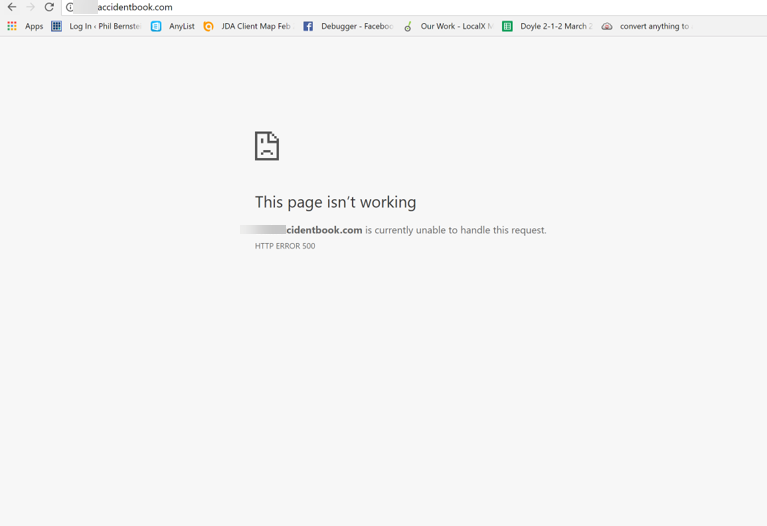
Here’s what I saw next:

Salespeople should check the sales funnel before the TV or radio campaign launches
Identifying details have been deliberately blurred.

I tried three times to order the book, and got the same screen each time. When I met with the law firm again I showed them a screen shot, and asked, “How long has this been happening?”

The managing partner admitted he had no idea. “I guess we haven’t checked things in a while.”

“I can’t prove it,” I replied. “But there’s a pretty good chance your radio and TV ads were working fine. If the first exposure they have to your firm is a non-working web page, they’re not going to call you, and you’ll never know who they are.”

That same week, in the same market, I met with the owner of a moving and storage company. They had all the customers they could handle — what they needed was employees. They’d been running recruitment ads online, without much success.

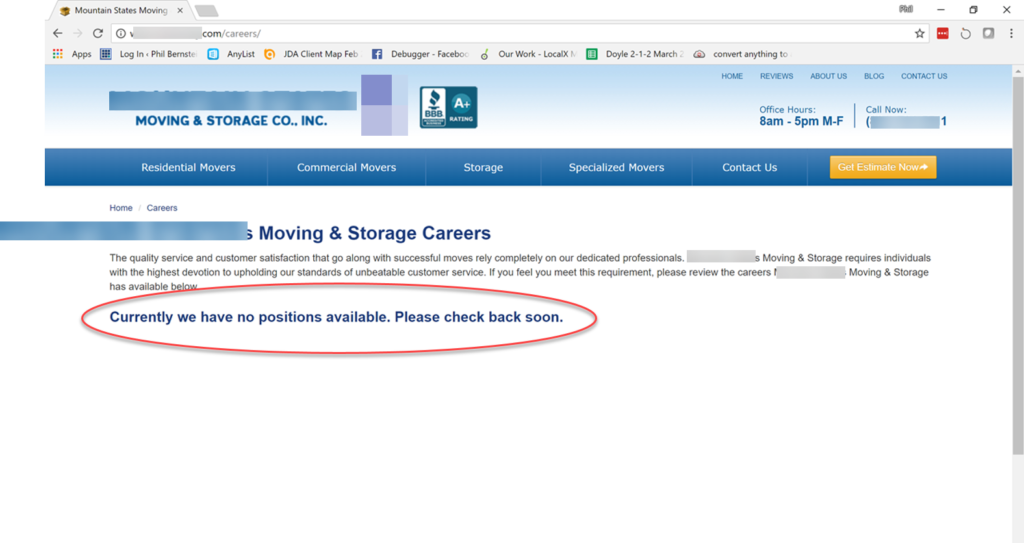
Preparing for a follow-up meeting, I took a look at the company’s “Careers” page. It looked like this:

Radio and TV salespeople should check the sales funnel
Identifying details have been deliberately blurred.

The company had lots of positions available. But visitors to their website wouldn’t know that. 

These sorts of oversights are distressingly common. 

  • I’ve seen incorrect phone numbers in ads.
  • Links from social media go to “404 Not Found” pages.
  • Banner ads for specific products go to the advertiser’s home page, which has no information about the product being advertised.
  • “E-commerce” sites make it hard for people to find items or make a purchase.

Potential customers and applicants follow the call-to-action, and wind up confused.

Confused people do nothing.

And the advertiser shakes their head and says, “I tried [name of your medium] and it didn’t work.”

As advertising sales professionals, we can say, “Our responsibility is to bring the prospects to their door. If they can’t convert them, it’s not our fault.”

I’ve talked to plenty of salespeople and sales managers who have taken that position. They’re not wrong.

But when the advertiser cancels the campaign, the money comes out of your pocket no matter whose fault it was.

My position is this: If you’re an Account Executive, your responsibility is to execute. That means putting in the extra time and effort to make sure the sales funnel’s working properly. 

Before the ad goes on the air, ask, “What’s the call-to-action? What is the prospect expected to do as a result of seeing or hearing the commercial?”

Then, pretend to be a customer. Take the action.

  • If the commercial directs people to a website, go to the site. What do you see? Does the site pass the “Mom Test?” Will prospects know what to do next, or will they be confused?
  • If there’s an inquiry form on the site, fill in your information and submit it. What happens next? How long does it take to get a response.
  • If the ad tells people to call a phone number, grab your cell phone and call it. Does the right department answer?
  • Does the store have the merchandise in stock? Do the clerks know where it is?

Do this before the ad hits the air. If you find a problem, alert your client. If necessary, delay the campaign launch until the problem can be fixed.

In the short term, this will be an inconvenience, and might even cost you some revenue if a schedule has to be moved. 

But in the long term, you’ll have a happier client who trusts you to give them advice that gets them results.

[reminder]

Your Clients’ Competitors Are Your Leads

Are you avoiding a great source of new business?
 

If you’re not talking to your clients’ competitors, you’re wasting a big opportunity.
 

Competitors are a great sales opportunity
Photo by Andy Dean

It’s One You May Have Created

About a year ago, a Midwest optometry practice started a television and digital advertising campaign, using a creative idea my company gave them. It worked really well — their practice grew by over 30% over the next year.
 
Where did that business come from?
 
Recently, I met with one of that practice’s rivals. As the meeting progressed, it became clear he was in pain — his business was down almost 40% over the same period .
 
He constantly saw his competition — our partner station’s client — on the air, taking money out of his pocket. He wanted to start his own television and digital campaign.
 

Your Customers’ Competitors
Are Great Sales Leads

 
When you put a new advertiser on the air, and the campaign works, it affects the rest of the market.
 
Advertising ripples through the water of the marketplace
Photo by Mark Ross
 
Sometimes advertising creates new demand for a product or service, but in many cases existing demand shifts from one vendor to another.
 
When your client gains revenue, some of that money would have otherwise gone to a competitor down the street. 
 
The guys down the street now need help. You can help them.
 
Should you call?
 
Yes.
 

Is It Ethical to Work With
Competing Businesses?

[shareable]If advertisers can work with your competitors, you can work with theirs. It’s only fair.[/shareable]

 
If you’re doing your job right, you’re building good relationships with your clients. They may share confidential business information with you. You get to know the office staff, and sometimes their families. 
 
Would it be right to start working with their enemies?
 
Yes, it would. Here’s why:
 
Every day, your customers are talking with your competitors.
 
They meet with radio reps, TV reps, billboard salespeople, advertising agencies — the people trying to take money out of your pocket.
 
Every day, your clients share their information with these people, and review proposals from them.
 
They have every right to do this. And here’s the corollary:
 
If they can work with your competitors, you can work with theirs. 
 
Fair is fair.


But You Have to Do It Ethically

 
Never lie about what you’re doing. There’s no need to volunteer the information, but if an auto dealer asks you if you’re working with any other auto dealers, answer honestly. If you lie, they’ll find out eventually.
 
Keep everything you learn confidential. Your customers trust you, and will share proprietary information with you — revenue figures, business challenges, promotional plans.
 
If they know that you’re working with the other guys, they may ask about the other guys’ plans. Never give that information up. The correct answer to the question is, “I’d never tell them anything about you, and I can’t tell you anything about them.”
 
Don’t give the same creative or promotional idea to both of them. If two competitors run identical ads on your station, it will not turn out well for you.
 
If one of them turns the idea down, feel free to bring it to the other one.  Before you do, give the first one a final chance with this line:
 
This is a great idea, and that’s why we gave you an exclusive first shot at it. Just so you know… now that you’ve turned it down, we’re going to be showing it to the competition. It’s too good to go to waste.”
  

Sometimes You Just Can’t

 
In the vast majority of cases, it’s your right and your responsibility — to your company and to your own bank account — to work with anyone you choose.
 
There are, however, a few exceptions:
 
  • When you’ve spent a great deal of time and energy on specific strategies to go after a particular competitor, it may not feel right to work with that company, too. 
  • When you’ve built an exceedingly close relationship with one major client, and that company represents a major part of your income, the opportunity may not be worth the risk.
 
If you just can’t bring yourself to call on the competitor, don’t let the opportunity evaporate. Pass the lead to a co-worker, along with any information you can ethically give them.
 
You’ll be making a deposit in the Karma Bank, and one of these days it’ll pay you back with interest.
 
[reminder]

How to SHOW Instead of Tell…and Why It Matters

Most people don’t want to go first.

Salespeople should show others climbing the mountain

  Photo by Alphaspirit
 
Dave Trott recently recounted  the launch of world’s first underground railway — and the “mechanical staircase” that would bring people up and down. It was 1911 in London.
Today everyone knows what an escalator is. You’ve probably ridden one in the last few days. But in 1911 this was a scary new concept for most people…and they didn’t want to ride it.
 
The railway operators posted signs promising that the ride would be safe, but nobody believed the signs.
 
So the authorities decided to show people how safe it was.
 
William ‘Bumper’ Harris was an employee who’d lost a leg in an accident.
 
He was told to come to Earls Court station and ride up and down on the escalator.
 
Just that, ride up and down, nothing else.
 
People at the bottom would see a one-legged man with crutches nonchalantly hop onto the escalator and ride it to the top.
 
Then he’d turn around, and people at the top would see a one-legged man with crutches nonchalantly hop onto the other escalator and ride it to the bottom.
 
‘Bumper’ Harris just did that all day.
When frightened passengers saw him do it they were reassured and ashamed.
 
Reassured that if a one-legged man could do it anyone could.
 
And ashamed that they were ever frightened in the first place.
 
So they stopped worrying and hopped on.
 
After a day of ‘Bumper’ riding up and down, everyone was using the escalator as if it was the most normal thing.
 
And once that happened, the problem disappeared.”
 
When you call on a new prospect — one who’s never used your medium before — you’re selling an escalator. The client is wondering:
 
  • If I advertise with you, what’s it going to look like? What’s it going to sound like?
  • How do I know it’s going to work?

You can answer those questions with words… or you can show ’em.

Sales advice: put the prospect behind the wheel
Photo by Africa Studio

If they’re wondering whether it’ll work, the best thing to show them is a success story — the story of someone like them who’s advertised with you (or your company) and made money.

Your prospect won’t be the first advertiser your station’s ever had — it’s been on the air a long time. Even if you’ve only been there a few months, your station’s got a track record.

There are lots of happy advertisers — “Bumpers” —  getting good results right now. 

  • A Good Idea: tell the stories.
  • Better: Let your clients tell the stories, with letters or emails.
  • Best: Let your clients tell the story on video.

Your production department may be able to do the recording and editing, but it’s not necessary. All you need is a smartphone, and you’re a videographer.

For a little extra money, you can improve the video quality with an inexpensive tripod  and an external microphone . If you work in radio or TV, you might be able to borrow a mic from the production department or the newsroom. I travel with this one.

I’ve got dozens of advertiser testimonials from all over the country in my library — car dealers, attorneys, doctors, home improvement contractors, and more — talking about how broadcast and digital advertising, using the right creative and high frequency, has helped them grow their business. 

These videos are usually two to three minutes in length, and they go a long way in convincing a prospect it’s both safe and beneficial to follow my advice.

I recently put three of them together on a “testimonial reel” — three advertisers I’ve worked with who have gotten great results. It looks like this:

How will the ad look or sound? You can answer that with a spec ad. After a solid needs analysis meeting, write a script and have your production department produce a basic version of the commercial.
 

Why do spec ads work so well? One of the best explanations comes from an old radio sales training recording by Jim Williams*:

What we’re doing is a thing called demonstration selling… it ranges from the tiny nibble of peach at your outdoor farmers market by the peach vendor to the one-ounce tube of shampoo they hang on your doorknob to the showy exhibition of all the uses from slicing and dicing of those famous knives on TV.
When you test drive a car, slip on new shoes and walk about or study the floor plan of an unbuilt home, you are involved in one of the many forms of demonstration selling.
 
When you enter your client’s office and play a cassette tape as part of your presentation you are doing demonstration selling. The words and sound that come from your tape recorder, regardless of content, are a demonstration of how radio works.
 
Thoughts come out of a small electric box and into the brain of the listener. That is the essence of radio. You are using radio to sell radio.
The tools have changed since Williams recorded those words. Cassettes are gone, replaced by digital files you can play for your client on an iPhone.
 
While the technology is different, human nature is not. Show your prospects what’ll happen, and they’re much more likely to get on your escalator.
 
* A tip of the hat to my friend Rod Schwartz for introducing me to Jim Williams, whose work has held up quite well in the decades since it was recorded. Rod has digitized some of Williams’ material, and you can listen to it here.
 
[reminder]