Pitchman Power: Killer Sales Lessons From the Ohio State Fair

In an increasingly-online world, your real money still comes from selling in person. Face-to-face, belly-to-belly with your clients.

Another industry that still thrives on face-to-face sales is non-electronic gadgets. The peelers, choppers, and miracle showerheads. Thousands are sold every weekend at state fairs and carnivals.

Sales tip from a demonstration chef
Photo by -Marcus-

The best of the pitchmen and women are highly-skilled professionals. They have learned to quickly get the attention of passersby, draw them in, and convince them to buy something they didn’t know they wanted.

You can learn from them. 

Robert Smith and Kenny Malone of NPR’s Planet Money recently visited the Ohio State Fair and spent some time on the midway. 

Robert and Kenny Go to the Fair is the best 23-minute sales lesson you’ll hear this week.

Here is a direct link to the podcast.

Among the lessons:

  1. The power of getting the prospect involved. At about the 10:30 mark, pitchwoman Heather Keto is selling a pruning tool called the Tiger Jaw. 

ROBERT: All of a sudden, she has placed into my hand, like, these garden clippers…And before I could set it down, Heather pulls out a branch – like a real piece of wood. And she offers it up right in front of me to cut.

KETO: Go for it. You know you want to.

(SOUNDBITE OF BRANCH BEING CLIPPED)..

KENNY:  And what’s amazing about the way Heather has hooked Robert into her presentation is that she’s put him in a position where in order to walk away, he has to put down the fun, new toy. And it’s a loss. Like, no more chopping sticks. No more wow factor.’

In the car business, the close rate goes way up if the dealer can get the customer behind the wheel for a test drive. 

In your business, the test drive is the spec ad.

2. The real pros practice, review, and practice some more. Just past the 14-minute mark, Robert is talking to PJ Magee. The consensus of the folks at the fair is that Magee is the single best pitchman there. 

PJ is selling $100 showerheads to people who aren’t looking for a showerhead. He takes his profession seriously:

ROBERT He still records his pitches, so he can listen back and see, like, are the jokes landing? Or how’s the audience reacting?
 
MCGEE: You’ve got to understand there’s a difference between a professional salesman and a guy that talks [expletive]. Really. The most insulting thing we hear is when someone says, you’re a natural-born salesman. Well, screw you. I spent a lot of time and effort and a lot of energy to learn how to do this properly.’
 
3. You need to ask for the money.
 
ROBERT: What’s your best close move?
 
MCGEE: The best close? The best close is asking for the money. I’ll ask you three questions. Is this product better than the one you have now? Usually, they say, yeah. And then I always ask them this defensively and always back up and put my palms up – if you bought this today, would you use it? I mean, not everybody needs a new showerhead.
 
ROBERT: OK. You cannot see this. But at this point, P.J. McGee has stepped back from the customer. His hands are up like he’s being robbed.
 
KENNY: And he – like as if he’s saying, oh, no, did I cross a line or something?
My instinct is like, no, no, no.
 
ROBERT: You’re fine. You’re fine. Keep going.
 
KENNY: You’re fine. I like you. Keep going.
 
ROBERT: Keep going.
 
MCGEE: Please take my money. Please.
 
KENNY: Oh, so good. And then P.J. McGee has you.
 
MCGEE: ‘You want to use debit, credit or cash?’ Biggest problem with salespeople – 95 percent of new salespeople are afraid to ask for the money. They think it’s rude. Get into another business.’

Get the prospect involved. Practice your craft. Don’t be afraid to ask for the money. Whether you’re selling pruning shears on a carnival midway or digital solutions in a client’s office, the principles are the same.

  • Salespeople: listen to the full episode. 
  • Sales managers: this would make a great subject for a sales meeting.

[reminder]If you’ve listened to the podcast, what will you implement tomorrow — or later today?[/reminder]


 

How to Play the “I’m New” Card — and Why You Should

If you’re a brand-new media salesperson, you don’t want to seem like you’re new at this. When somebody asks you a question, you don’t want them to know you’re a rookie. You’ll be tempted to guess at the answer.

So here’s some advertising sales advice: resist the temptation. Guessing at the answer can only make a mess.

New salespeople can make a mess
Photo by jstaley4011

The Day I Guessed At The Answer
A Cautionary Tale

It was 1995, and I’d been a KEX Radio Account Executive for all of three weeks.

The Sales Manager had introduced me to the Program Director, the News Director and the Production Director. He’d handed me the Yellow Pages (note to millennials: kind of like Google, but on paper), clapped me on the back, and sent me out on the streets.

I got the call-ins that day. A call came in from the director of the local AFL-CIO. He was contacting every station in town looking for morning drive rates.

I quoted a number off the rate card. The prospect asked me why KEX’s morning drive rate was higher than KWJJ’s morning drive rate.

I had no idea. So I guessed.

  • Me: “Our ratings are higher.”
  • Him: “Really? They told me their ratings were higher than yours.”

At that point in my career, the caller knew more about ratings than I did. I tried to defend myself by explaining something I didn’t understand. 

If you’ve ever lost control of a car and landed upside down in a ditch, the conversation went kind of like that. It ended with the client saying this:

I think you’re trying to pull a fast one on me, and I don’t want to do business with you.”

This was followed by the sound of the caller hanging up. For those who’ve never experienced a corded landline, here’s a taste:

I spent the next 20 minutes staring at the wall, assuming I’d be fired as soon as the guy called my boss. 

Today’s Sales Tip From Experience:
Play the “I’m New” Card

When you’re new, there’s a lot you don’t know. You’ll get some training at the start, but much of what you learn comes when somebody asks you a question you haven’t heard before.

When the client asked me why our rates were higher that the competitor’s, the correct answer was, “Bill, I have a confession to make. I’m new here, and I’m not familiar with how our rate structure compares with theirs. Rather than making something up, let me find out the right answer and give you a call back.”

Radio sales veteran Joe Ferguson of Affiliated Media recently gave this advice on LinkedIn:

At the end of every meeting, make a note of any question you were asked to which you did not know the answer and then, learn the answers. In the beginning the list will be lengthy but as your experience builds, so will your knowledge and soon you won’t have many unanswered questions at all.

Don’t make an answer up — doing that will only create heartache when it turns out to be wrong. Admit you don’t know and promise to get back to them with the right answer.

Then get back to them with the right answer. This simple step, by itself, will give you credibility. 

Epilogue: I Wasn’t Fired, and It Got Better

With plenty of time to stew about it, I decided he was going to tell every other radio station in town that Phil Bernstein was a liar. Once KEX fired me, my advertising sales career would be over.

I decided to throw myself on the mercy of the court. I got in the car, drove to the AFL-CIO office, and asked to see Bill. 

He came downstairs and said, “You’re pretty much the last person I expected to see here. Come on up.”

When we got into his office, I said, 

“Bill, here’s what I should have told you when you called: I’ve been doing this for three weeks — I’m brand-spankin’ new at this. I didn’t want you to know that, so when you asked me about KWJJ’s rates I came up with an answer that sounded good to me. You caught me trying to fudge, and you had every right to hang up on me.

I know I’m not going to get any business from you, and that’s only fair. But I don’t want this to reflect badly on KEX Radio.

That broke the ice, and we talked for about 45 minutes. Two days later, he gave me a $2000 order. It was a “pity buy”, but the money spent like I’d earned it.


[reminder]If you’re new, what’s the toughest question you’ve had to deal with? 

If you’re a veteran, what’s the biggest mess you made as a rookie?[/reminder]


Before The First Meeting: Have You Done Your Homework?

If you’ve spent any time as an advertising salesperson, you’ve learned that our reputation out there isn’t particularly good.

Too many of our colleagues and competitors walk into a prospect’s office with a media kit, a “new advertiser package,” and no knowledge of the client’s business.

The bad news: this makes it tough for everyone. Businesspeople are reluctant to let us in, because they don’t want to waste yet another hour with another unprepared peddler.

The good news: if you can get in the door, it’s not all that hard to set yourself apart from the others.

You just have to do your homework.

Radio television salespeople should do their homework
Photo by jminso679


Hubspot recently compiled a list of 18 Places to Research a Prospect Before a Sales Call.  #18 in particular stood out to me:

18) Yelp

Does your prospect work directly with consumers? If so, browsing their Yelp page is a great way to learn more about their strengths and weaknesses. For example, maybe 40% of their reviews mention their poor customer service. In your initial email, you can give a few suggestions to improve service. Or maybe multiple reviewers praise their reasonable prices. You might offer to share some strategies for directing customers to the most high-margin products.”


My book, Breakthrough Prospecting, has a chapter devoted to pre-call preparation, and a long section on preparing the right questions for a first call. If you don’t already own the book, you should buy it.

If you already own a copy, it’s worth noting that Breakthrough Prospecting makes a great gift.

[button href=”https://philbernstein.com/bernstein-worldwide-breakthrough-prospecting-order-page” primary=”true” centered=”true” newwindow=”true”]Buy Breakthrough Prospecting Here[/button]


Sam Richter, author of Take the Cold Out of Cold Calling, has an interesting method for using LinkedIn on a first meeting. You might call it the “Guess What I Found” method:

Richter searches the prospect’s LinkedIn profile for something interesting and different, and then makes sure to work it into the conversation:

Before I meet with people I like to do a little bit of homework. You’re a busy guy, and I don’t like to waste your time. Guess what I found? I was looking at your LinkedIn profile and I see that you are on the board of directors of the Hochstein School of Music and Dance. That’s really interesting, do you have a family member involved in dance? How did you get into that?’

…It sounds a little bit corny, but I have to tell you it really works because the first part of that: ‘Hey, before I meet with people I like to do a little bit of homework.’ Right there you’ve just differentiated yourself from pretty much every advisor, every accountant, every lawyer, every salesperson this person’s ever met with… The second you say to somebody, ‘I did a little homework on you and guess what I found?’ When you say that phrase, ‘And guess what I found?’ you have the other person’s full attention. ‘What’d you find?

As my boss and mentor Jim Doyle likes to say, the wing-it days are over. The information you need to be prepared is as close as your laptop or your smartphone.

It’ll take you 15 minutes or less to get ready. Those 15 minutes could be the difference between making a sale and getting thrown out of the office.

[reminder]

Should You Promote Prevention Or The Cure?

Why isn’t my service contract campaign working?”

The question came from a television station AE in the Southeast.

His customer was an HVAC contractor who wanted to sell more maintenance service agreements. The TV ad had been on the air for about three months. There had been little response.

Many heating and air dealers and auto repair shops I’ve worked with have are big fans of service plans — they are an excellent source of steady, ongoing revenue.

But the most successful ones have told me new customers aren’t particularly interested in a service agreement. The best candidates for these plans are existing repair customers.

Why?

Perry Marshall, author of 80/20 Sales & Marketing, has this explanation:

People don’t buy prevention, they buy a cure for their existing problem. If you want to sell it, it’s much easier to sell it as part of a cure than trying to convince someone who’s never had the problem in the first place.”

Advertising should sell the cure
Photo by Rasulov

The principle applies to many categories:

  • When are we most likely to sign up for automated computer backup? Right after our laptop crashes.
  • Many of us don’t make the effort to exercise or eat right… but we’ll pay thousands for the crash diet plan to shed the weight we gained through poor nutrition and inactivity.
  • This fall, hundreds of thousands of Americans won’t bother to get a flu shot… but they’ll head right to the doctor and demand antibiotics once they get sick.

As we discussed strategy for the HVAC campaign, I gave the Account Executive some advice a very smart heating-and-air guy once gave me: 

The most reliable trigger for a service contract purchase is an emergency repair.

 The best time to sell a service contract is when we’re in the customer’s home, working on their broken air conditioner.”

Advertise for emergency repair customers, and the service contracts will almost sell themselves.

Promote the cure.

[reminder]

Why You Might Want to Think Twice Before Advertising On Yelp

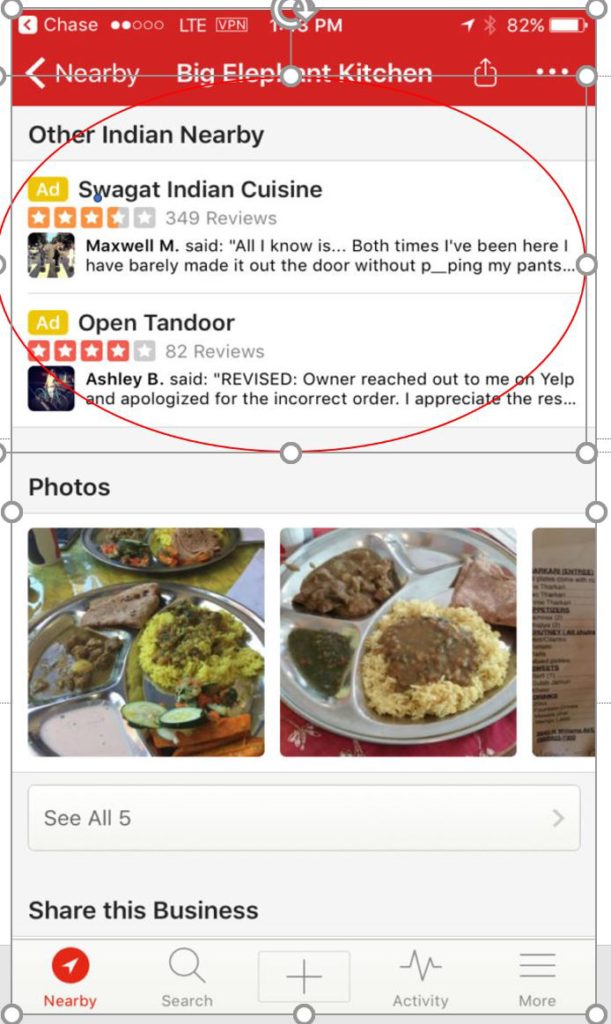
A couple of Indian restaurants in my hometown of Portland are paying to advertise on Yelp. Here’s what appeared on one smartphone over the weekend:

Photo by Tyler Bernstein


The little “Ad” icon next to each review makes it clear — these restaurants paid for this to appear.

If you can’t control the copy, there is danger.

[reminder]