A Marketer’s Defense of the Ice Bucket Challenge

“When a dog bites a man, that is not news, because it happens so often. But if a man bites a dog, that is news.” — Alfred Harmsworth,

The  Ice Bucket Backlash is now underway.

After several weeks of viral videos and millions of dollars raised, my Facebook  news feed (and likely, yours too) is now filled with people questioning the wisdom and appropriateness of the campaign.

The hip-hop group De La Soul posted a photo on their Facebook page  asking a simple question:
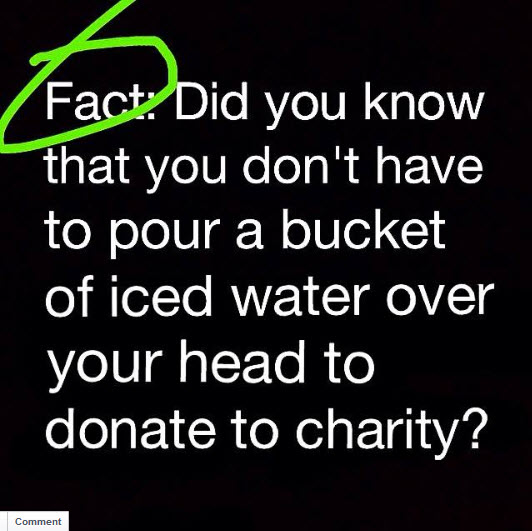
De La Soul


Recently Will Oremus of the Chicago Tribune, under the headline “Say ‘No!’ to the Ice Bucket Challenge (registration required to read the full article) noted that the original Ice Bucket Challenge had nothing to do with the ALS Association, and had this to say:

…I’m proposing what is sure to be an unpopular alternative to the #IceBucketChallenge. It’s called the no ice bucket challenge, and it works like this:

1. Do not fetch a bucket, fill it with ice or dump it on your head.

2. Do not film yourself or post anything on social media.

3. Just donate the damn money, whether to the ALS Association or to some other charity of your choice.

My take? I’m willing to concede, without doing any research, every fact he cites in his column.

The possibility exists the origin story put forth by the ALS Association is at least somewhat fictional, and that the Ice Bucket Challenge does not “belong” to the ALS Association or anyone else, for that matter.

We are all capable of making a donation to ALS or any other charity without using ice water, a video camera, or anyone else.

Having conceded all that, I believe that Oremus’ conclusion is wrong. As a marketing program, the ALS version of the Ice Bucket Challenge is superb.

  • It is distinctive – different from any other charity fundraising campaign out there.
  • It is a great example of Cialdini’s example of “social proof” as a persuasion technique – all of our friends are doing it and posting video on Facebook. We’d better do it too if we want to be accepted by the group.
  • It gives people distinctive instructions: dump a bucket of ice water on your head, or donate $100 to ALS. Not everybody fully understands the instructions — I’m sure there are lots of people dumping ice water on their heads without making donations. That’s okay. Most people get it.
  • It has raised public awareness about the effects of a horrible disease. Not everybody who posted a challenge video talked about this, but the donors to ALS are going to get plenty of mail from the Association, and that will educate at least some of them.
  • And finally, it’s worked. A of August 27, it has raised more than $88 million for the ALS Association — much, much more than the Association is used to receiving from the regular donors.

Yes, it’s possible to donate to the charity of your choice, and ask anybody else to donate, without using an ice bucket. That’s “Dog Bites Man”. by incorporating a simple bucket of ice water, the ALS Association has gotten the man to bite the dog, to the tune of $88 million. Bravo.

How Long Will It Take For The Advertising To Work?

Whenever we present an advertising plan to a new client, one of the first questions we hear (right after “How much will it cost”?) is “How long will it take to work?”

It’s a difficult question to answer — some products are impulse buys while others require painstaking research… some people need it now while others won’t buy until they’re ready. Roy Williams, The Wizard of Ads, recently tackled an underrated variable: the quality of the marketing message.

In a recent Monday Morning Memo, Roy had this to say:

Advertisers often ask, “How many times does the average person have to see or hear my message before it will be transferred into the automatic recall part of the mind?” Although this seems like a reasonable question, it’s a little bit like asking, “How many ounces of alcoholic beverage does it take for the average person to get drunk?” We can’t really answer that question until we know whether the “ounces of alcoholic beverage” are beer with 5% alcohol, wine with 14% alcohol, or Scotch with 45% alcohol.
How strong are your ads? The stronger your ads, the fewer times they have to be heard.
Alcohol and marketing
Photo by Didriks

Even then, as Williams points out later in the article, mindshare once attained must be maintained. Williams cites Bob Hoffman’s discussion of Pepsi, who cancelled their TV advertising and replaced it with a social media strategy in 2010. According to Hoffman, the strategy got them millions of Facebook likes… and a 5% loss of market share.

The example I often use is McDonald’s. Wherever I am in the country, I can walk down to my hotel lobby and ask the front desk clerk where McDonald’s is. She won’t ask me who McDonald’s is — she knows what it is, where it is, and what I’ll find when I get there. So does everyone else in town.

And yet, if I return to my hotel room and turn on the TV, I’ll soon see a McDonald’s commercial.

Because Mickey D’s doesn’t want anyone to forget.

“You Simply Cannot Kill Advertising”

In the video below, Bob Hoffman, the Ad Contrarian, tackles the claims of many that traditional advertising is dead.


I’m sorry, you simply cannot kill advertising. On the final day, when the big flaming asteroid bears down on our poor little planet and all is destroyed, there’ll be only two things left: cockroaches, and copywriters.

It’s fair to say that Mr. Hoffman is not much of a fan of social media as a marketing tool. If you have any interest in where advertising is going and what still works, you’ll find him unafraid to dispute pretty much everything you’ve read elsewhere. This speech, from Advertising Week Europe a few months back, is fascinating stuff, and well worth the 44 minutes it’ll take to watch.


What do you think? Is social media worth the time, effort, and expense? Or is it, to use Mr. Hoffman’s vernacular, bullshit? Leave a comment below.

How a Shoe Store Owner Gets Free Facebook Advertising

I was meeting with the owner of an upscale ladies boutique in a southeastern state. Although the store sold all manner of women’s clothing, the largest revenue driver was shoes.

Apparently, ladies love shoes. Who knew?

The conversation had just turned to social media, and I asked the owner how effective the store Facebook page was as a marketing tool. “It’s okay, I guess,” he said. “But I found a much better way to use Facebook.”

He had my attention. I bit. “How do you do that?” I asked.

 “My customers all have cell phones, and just about all of them have a camera. Whenever a customer tries on a pair of shoes and decides to buy them, we ask if they’d like us to take their picture — with their phone. Women like to show off their new shoes, so most of them say yes.”

“Do they let you post those pictures on your Facebook page?” I asked.

“Some do, but I don’t really care about that,” he replied. “What makes this work is that as soon as they go home, they post that picture on their own Facebook page. And they usually mention that they got the shoes at my store.

That means that we just got a free Facebook ad, and it gets seen by 500 of my customer’s friends. Two or three times a week, someone will walk into my store and ask to try on a pair of shoes that their friend posted on Facebook.

All of this costs us nothing – we don’t even pay for the camera!”

The store owner has stumbled on a great way to use Facebook in its most effective form – to accelerate word-of-mouth. It’s a technique that can be used in a variety of consumer settings:

  • A furniture store can take pictures of a customer’s new couch, in the customer’s home.
  • A car dealer can shoot a photo of a happy couple standing next to the new SUV they just bought.
  • A window company can take pictures of a homeowner posing in front of her newly-installed windows.

The key is to take the picture with the customer’s phone, not yours.

Rather than begging people to “like” your Facebook page, you can intersect with existing consumer behavior. Happy customers love the show off the things they just bought… on Facebook.

Who knew?

________________________________________________________________________________________

Want to email Phil Bernstein? Do it here.

If you like what you’re reading, there’s more! Sign up for Phil Bernstein’s free advertising and marketing e-newsletter here. As a bonus, I’ll send you a copy of my newly-revised and expanded e-book, The Seven Deadly Mistakes of Advertising and How to Fix Them when you subscribe.

You can become a Facebook Fan of “Doctor” Phil Bernstein, Portland’s Advertising Expert  here.

If you like this post, share it — click the “Share” button below.

SuperBookDeals and the Limits of Crowd Power

Alternate title: “Some Companies Just Don’t Care”

People in the customer-service advice-giving business love to tell the story of United Airlines and Dave Carroll. It’s a very entertaining tale of a customer who, having felt mistreated, used the power of the internet to do an enormous amount of damage to a large company’s reputation.

It’s an article of faith to many of us that in the age of the internet, poor customer service will result us a huge loss of good will, and money. As Mike Frichol of Marketance put it,

Companies that don’t pay attention to what their customers are saying about their business/brands/products/services/solutions via social media sites pay a serious penalty in bad publicity and lost revenues.

Your business/brands/products/services/solutions reputation is open to positive and negative social media discussion online. This is your reputation – you need to be engaged – you need to monitor what’s going on – you need to respond appropriately.

But then, there’s SuperBookDeals, an online book dealer who sells books  via their own site, along with partners such as Amazon.com and Barnes & Noble. In 2008, I had an extremely bad experience with SuperBookDeals and wrote about it here. I wondered whether SuperBookDeals would see the post — and whether their concern for their online reputation would cause them to reach out to me.

They didn’t.

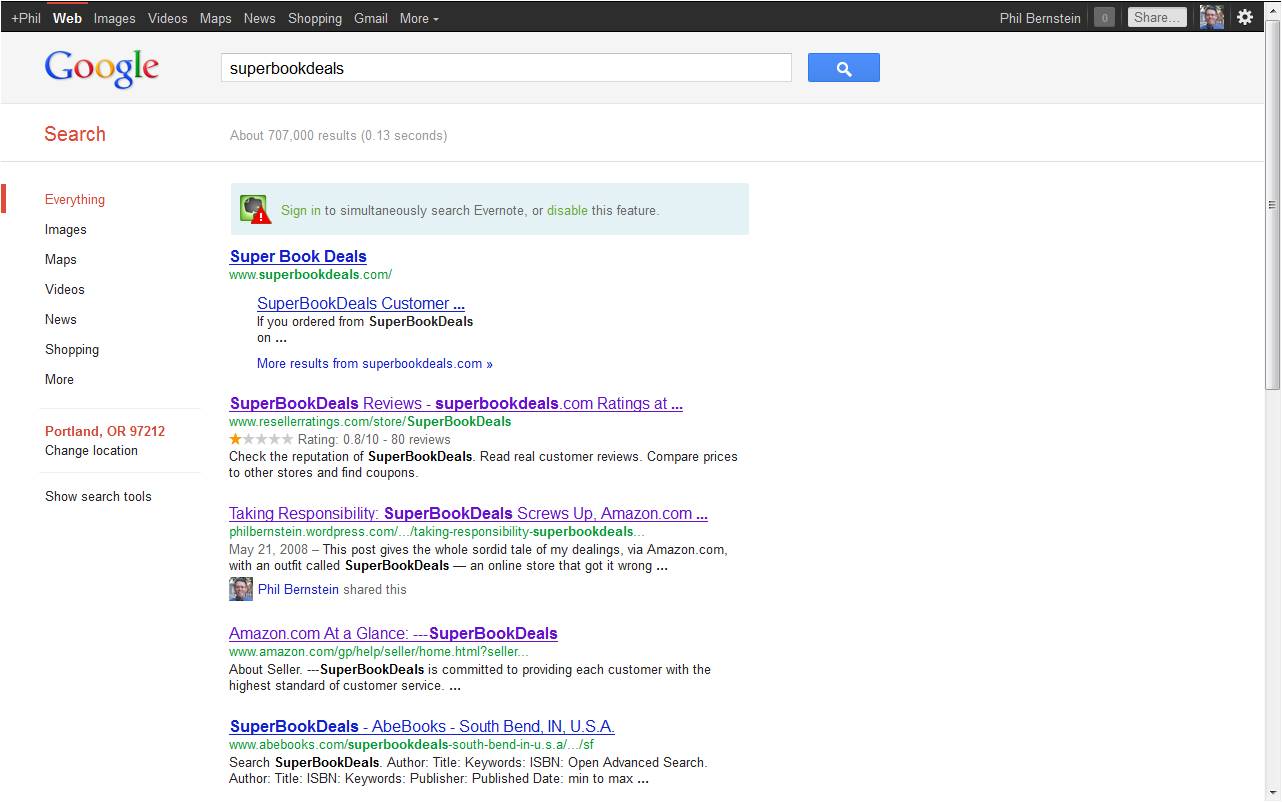
Nearly four years later, a Google search for SuperBookDeals returns this:

The top listing is the company site, which is fair. But the Number Two listing when you look up the company is a consumer review site, Reseller Ratings. There are 80 reviews on the site, and almost all of them are extremely negative. A quick sampling:

“I will NEVER EVER order from here again!!!!! I order a book for school and was advised i would recv it in 14 days which would have been on the 16th of sept. Did i get it ?? ummmmm.NO!”

“Horrible, horrible horrible.”

“Do not order from this company.”

It goes on for page after page — dozens of angry consumers complaining bitterly about the books they ordered and did not receive… and the complete disdain they did receive when they tried to find out what happened to their merchandise.

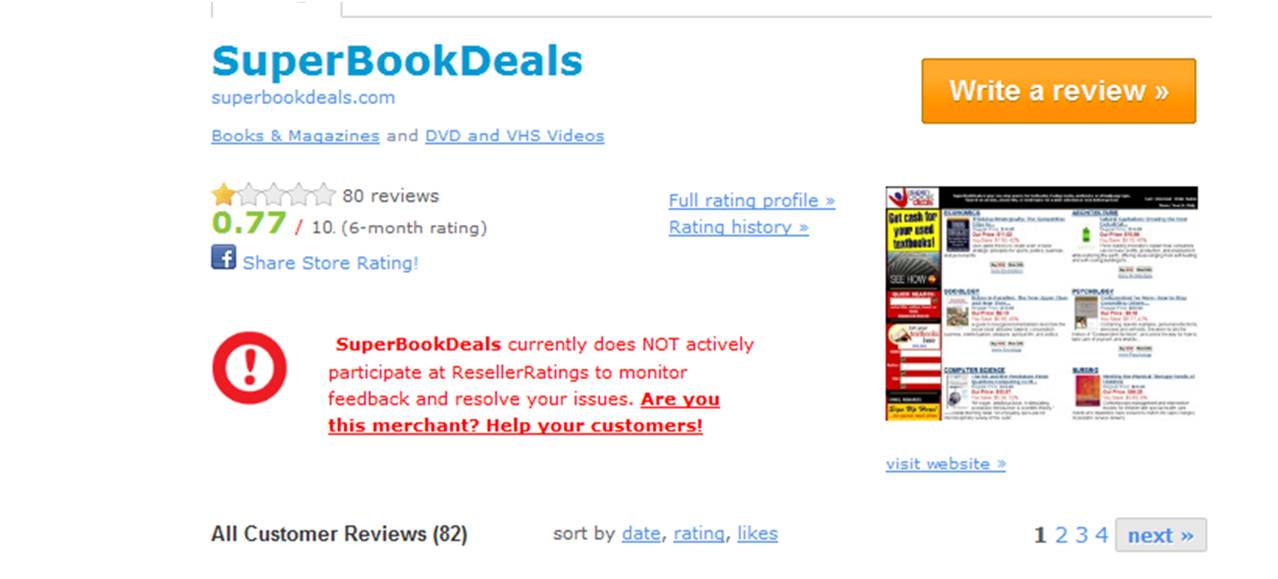
More important, perhaps, than the stories themselves is this notation at the top of the review site:

Superbookdeals does NOT actively participate at Reseller Ratings to monitor feedback and resolve your issues. Are you this merchant? Help your customers!

In spite of 82 separate reviews — 81 of them extremely negative… in spite of the fact that this is the second listing on the page when someone Googles the company name… SuperBookDeals ignores it.

Meanwhile, my nearly four-year-old blog posts appear at #3 and #6 on the page. Although both posts get regular traffic and occasional comments, SuperBookDeals has not bothered to contact me, either.

So, this appears to be a case study in a company — an online seller, at that — completely ignoring its online reputation. Anyone wondering whether to do business with them can look them up and easily determine that they should not. Has this cost them anything?

As of this morning, SuperBookDeals still in business, still angering customers on a daily basis, and laughing all the way to the bank.

So the question for the group is this: how important is your online reputation? Leave a comment below.

___________________________________________________________________________________

Email Phil Bernstein here.

Like what you’re reading? There’s more! Sign up for Phil Bernstein’s free advertising and marketing e-newsletter here.

Become a Facebook Fan of “Doctor” Phil Bernstein, Portland’s Advertising Expert  here.

If you like this post, share it — click the “Share” button below.