How to Handle a Client Who Won’t Meet Deadlines

Do you have an advertiser who just can’t get you their copy on time? You might be able to change their behavior with a creative pricing strategy.

salespeople can get clients to meet deadlines
Photo by Katie Martynova

My Client From Hell
A Story From My Radio Sales Days

In my iHeart Radio days, I worked with a car dealer who constantly missed deadlines.

I wrote all of his copy for the market; I needed information from him in order to get it done.  

  • Manufacturer incentives.
  • Interest rates.
  • Goals for the month — were his new cars a priority this month, or was this a time to push used?

I needed time to get a high-quality script written.

Matt Jones, my Production Director, needed to schedule a recording session, which usually involved the dealer reciting some lines.

Without a script, we couldn’t schedule the session.

Without a recording session, there’d be no commercial. 

As each new month approached, the dealer would stop returning my calls.

Eventually, with enough pleading and pestering, he’d send me something.

I’d write as fast as I could, we’d rush the client in to read his lines, and Matt would somehow turn our efforts into something special — a skill he continues to exhibit to this day.

How could I convince a recalcitrant client to get me the copy points on time? I never came up with a good answer.

This went on for years. 

Since I’ve become a media sales trainer, dozens of AE’s have told me similar stories.

Is A Rush Discount The Answer?

Josh Bernoff, author of Writing Without Bullshit: Boost Your Career By Saying What You Mean,  has a method he calls the rush discount. He explains:

“We’ll agree on the deadlines. I’ll go as fast as I can. And if you get me everything I need in the time frame I need it to meet those deadlines, you get the work for 10% off.”

This is not a completely new invention. 

“Added value” incentives for signing by a certain date are not uncommon. Some companies allow discounts to clients who pay for several months’ worth of advertising in advance.

A “Rush Discount” is a new way of using this old concept to influence another kind of behavior.

How to Implement This*

Here’s one way to do a Rush Discount:

  • The campaign is scheduled to begin on August 6.
  • Your Production Department wants at least two weeks to produce a spot (this is just an example —- your mileage may vary).
  • The client is a well-known serial procrastinator.
  • The campaign investment you’re proposing is $5000 per month.

You would put two numbers on the agreement:

  • $5000 per month.
  • $4500 for July if all necessary materials are turned in by COB on July 15.

*You’ll want to check with your company’s business department before implementing this strategy.

Would it work? Maybe, maybe not. 

Is it worth a three-month experiment to see if it restores sanity to the process? I submit it is.

If you try it, let me know how it works! You can email me at phil@philbernstein.com.

[reminder]What’s the most creative way you’ve gotten a client to meet a deadline?[/reminder]

How Much Can Happen In a Year?

How long has it been since you did a full needs analysis with your best long-term client? You might be surprised at how much has changed.

Salespeople should avoid surprises
Photo by Maruba

It’s easy to let that sort of thing slip.

  • You negotiate “the annual”.
  • You take the client to lunch once a quarter.
  • You bring them concert tickets every now and then.
  • You call periodically to “check in.”
  • A year later, it’s time to negotiate “the annual” again.

If you haven’t been paying attention, you may get an unpleasant surprise — a lot can change in a year.

Recently I had an opportunity to find out exactly how much could change. I presented an advertising plan to a roofing company…more than a year after the needs analysis meeting. 

I’ll explain.

In the spring of 2017, I met with the roofers for about an hour. They gave me a lot of information on their history, their customers, their business model, and their goals. We scheduled a presentation for two weeks later, and I got to work on an advertising plan.

The day of the presentation, the roofers canceled the meeting. We rescheduled it and they canceled again. I left town, we scheduled a webinar, and they canceled again.

We gave up. A year went by.

I came back to the market to work with the TV station again.

On a whim, the Account Executive called the roofing company and told them I was coming back. They wanted to meet with me. But they only had time for one meeting.

No new needs analysis — we had to work with the year-old data from the last one. We decided it was better than no opportunity at all. 

Our plan: dust off our old presentation, update the rates, and give it our best shot. How much could change in a year?

I opened the meeting by saying, “Gentlemen, everything I’m about to present to you is based on year-old information. If I say something that no longer applies, raise your hand and correct me, and we’ll make adjustments as necessary.”

They stopped me on the first slide.

A year earlier, 90% of their installations were foam roofs. Now foam was less than 50% — since our last meeting, they had diversified into TPO, metal and shingle roofs. 

In the spring of 2017, they’d wanted to dominate foam. Now, they didn’t want to be known as a foam roof company anymore.

So… completely new business model.

This was a problem, since the creative concept I’d put together was focused on selling foam. 

As we moved on, more change became evident.

A year earlier they’d been at the bottom of Page 2 on Google for general roofing. Their big priority then was to get onto Google’s Page 1. As a result, a big part of our recommended strategy involved SEO.

This no longer applied, either — since then they’d put a lot of money and effort into SEO and were ranking well now.

At this point, we stopped presenting and started asking questions. It was clear the whole basis for our presentation was obsolete.

We asked for a few days to re-write the TV script and the entire advertising plan.

We wound up getting the money… but we had to dance to get it.

Lesson learned.

The Sales Lesson:
Do a Deep Needs Analysis Regularly

If you’ve been working with a client for a long time, it’s easy to assume that you’ve got a handle on their business. 

But you don’t know what you don’t know.

  • Market conditions change.
  • Budgets change.
  • Departments reorganize.
  • Goals change.

Maybe the client will actively keep you up to date on all the changes. But it really helps to ask.

For a significant advertiser, you should take the time to do a full needs analysis at least once a year. With a year-round customer (keep in mind that an “annual” can be longer than a year) the six-month mark is a good time to do it.

When you do that quarterly lunch, make a point of asking if there are any new developments. 

Finally, it doesn’t hurt to double-check once more at renewal time:

I’ve learned to open every meeting in which I ask for money this way:

“Before we begin, I need to ask a quick question. Has anything changed since our last meeting?”

A lot can change in a year if you’re not paying attention. Make a point of asking often.

[reminder]

Who Says an “Annual” Has to Stop at 12 Months?

How long are the schedules you propose? You may be leaving money on the table.

Sales tip: don't be afraid to ask for a longer commitment

Most of the radio and television salespeople I encounter default to one of these:

  • Three months
  • Through December of this year
  • 12 months

When I ask how they arrived at the proposed length, it turns out there’s no formula. Sometimes the terms are set by an RFP, or a specific client request. Most of the time the salesperson just decides.

  • “I didn’t want to ask for less than three months.”
  • “December’s the end of the year, and that seemed like a logical time to end it.”
  • “I always ask for an annual, and that’s 12 months.”

There’s logic behind each of these answers. But the one thing they have in common is that the proposed length of most proposals is completely arbitrary.

In other words, we make it up. 

As long as we’re making it up, why not go longer?

I’ve been experimenting with longer asks. With some coaxing, I’ve convinced AE’s and sales managers that they can, and should, ask for longer commitments.

Early in the year, we went for 13-month deals. For example: instead of a “March 2018 through February 2019” agreement, we wrote each proposal to run March 2018 through March 2019. 

What we found: if a client is willing to commit to 12 months, they’ll commit to 13. Rarely did we encounter an objection.

Recently, I helped some AE’s become even more ambitious. We wrote a series of proposals that began in the middle of this year and went through the end of next year.

June 2018-December 2019. 19 months.

There was nothing deceptive in our approach. We made it clear to each client exactly what we were asking for.

Out of 15 proposals in this particular market, 12 of them were for 19 months (the other three clients could only consider schedules that ran during their fiscal year.)

So far, seven clients have signed, and five of those signed for the full 19 months. 

5 proposals x 7 extra months per proposal = 35 months of additional advertising sold. That’s almost three full years’ worth of additional revenue, with virtually no additional effort expended. 

Note well: if the station doesn’t provide good service, or the advertising doesn’t work, or the marketing director gets fired, the usual cancellation policy applies. The money is not guaranteed.

But that risk applies to every schedule the station sells. These things are never final until the money’s in the bank.

For now, we’ve got five new clients who fully expect to run on our station until December, 2019.

Why? Because we asked them to.

The next time you’re preparing an “annual” presentation, raise your expectations. There’s no law limiting you to 12 months.

[reminder]What’s the longest plan you’ve ever sold?[/reminder]

Have You Tested The Funnel?

The law firm had recently cancelled its radio and television advertising.

“We got great results from the campaign for a long time,” the managing partner told me. “But it hasn’t been working the last three or four months.”

TV and radio salespeople must keep customers from confusion
Photo by mimagephotos

The personal injury firm had been advertising an “accident book”  — a short book on what to do in the event of an auto accident. Radio listeners and television viewers were directed to a special website where they had to enter their name, address, and email address in order to get the book.

In the internet marketing world, this is known as a Lead Magnet. 

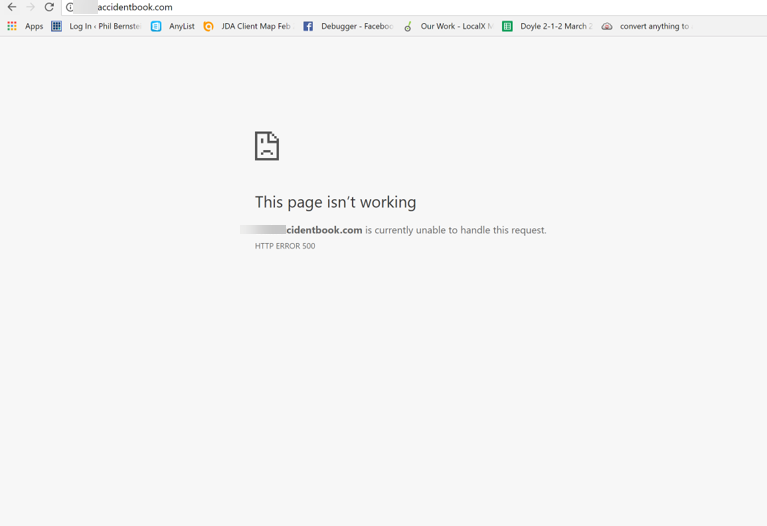
Back in my hotel room that night, I decided to test their system. I went to the website, filled in my information, and hit Submit.

Here’s what I saw next:

Salespeople should check the sales funnel before the TV or radio campaign launches
Identifying details have been deliberately blurred.

I tried three times to order the book, and got the same screen each time. When I met with the law firm again I showed them a screen shot, and asked, “How long has this been happening?”

The managing partner admitted he had no idea. “I guess we haven’t checked things in a while.”

“I can’t prove it,” I replied. “But there’s a pretty good chance your radio and TV ads were working fine. If the first exposure they have to your firm is a non-working web page, they’re not going to call you, and you’ll never know who they are.”

That same week, in the same market, I met with the owner of a moving and storage company. They had all the customers they could handle — what they needed was employees. They’d been running recruitment ads online, without much success.

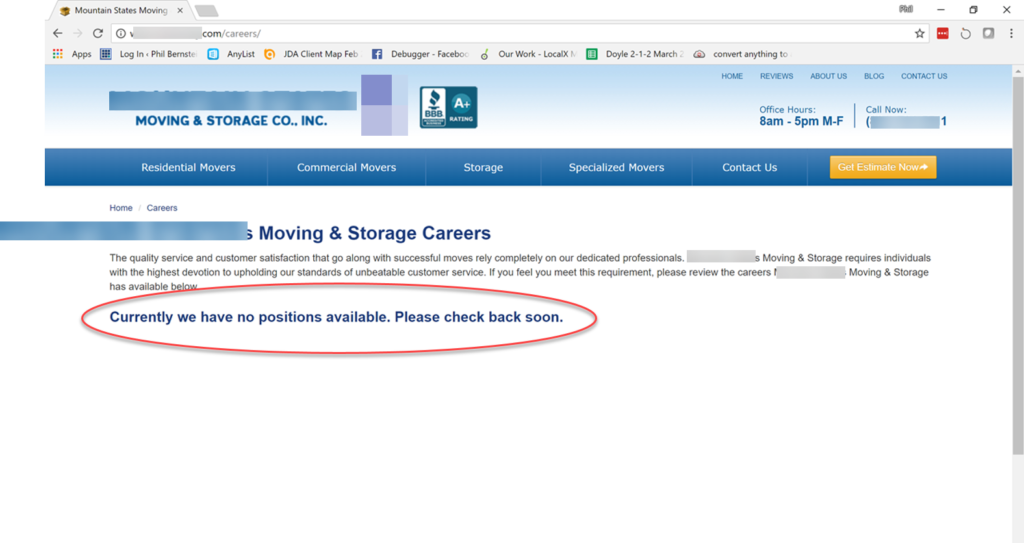
Preparing for a follow-up meeting, I took a look at the company’s “Careers” page. It looked like this:

Radio and TV salespeople should check the sales funnel
Identifying details have been deliberately blurred.

The company had lots of positions available. But visitors to their website wouldn’t know that. 

These sorts of oversights are distressingly common. 

  • I’ve seen incorrect phone numbers in ads.
  • Links from social media go to “404 Not Found” pages.
  • Banner ads for specific products go to the advertiser’s home page, which has no information about the product being advertised.
  • “E-commerce” sites make it hard for people to find items or make a purchase.

Potential customers and applicants follow the call-to-action, and wind up confused.

Confused people do nothing.

And the advertiser shakes their head and says, “I tried [name of your medium] and it didn’t work.”

As advertising sales professionals, we can say, “Our responsibility is to bring the prospects to their door. If they can’t convert them, it’s not our fault.”

I’ve talked to plenty of salespeople and sales managers who have taken that position. They’re not wrong.

But when the advertiser cancels the campaign, the money comes out of your pocket no matter whose fault it was.

My position is this: If you’re an Account Executive, your responsibility is to execute. That means putting in the extra time and effort to make sure the sales funnel’s working properly. 

Before the ad goes on the air, ask, “What’s the call-to-action? What is the prospect expected to do as a result of seeing or hearing the commercial?”

Then, pretend to be a customer. Take the action.

  • If the commercial directs people to a website, go to the site. What do you see? Does the site pass the “Mom Test?” Will prospects know what to do next, or will they be confused?
  • If there’s an inquiry form on the site, fill in your information and submit it. What happens next? How long does it take to get a response.
  • If the ad tells people to call a phone number, grab your cell phone and call it. Does the right department answer?
  • Does the store have the merchandise in stock? Do the clerks know where it is?

Do this before the ad hits the air. If you find a problem, alert your client. If necessary, delay the campaign launch until the problem can be fixed.

In the short term, this will be an inconvenience, and might even cost you some revenue if a schedule has to be moved. 

But in the long term, you’ll have a happier client who trusts you to give them advice that gets them results.

[reminder]

After a Huge Screw-Up, How to Handle the Aftermath

Inevitably, you or your company will screw up. Maybe today, maybe next week, maybe six months from now. How you respond will show what you’re made of.

Sales advice: take responsibility
Photo by Elnur

When Dr. David Dao was beaten and dragged off a United Express flight last April, United Airlines’ upper management very publicly botched the initial response to the incident. Their reputation has not yet recovered.

When two African-American men were asked to leave and then arrested at a Philadelphia Starbucks, that company was similarly under the microscope. Unlike United, Starbucks’ management has performed impressively.

What’s the best way to respond when things go south? Customer support expert Len Markidian points to Disney’s approach to service failures:

Their approach to service recovery is a five-step process, easily remembered with the acronym H.E.A.R.D:

  • Hear: let the customer tell their entire story without interruption. Sometimes, we just want someone to listen.
  • Empathize: Convey that you deeply understand how the customer feels. Use phrases like “I’d be frustrated, too.”
  • Apologize: As long as it’s sincere, you can’t apologize enough. Even if you didn’t do whatever made them upset, you can still genuinely be apologetic for the way your customer feels (e.g., I’m always sorry that a customer feels upset).
  • Resolve: Resolve the issue quickly, or make sure that your employees are empowered to do so. Don’t be afraid to ask the customer: “what can I do to make this right?”
  • Diagnose: Get to the bottom of why the mistake occurred, without blaming anyone; focus on fixing the process so that it doesn’t happen again.

Based on this criteria, how has Starbucks done so far? 

  • Hear: Within days of the incident, Starbucks CEO Kevin Johnson traveled to Philadelphia and met personally with the two men. He also met with Philadelphia’s mayor and police commissioner.
  • Empathize: Prior to the meeting, Johnson issued a statement saying the incident had “a reprehensible outcome.” Referring to the two men, Starbucks Chairman Howard Schultz told CBS News that “the reason the call [to the police] was made is because they were African-American.”
  • Apologize: Both Johnson and Schultz apologized publicly to the men. Johnson also did so in person.
  • Resolve: Starbucks quickly escalated the response to the highest level of the company. Schultz told Gayle King at CBS This Morning that they have asked the men, “What can Starbucks, given our resources and the capabilities we have — they have an interest in real estate — what can we do to help advise them and support their own business endeavors?…Given the resources we do have, we will provide them with a foundation of learning, and provide them with an opportunity to be part of our company, either directly or indirectly, as a result of this situation.” It’s fair to surmise that at the very least, money will be changing hands.
  • Diagnose: Starbucks has announced plans to close 8,000 company-owned stores for several hours of racial-bias training, at a cost that’s been estimated at as much as $12 million. They clearly don’t want anything like this to happen again.

Shultz also met with the store manager who called the police. Although he made it clear she is no longer with the company, Starbucks has avoided the temptation to blame the whole thing on her. 

Here are some tips to follow the next time you or your company disappoints a customer:

  1. Make a point of accepting all of the blame, even if you believe your customer is partially at fault.
  2. Don’t point fingers. Starbucks didn’t publicly blame the two men for insisting on staying, or the police for making an arrest. Your client doesn’t care that Corporate changed the policy, or that your production department was shorthanded, or that the sales assistant misfiled the paperwork.
  3. Make it right. Give the client much more in return than they lost — and do it quickly.
  4. Once the dust settles, figure out what caused the problem, and how you can prevent it from happening again. 

Your best opportunity to demonstrate your customer service chops is when something has gone horribly wrong. With the right mindset, you can correct a big mistake and position yourself as a true professional.

[reminder]What’s the worst customer service fail/mess you’ve ever had to clean up? What did you do to resolve it, and what did you learn from the experience?[/reminder]