How to Find the Money: A Powerful 3-Question Process to Learn the Client’s Budget

It’s tough to ask “the budget question” on a sales call, especially with a new prospect. The client doesn’t know you, doesn’t trust you yet, and may be reluctant to give you the information.
sales find the money
Photo by vvoe/dpc

Many salespeople don’t ask at all. This is a big mistake.

If you don’t ask, you won’t know.

In my day job, I teach sales skills to radio and television station advertising salespeople. I train them to break the question into three parts.

Part 1: Ask Permission

Part 2: Ask About the Process

Part 3: Ask For the Number


Permission: “Can I ask you a few questions about your advertising plans?”

This question comes well into the meeting. By this time, we’ve already covered many other aspects of the client’s business — history, inventory, customer demographics, business philosophy — pretty much everything except that which we’ve come to sell.

If we’ve done this properly, we’ve begun to establish some rapport and trust, and the customer is beginning to let down his guard. If we just jump in and ask, “What’s your advertising budget”? the door could slam closed again.

Asking permission seems polite and considerate. The client will virtually always say yes. This obligates them to answer the next question.

Process: “Things are going pretty well for you these days, but you never know what’s coming next. You don’t know what the economy’s going to do… you don’t know what the weather’s going to do… you don’t know what the government has planned for you next.

But at some point every year, even with all this uncertainty, you have to decide how much you can spend on advertising. How do you come up with that number?”

The three factors mentioned above — economy, weather, and government — affect just about any business. Before asking for the number, we’re expressing some empathy and asking the client to open up about how they come up with the budget. We’re not ready to ask for the number yet. First we acknowledge the difficulty any company owner or executive has in predicting the future.

Some customers have a formula (usually a percentage of revenue) that they stick to. Others have a dollar figure handed to them from above. A surprising of businesses have no process at all, and just fly by the seat of their pants.

Whatever the case, knowing how they get to the dollar figure is as important as knowing the number itself.

The Number: “Okay, thanks for that. So for all the advertising you do — radio, television, digital, newspaper, magazines, billboards, Yellow Pages, and anything else — how much do you think you’ll spend this year? [Some clients won’t know a yearly figure; in that case, you can ask them to estimate how much they spend per month.]

By this time the client’s given you permission to ask, along with some insight as to the budget process. It won’t happen every time, but the odds have become much greater that they’ll tell you what you want to know.

[reminder]Do you find yourself reluctant to ask about the money? How do you deal with that?[/reminder]



5 Great Books Every Advertising Salesperson Must Read (Or Re-read) in 2017

We work in the persuasion industry. As advertising sellers, first we must persuade a prospect to meet with us… and then consider our proposal… and then buy. Then we must design a campaign that persuades our client’s prospects to take action.

Here are five books that will help you develop the sales skills to persuade… and sell.

5 Great Advertising, Marketing and Sales Books

The Accidental Salesperson by Chris Lytle: I read the original version of this book more than a decade ago. It was early in my selling career. I was looking for anything that could teach me the sales skills I needed.  This book taught me enormous amount. When the new edition came out, I took it out of the library — being a cheapskate, I didn’t feel like paying for it a second time. Two chapters in, I returned the library copy and bought my own. I wanted to read it and highlight the hell out if it. For example, this:

If you work on straight commission, you prospect for free. You do a customer needs analysis for free. You do the research for free. Then you write the proposal for free… At least you don’t have to pay to make your presentation to the prospect.

What if you did have to pay to make your presentation? You obviously would put more time and thought into it. You probably would even rehearse it a few times…”

I’ve gone from being a salesperson to a combination salesperson/sales trainer role.  I have read that passage repeatedly to groups of radio and television advertising sellers all over the country. It gets through.

Slow Down, Sell Faster! by Kevin Davis: This is one of the rare sales skills books that has actually given me a new perspective on the process of selling. The author’s contention is that we spend so much time focusing on our needs and our timetable that we forget what’s important to the client. He sums it up this way:”Every sales leader wants fast sales; the trouble is, there aren’t many fast buyers…They are unlikely to change their buying process to match your selling process, so your only option is to be the one who switches.”

Influence: The Science of Persuasion by Robert B. Cialdini A classic in the field — enough science to demonstrate that the author knows what he’s talking about, but accessibly written for salespeople (like yours truly) who didn’t pay attention in science class. Cialdini, who holds professorships in Marketing and Psychology at Arizona State University. The principles he teaches in this book will help you do a better job convincing clients to buy, and can also help make you a better marketer and copywriter.

Advertising Headlines That Make You Rich by David Garfinkel: Although this book is aimed at those who sell with the written word — direct mail, print publications, and web pages — the techniques can help marketers in any medium. However your prospects see or hears your sales message, you have a very short window in which to convince them to pay attention. The headline in a print ad, or the opening five seconds of a radio or TV commercial, will cause your target to either pay attention to the rest of the message or tune you out. Garfinkel gives you a series of headline templates that have worked for selling a wide range of products and services, discusses why each one has been effective, and lists several variations on each headlines. When I’ve hit a wall while writing copy, I’ve gone to this book to help get unstuck.

Dan O’Day’s Guaranteed 5-Step System For Creating 30-Second Radio Commercials That Get Results: Another good cure for (copy)writer’s block, and an excellent companion to the Garfinkel book. I bought this when I was working in radio; now that my primary platforms are television and digital, I still use it regularly. Like Garfinkel, O’Day teaches a headline-based approach to designing a campaign. Besides the headlines, the true benefit of O’Day’s system is in the exercise of settling on a Unique Selling Proposition before starting the script. It’s not a long book, but it’s a powerful one.

[reminder]What’s the best advertising, marketing, or sales book you’ve read in the past 12 months?[/reminder]

Does Your Name Tell Your Story?

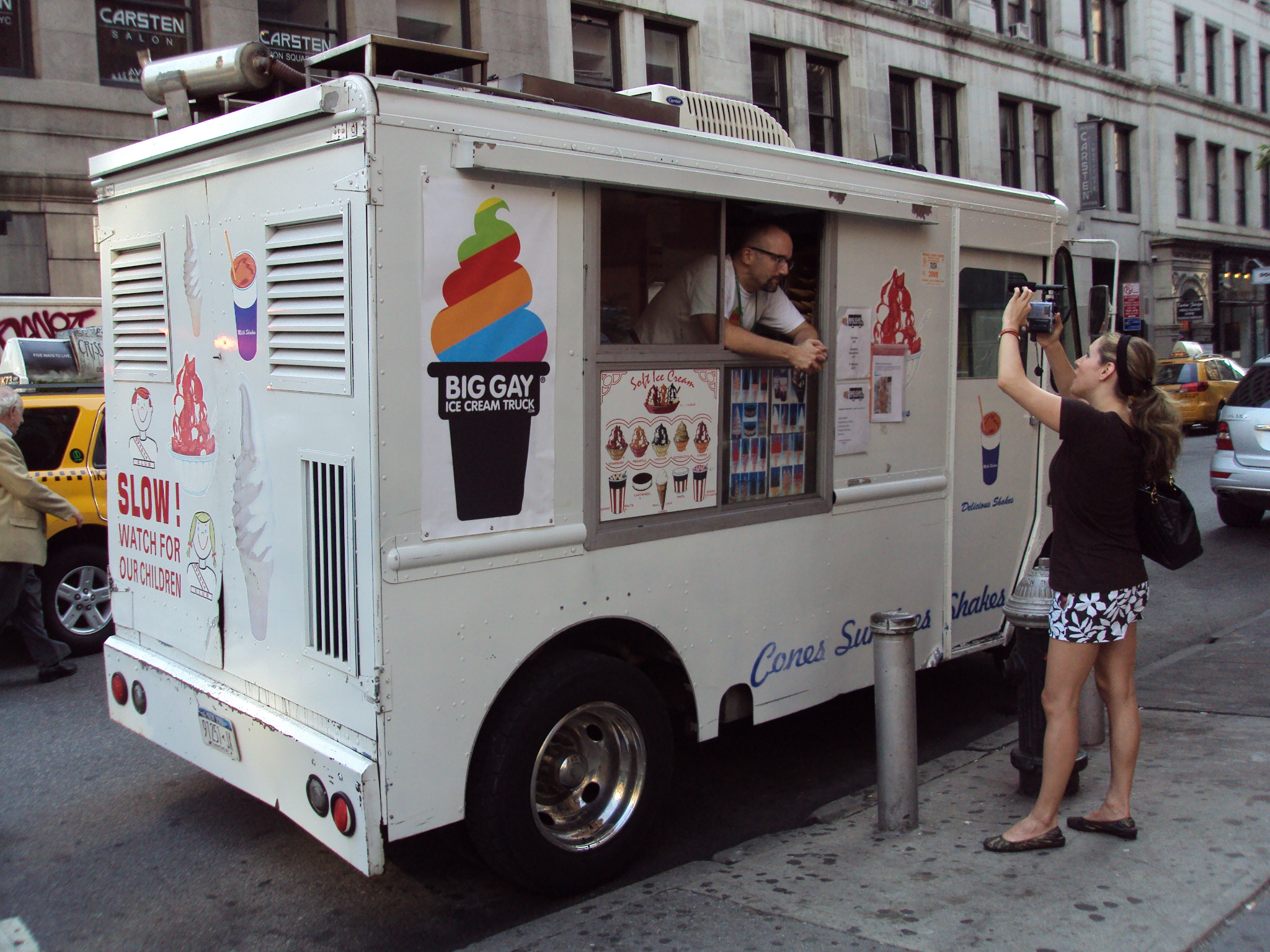
There are lots of ice cream store chains in the United States. But there’s only one Big Gay Ice Cream.

Doug Quint and his Big Gay Ice Cream Truck
Photo Credit: *Bitch Cakes* via Compfight cc

The company began its existence in Manhattan as the Big Gay Ice Cream Truck in 2009, and quickly took off. There are now two shops in Manhattan, along with a “permanent pop-up” at the Ace Hotel in Los Angeles. The web site indicates that more stores are planned for Los Angeles and Philadelphia.

As a marketing tool, the name has three important things going for it:

  • It is so far from the expected that it forces  people (i.e. potential customers) to pay attention.
  • It establishes a genuine point of differentiation. That differentiation doesn’t have to be the product itself to be significant, which is likely similar to ice cream you can buy elsewhere.
  • It implicitly accepts the risk that some people will be offended, and will refuse to buy ice cream from this truck because of the name. Owner Doug Quint is willing to sacrifice that business in return for a (presumably larger and more loyal) customer base that will seek him out. (For more on this concept, go here).

[reminder]What’s the most unusual name you’ve seen for a (reasonably mainstream) business? Please keep it PG-13 for a family readership.[/reminder]


When People Complain About Your Advertising

“Most ads aren’t written to persuade, they’re written not to offend.” — Roy Williams


What do you do when people don’t like your ads?

Chaos on my mind
Photo Credit: Hermano Gris via Compfight cc

Not long ago an ad agency pulled a home improvement commercial off the air in Portland and Seattle because several listeners had called the client to complain about it. The client was concerned that he was offending potential customers, and the agency had to  scramble to come up with something else.

So what happens when some people don’t like your advertising?

[bctt tweet=”They don’t have to like your advertising — they just have to buy.”]

Sunny Kobe Cook, whose relentless pitches for Sleep Country USA in the 90’s irritated thousands, once told a seminar audience that she would occasionally work behind the counter at one of her stores.

Customers would walk up to the counter after choosing a bed, hand her their credit card, and then do a double-take. She described the typical encounter like this:

Customer: You’re Sunny Kobe Cook!

Sunny: Yes, I am.

Customer (leaning forward, whispering): I hate your commercials!

“They’re standing in my store,” said Cook, “and making a purchase for a thousand bucks or more. I want everyone to hate my commercials like that!”

Cook annoyed people with her voice and relentlessness. Rob Christensen, by contrast, deliberately pushed the envelope of good taste. Christensen ran Apple Auto Sales of Charlotte, North Carolina. In his TV ads, he played “Reverend Rob”, a televangelist who would “HEAL your credit.” They’re cheesy, poorly-acted, and have the ability to offend on multiple levels.

They also sold cars. You can watch one here.

According to Mike Drummond of the Charlotte Observer, Christensen began running these ads since 1997. Viewers  complained, and some stations  refused to run the spots.

Christensen aired the commercials on stations who would accept them, and took his money to the bank. “I’ve had people tell me they hate my ads — hate them,” Christensen told Drummond. “And yet they still bought a car from me.”

Roy Williams echoes the sentiment:

Ninety-eight point nine percent of all the customers who hate your ads will still come to your store and buy from you when they need what you sell. These customers don’t cost you money; they just complain to the cashier as they’re handing over their cash.

A caution is in order here: An annoying campaign may get you noticed, but you can’t forget to sell within the commercial. The Sleep Country and Apple Auto Sales commercials were more than just exercises in irritation. Each one contained a powerful sales message and a call to action.

Don’t reject an idea simply because some folks might not like it. They don’t have to like it — they just have to buy.

[reminder]If you work in advertising, have you ever had to deal with a client who wanted to bail on a campaign that was generating heat? How did you deal with it?[/reminder]

Is Your Website Killing Your Campaign?

Is your website working against the rest of your advertising? A poorly-conceived site can stop the traffic dead in its tracks.

Old Window Grid

Photo Credit: Free HDR & Photomanipulations – www.freestock.ca
via Compfight cc


I met recently with a personal injury attorney in the south. His practice handles the usual PI stuff — car wrecks, product liability, medical malpractice, etc. But he has a special expertise in one particular area: oilfield injuries.

He graduated college with a degree in petroleum engineering, and spent several years working on the rigs before going into law. An oil worker injured on the job might be very interested in an attorney who knew the industry, and this guy knows it.

The attorney’s TV commercial does a great job telling the story. He appears in a workshirt and hard hat. There are powerful images of oil rigs, workers in baskets hanging from a crane, helicopters.

The commercial invites viewers to go to his website to find out more. And that’s where everything he’s gained with the TV ad begins to evaporate.

  • Instead of oil rigs, there’s a picture of a generic courtroom.
  • Instead of workers hanging in baskets, there’s a photo of a gavel.
  • Instead of the story of a guy who worked on the rigs right out of college, there’s a generic “About Our Firm” page.

The TV ad was working — it drove people to the website — but that’s where the traffic stopped. Viewers wanted to hire the guy in the hardhat, but the guy in the hardhat was nowhere to be found. I’ve advised him to work with his web developer to make sure the message on the site matches the message on the TV ad.

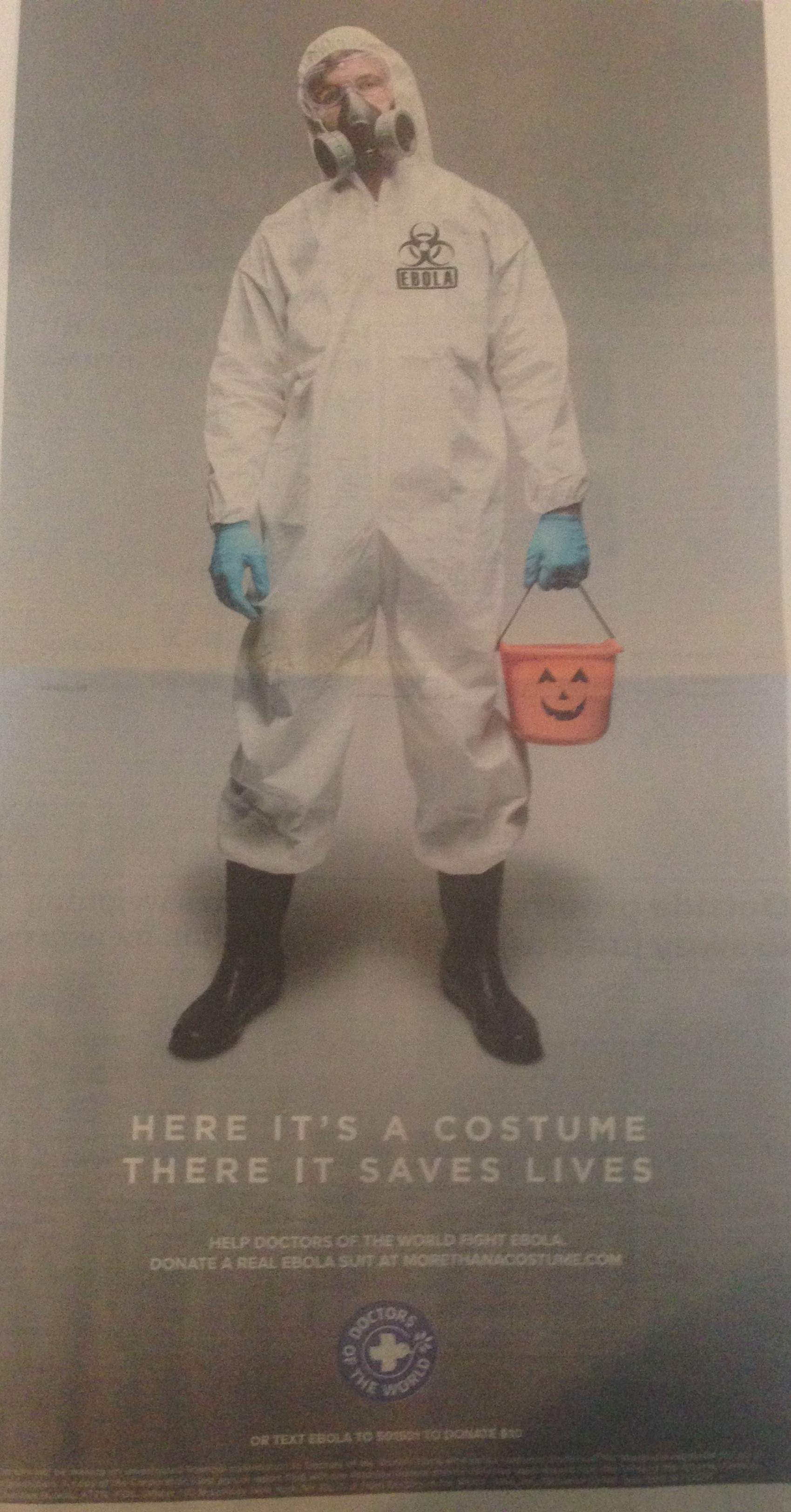
By contrast, Doctors of the World recently did a fabulous job of matching offline and online marketing. As I discussed in this space last week, the humanitarian organization tapped into the “Ebola Costume” craze by encouraging people to donate money to buy real Ebola gear for real doctors. The print ad looked like this:

Ad appearing in USA Today October 30, 2014

Ad appearing in USA Today October 30, 2014


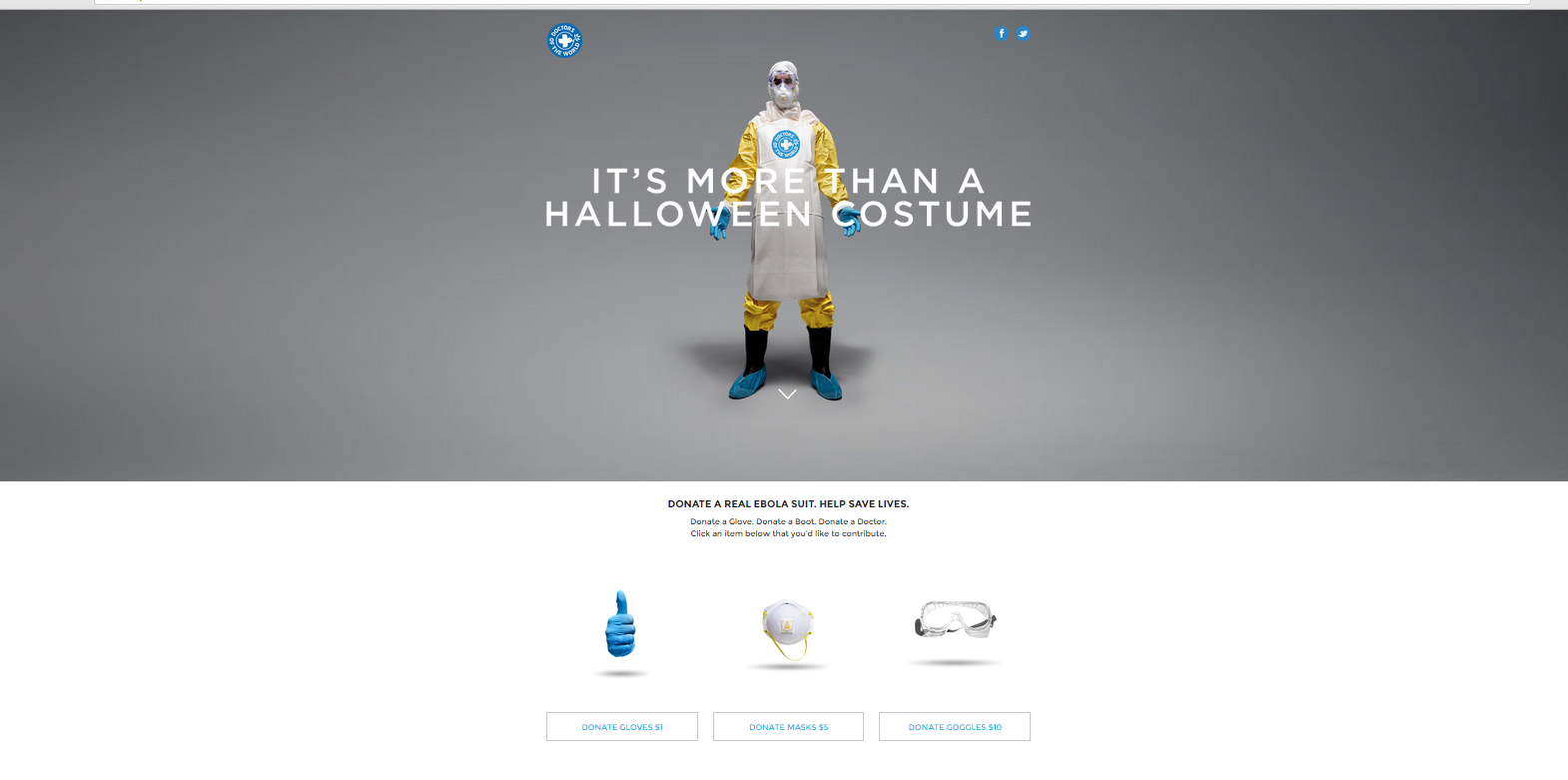
Readers were directed to an online direct-response landing page. You can see it below.

 Doctors of the World Ebola landing page.

The photo on the site immediately notifies readers they’ve come to the right place. Below the photo is an easy way to take action — a simple set of “click to donate” buttons with amounts cleverly matched to specific pieces of equipment.

[reminder]What’s the best message-matching website you’ve encountered? What’s the worst?[/reminder]