A Budding New Advertising Category

This isn’t a new product, but it’s a new advertising category for most of us:

The category is medical marijuana. For most of our lives, it’s been against the law everywhere in the country. But in the past few years, a steadily increasing number of communities have decriminalized the possession and use of the drug for certain medical purposes. In those communities, “dispensaries” have sprung up to handle the demand.

Guess what? They want to advertise! Print publications are taking the money, and some broadcasters are beginning to accept it as well.

Here’s how the New York Times put it in a recent article:

What would happen in the many communities now allowing medical marijuana had been a subject of much hand-wringing. But few predicted this: that it would be a boon for local newspapers looking for ways to cope with the effects of the recession and the flight of advertising — especially classified listings — to Web sites like Craigslist.

But in states like Colorado, California and Montana where use of the drug for health purposes is legal, newspapers — particularly alternative weeklies — have rushed to woo marijuana providers. Many of these enterprises are flush with cash and eager to get the word out about their fledgling businesses.

“Medical marijuana has been a revenue blessing over and above what we anticipated,” said John Weiss, the founder and publisher of The Independent, a free weekly. “This wasn’t in our marketing plan a year ago, and now it is about 10 percent of our paper’s revenue.”  It is hard to measure what share of the overall market they account for, but ads for medical marijuana providers and the businesses that have sprouted up to service them — tax lawyers, real estate agents, security specialists — have bulked up papers in large metropolitan news markets like Los Angeles, San Francisco and Denver.

It’s not just the alternative weeklies who are accepting the business. Respectable mainstream dailies like the Denver Post and The Bozeman Daily Chronicle are also running ads from these businesses. As print continues to struggle, more newspapers are likely to decide that it’s silly to forgo the revenue.

Is it time for television stations to think about the once-unthinkable? Perhaps. There is significant evidence that society’s view of marijuana is shifting. Some state legislators, strapped for cash, are looking at  a variety of legalize-it-and-tax-it schemes. And a follow-up article in the Times discusses a related, somewhat ironic phenomenon: families in which elderly parents, suffering from cancer and other illnesses, are now asking their boomer kids to bring them the drug to ease their symptoms.

Here are the states in which medical marijuana has been decriminalized: Alaska, California, Colorado, District of Columbia, Hawaii, Maine, Michigan, Montana, Nevada, New Jersey, New Mexico, Oregon, Rhode Island, Vermont, and Washington. Each has its own rules, regulations, and quirks. You can find a basic summary here.

I recently discussed the issue during a television station sales meeting, and learned that one enterprising AE had already put two clients on the air. Perhaps it’s not surprising that this station is in a college town…

If you’re an ad rep, you should talk to your manager before you start cold calling, if only to save an argument later. Find out whether the subject’s been discussed, whether your station or group is willing to take the business, and what restrictions there would be. Do not ask if you can do trade.

And keep in mind that even if the answer’s “no” today, it might turn into a “yes” if your local daily paper starts making good money on it.

___________________________________________________________________________

Email Phil Bernstein here.

Like what you’re reading? Sign up for Phil Bernstein’s free advertising and marketing e-newsletter here.

Become a Facebook Fan of Phil Bernstein, Portland’s Advertising Expert  here.

You Know Your Ad Campaign Has Entered Popular Culture…

…when Sesame Street does a parody, and never mentions the product — because they don’t need to.

[youtube=http://www.youtube.com/watch?v=zkd5dJIVjgM&feature=player_embedded]

Congratulations to Wieden + Kennedy and Old Spice.

___________________________________________________________________________

Email Phil Bernstein here.

Like what you’re reading? Sign up for Phil Bernstein’s free advertising and marketing e-newsletter here.

Become a Phil Bernstein Portland’s Advertising Expert Facebook Fan here.

Safeway Print Ad Fail

Today’s lesson: make sure the folks in Marketing and Operations are talking to each other.

This ad was on the front page of today’s Sunday Oregonian:

Safeway Delivery Ad

As an ad professional, they had me at “$15 off plus free delivery”.

A nice, simple offer. Strong call to action, with a reward for taking it. Although the print on the deadline is way too small — they would have been better off making the deadline font every bit as big as the rest of the copy — but there is a deadline.

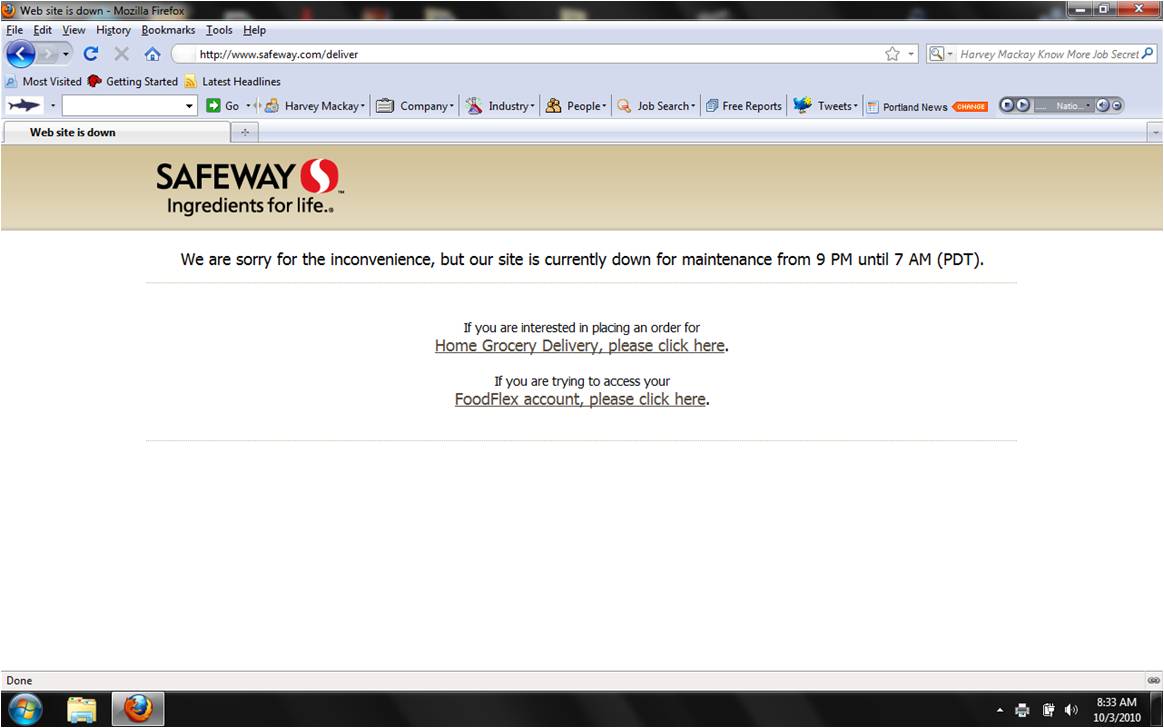
As a person who consumes groceries, I was interested, so I went directly to my computer and logged onto their web site. This is what I found:

We are sorry for the inconvenience, but our site is currently down for maintenance from 9 PM until 7 AM (PDT).

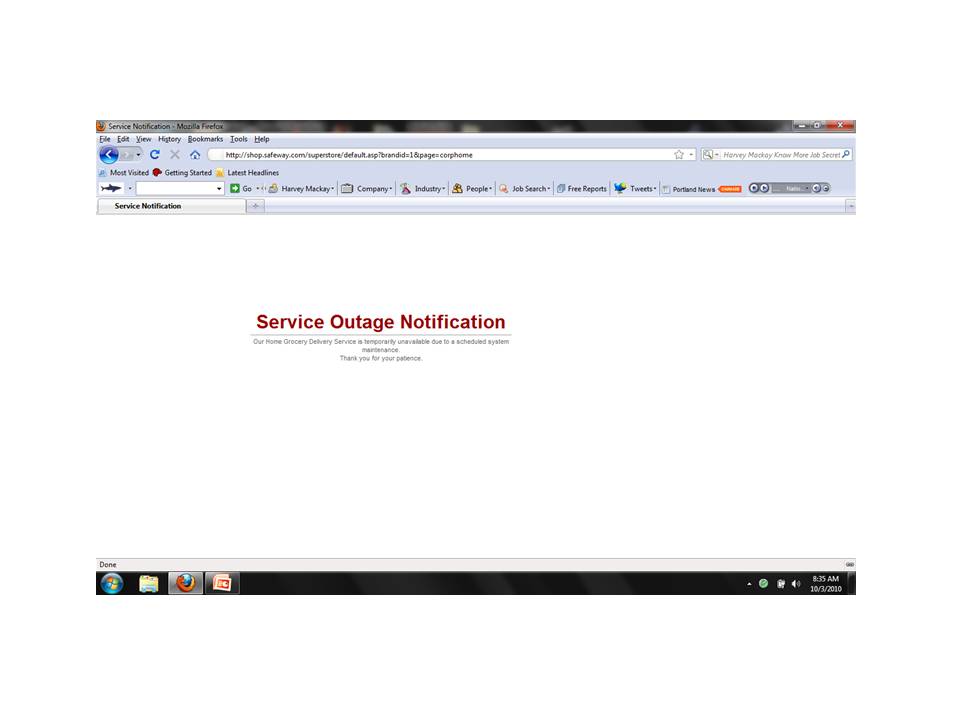
It was 8:35am. In an effort to take care of delivery customers, there was a link, but it went to this:

Our home delivery system is temporarily unavailable due to a scheduled system maintenance. Thank you for your patience.

While the folks in Advertising were arranging to spend thousands of dollars to invite new customers to their web site, somebody in IT was scheduling a maintenance activity that took the site down. And if they figured that the maintenance would be over by the time most Oregonian readers were up and reading the paper, they figured wrong.


___________________________________________________________________________

Email Phil Bernstein here.

Like what you’re reading? Sign up for Phil Bernstein’s free advertising and marketing e-newsletter here.

Become a Phil Bernstein Portland’s Advertising Expert Facebook Fan here.

Delta’s New Campaign Misses The Point

I’m a Delta Airlines frequent flyer. Not quite George-Clooney-“Up In The Air”-frequent, but I average two round-trips a month on the airline, have managed to hit Gold Medallion status, and have an outside shot at Platinum.

A week ago, I was one of 180 passengers who had to hike from one terminal to another at Minneapolis-St. Paul airport because Delta had parked its plane at the wrong gate. This was the third time in 2010 this has happened to me on a Delta flight.

So I was amused and astonished to see  see this ad in today’s morning paper:

The substance of the message is terrific: Delta is bringing back their “Red Coat” agents to assist passengers who need help rebooking or otherwise solving problems. This is a good thing.

The problem with the ad is its self-congratulatory tone, which directly contradicts the experience of anyone who’s ever flown Delta.

You should be able to depend on an airline to make your trip easier, no matter what’s going on in the industry — those are our concerns, not yours.

Well, yes.

But this is not some secret information that only Delta knows. In fact, there is considerable evidence that in terms of dumping the industry’s problems on their customers, Delta has been one of the worst offenders for years.

Delta has consistently ranked near the bottom in national customer-satisfaction surveys. Their Skymiles frequent-flyer program is considered one of the very-worst in its availability of free tickets. Google “Delta Sucks”, and you’ll find page after page of horror stories.

Passengers really don’t like Delta Airlines.

There is significant evidence that Delta’s senior management recognizes the problem, and is taking steps to address it. The return of the Red Coats is certainly a signal of that. If the campaign told its customers, “We heard you, we know we have a problem, and we’re fixing it”, Delta would deserve applause.

Instead, this ad attempts to position Delta as if they’ve always led the charge for good service. Which reminds one of Judge Judy Sheindlin’s timeless advice:

Don’t pee on my leg and tell me it’s raining.”

Until Delta proves to its passengers that it is committed to improvement, this is one message that will be met with derision.

______________________________________________________________________________________________________

Got a question? Wanna argue? Email Phil Bernstein here.

Sign up for Phil Bernstein’s free advertising and marketing e-newsletter here.

Become a Phil Bernstein Portland’s Advertising Expert Facebook Fan here

When You Have Only One Chance to Persuade

There’s been a steady drumbeat for months about media dollars moving from “traditional” media to online. According to a recent report by Outsell, a California company that tracks the information industry, online advertising spending will exceed print advertising for the first time this year.

Here are some predicted numbers from Outsell:

  • $120B  Online/Digital
  • $112B   Print/Magazine
  • $  60B   TV
  • $  24B   Direct Mail

But the stampede to digital only goes so far. Media Blogger Tom Taylor reports that as the General Election approaches, political types are sticking with television:

Six weeks to go, says Borrell Associates, and digital media might get about 1% of the total political ad spend in this election cycle. Just 1%, versus the 65-70% that is funneled into TV. Borrell’s figuring a total commitment to digital this year of about $45 million, which is double 2008, but still a minuscule part of most candidates’ budget. Why so little going that way, after the Obama success with online in 2008 and the Tea Party social networking of the last year? Borrell theorizes that political consultants are sticking with proven techniques, and they know TV works. There’s relatively little research about doing political advertising online.

There are a number of ways to interpret this, including:

1. Some political operatives may just be scared of the unknown. They will continue to do what they’ve always done until someone forces them to do otherwise.

2. In some cases, campaigns have tried to use the “free” side of digital — videos on YouTube, tweets on Twitter, and Facebook “fan pages” — in the hopes that something will go viral. As Alabama Agriculture Commission candidate Dale Peterson found earlier this year, viral doesn’t always translate into votes. He got 1.5 million views on YouTube, but finished third in the Republican primary.

3. The fact that online spending doubled could mean it’s just a matter of time before digital dominates political advertising, too.

But the thing to keep in mind is that political advertisers are in the pure persuasion business. They need to force their way into the consiousness of people who may not be thinking about them, and convince them to take a particular action on a particular day. They only have one chance to get it right — Tuesday, November 2 — and if they fail, they will be unemployed on Wednesday.

With one chance to persuade, these people are still choosing intrusive old media — television wins this election in a landslide, 65 to 1.

______________________________________________________________________________________________________

Got a question? Wanna argue? Email Phil Bernstein here.

Sign up for Phil Bernstein’s free advertising and marketing e-newsletter here.

Become a Phil Bernstein Portland’s Advertising Expert Facebook Fan here