Have You Tested The Funnel?

The law firm had recently cancelled its radio and television advertising.

“We got great results from the campaign for a long time,” the managing partner told me. “But it hasn’t been working the last three or four months.”

TV and radio salespeople must keep customers from confusion
Photo by mimagephotos

The personal injury firm had been advertising an “accident book”  — a short book on what to do in the event of an auto accident. Radio listeners and television viewers were directed to a special website where they had to enter their name, address, and email address in order to get the book.

In the internet marketing world, this is known as a Lead Magnet. 

Back in my hotel room that night, I decided to test their system. I went to the website, filled in my information, and hit Submit.

Here’s what I saw next:
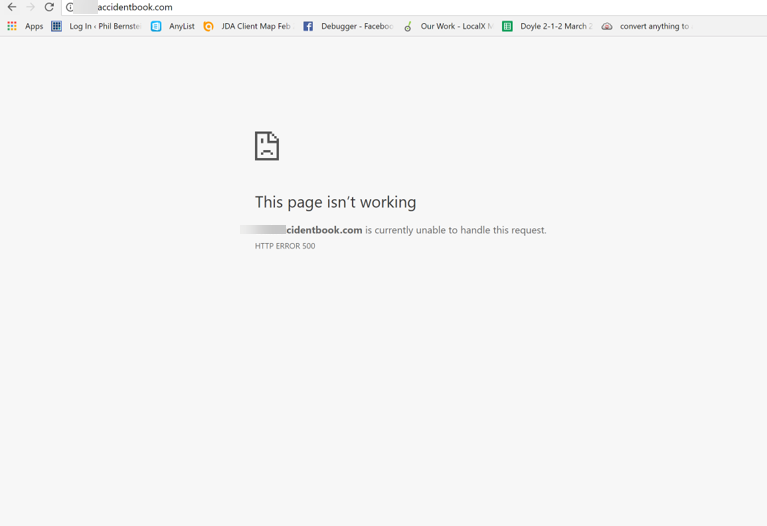
Salespeople should check the sales funnel before the TV or radio campaign launches
Identifying details have been deliberately blurred.

I tried three times to order the book, and got the same screen each time. When I met with the law firm again I showed them a screen shot, and asked, “How long has this been happening?”

The managing partner admitted he had no idea. “I guess we haven’t checked things in a while.”

“I can’t prove it,” I replied. “But there’s a pretty good chance your radio and TV ads were working fine. If the first exposure they have to your firm is a non-working web page, they’re not going to call you, and you’ll never know who they are.”

That same week, in the same market, I met with the owner of a moving and storage company. They had all the customers they could handle — what they needed was employees. They’d been running recruitment ads online, without much success.

Preparing for a follow-up meeting, I took a look at the company’s “Careers” page. It looked like this:
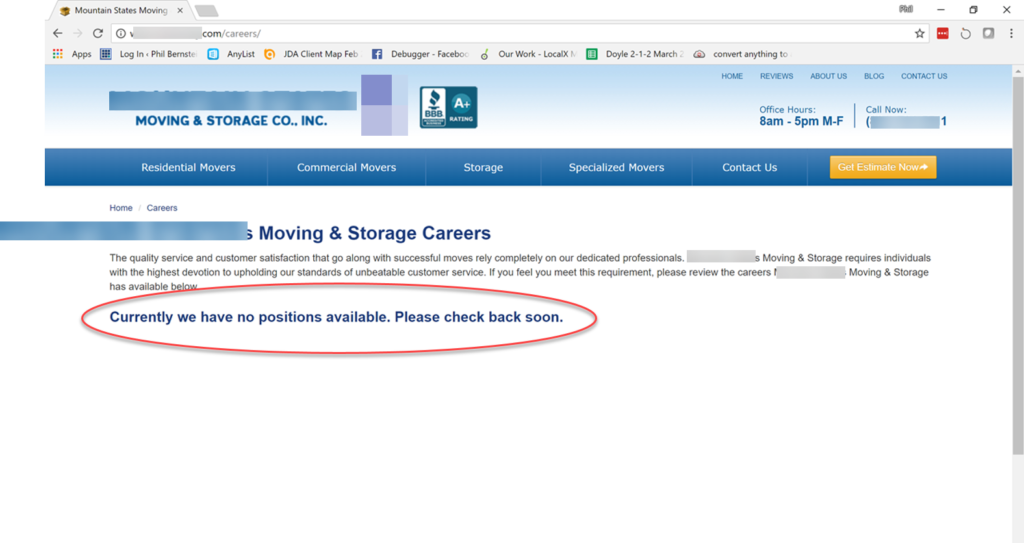
Radio and TV salespeople should check the sales funnel
Identifying details have been deliberately blurred.

The company had lots of positions available. But visitors to their website wouldn’t know that. 

These sorts of oversights are distressingly common. 

  • I’ve seen incorrect phone numbers in ads.
  • Links from social media go to “404 Not Found” pages.
  • Banner ads for specific products go to the advertiser’s home page, which has no information about the product being advertised.
  • “E-commerce” sites make it hard for people to find items or make a purchase.

Potential customers and applicants follow the call-to-action, and wind up confused.

Confused people do nothing.

And the advertiser shakes their head and says, “I tried [name of your medium] and it didn’t work.”

As advertising sales professionals, we can say, “Our responsibility is to bring the prospects to their door. If they can’t convert them, it’s not our fault.”

I’ve talked to plenty of salespeople and sales managers who have taken that position. They’re not wrong.

But when the advertiser cancels the campaign, the money comes out of your pocket no matter whose fault it was.

My position is this: If you’re an Account Executive, your responsibility is to execute. That means putting in the extra time and effort to make sure the sales funnel’s working properly. 

Before the ad goes on the air, ask, “What’s the call-to-action? What is the prospect expected to do as a result of seeing or hearing the commercial?”

Then, pretend to be a customer. Take the action.

  • If the commercial directs people to a website, go to the site. What do you see? Does the site pass the “Mom Test?” Will prospects know what to do next, or will they be confused?
  • If there’s an inquiry form on the site, fill in your information and submit it. What happens next? How long does it take to get a response.
  • If the ad tells people to call a phone number, grab your cell phone and call it. Does the right department answer?
  • Does the store have the merchandise in stock? Do the clerks know where it is?

Do this before the ad hits the air. If you find a problem, alert your client. If necessary, delay the campaign launch until the problem can be fixed.

In the short term, this will be an inconvenience, and might even cost you some revenue if a schedule has to be moved. 

But in the long term, you’ll have a happier client who trusts you to give them advice that gets them results.

[reminder]

After a Huge Screw-Up, How to Handle the Aftermath

Inevitably, you or your company will screw up. Maybe today, maybe next week, maybe six months from now. How you respond will show what you’re made of.

Sales advice: take responsibility
Photo by Elnur

When Dr. David Dao was beaten and dragged off a United Express flight last April, United Airlines’ upper management very publicly botched the initial response to the incident. Their reputation has not yet recovered.

When two African-American men were asked to leave and then arrested at a Philadelphia Starbucks, that company was similarly under the microscope. Unlike United, Starbucks’ management has performed impressively.

What’s the best way to respond when things go south? Customer support expert Len Markidian points to Disney’s approach to service failures:

Their approach to service recovery is a five-step process, easily remembered with the acronym H.E.A.R.D:

  • Hear: let the customer tell their entire story without interruption. Sometimes, we just want someone to listen.
  • Empathize: Convey that you deeply understand how the customer feels. Use phrases like “I’d be frustrated, too.”
  • Apologize: As long as it’s sincere, you can’t apologize enough. Even if you didn’t do whatever made them upset, you can still genuinely be apologetic for the way your customer feels (e.g., I’m always sorry that a customer feels upset).
  • Resolve: Resolve the issue quickly, or make sure that your employees are empowered to do so. Don’t be afraid to ask the customer: “what can I do to make this right?”
  • Diagnose: Get to the bottom of why the mistake occurred, without blaming anyone; focus on fixing the process so that it doesn’t happen again.

Based on this criteria, how has Starbucks done so far? 

  • Hear: Within days of the incident, Starbucks CEO Kevin Johnson traveled to Philadelphia and met personally with the two men. He also met with Philadelphia’s mayor and police commissioner.
  • Empathize: Prior to the meeting, Johnson issued a statement saying the incident had “a reprehensible outcome.” Referring to the two men, Starbucks Chairman Howard Schultz told CBS News that “the reason the call [to the police] was made is because they were African-American.”
  • Apologize: Both Johnson and Schultz apologized publicly to the men. Johnson also did so in person.
  • Resolve: Starbucks quickly escalated the response to the highest level of the company. Schultz told Gayle King at CBS This Morning that they have asked the men, “What can Starbucks, given our resources and the capabilities we have — they have an interest in real estate — what can we do to help advise them and support their own business endeavors?…Given the resources we do have, we will provide them with a foundation of learning, and provide them with an opportunity to be part of our company, either directly or indirectly, as a result of this situation.” It’s fair to surmise that at the very least, money will be changing hands.
  • Diagnose: Starbucks has announced plans to close 8,000 company-owned stores for several hours of racial-bias training, at a cost that’s been estimated at as much as $12 million. They clearly don’t want anything like this to happen again.

Shultz also met with the store manager who called the police. Although he made it clear she is no longer with the company, Starbucks has avoided the temptation to blame the whole thing on her. 

Here are some tips to follow the next time you or your company disappoints a customer:

  1. Make a point of accepting all of the blame, even if you believe your customer is partially at fault.
  2. Don’t point fingers. Starbucks didn’t publicly blame the two men for insisting on staying, or the police for making an arrest. Your client doesn’t care that Corporate changed the policy, or that your production department was shorthanded, or that the sales assistant misfiled the paperwork.
  3. Make it right. Give the client much more in return than they lost — and do it quickly.
  4. Once the dust settles, figure out what caused the problem, and how you can prevent it from happening again. 

Your best opportunity to demonstrate your customer service chops is when something has gone horribly wrong. With the right mindset, you can correct a big mistake and position yourself as a true professional.

[reminder]What’s the worst customer service fail/mess you’ve ever had to clean up? What did you do to resolve it, and what did you learn from the experience?[/reminder]


When You Lose a Sale to the Competition

The sale was in the bag.

From the first contact through the presentation, the customer was engaged, animated, and receptive to your ideas. All signs pointed to a signed agreement.

Instead, the client handed the business to your competition.

sales lessons from skeptical businesspeople
photo by Kurhan/dpc

Sales Advice: What’s your next move?

Your first impulse may be to argue. Resist it, even if you think the customer’s making a mistake. You won’t win the argument; going into attack mode guarantees you’ll never have a chance to win the account back.

[shareable]Never blame your customers when they don’t buy from you. [/shareable]

It’s your responsibility to convince them. You didn’t. So learn something.

What can you do differently next time? 

You need to ask some questions, starting with this one: “Is the decision final?”

If it’s final, accept it. You’ve lost this round. Your job now is to gather enough information so you know what went wrong, and can position yourself more effectively the next time an opportunity arises.

What can you change to generate a different result?

Say this:

Thanks for considering us. I’m sorry it didn’t work out, but my competitor’s going to do a great job for you. 

It will be painful to say this. Say it anyway.

I respect your decision, and I won’t try to change your mind. Could I ask you a couple of questions?”

Asking permission first lowers resistance. 

Once they grant permission, the client is obligated to answer. Here are your questions:

1. “What made you decide to go with the other guys?”

2. “If we had offered the same thing, would you have gone with us?”

No matter what the answer is, don’t  try to reopen the sale—you promised.

After the conversation’s over, review the whole sales process in your mind. What did you miss? What questions can you add to your process to make sure you won’t miss it again?

A lost sale stings. Make sure you learn something from each one. Turn lost income into tuition on your sales education.

[reminder]What’s the toughest sales defeat you’ve faced? How did you handle it?[/reminder]

The One Thing Your Prospects Can’t Ignore

You’ve got a great idea for a prospect. What’s the best way to communicate it?

Sales advice: nothing beats a face-to-face call.
Photo by Jeanette Dietl

I know. You’re crazy busy.

Between prospecting, internal paperwork, make-goods, and that new initiative corporate just dumped on you, there aren’t enough hours in the day.

So when you’ve got something big to propose to a client, email looks awfully tempting.

You could meet in person with them. But that means getting in the car, driving across town, and cooling your heels in the reception room before you get 15-20 minutes to explain the whole thing.

The other option: email. Attach the Powerpoint to the message, press “Send”, and call them later to make sure they got it. Email’s fast, it’s easy, and you don’t have to pay for gas or parking.

Think twice before you hit “Send.”

A study by Professors Mahdi Roghanizad (Western University) and Vanessa K. Bohns (Cornell) found that an in-person appeal was 34 times as persuasive as an email.

The researchers instructed 45 participants to each ask 10 people to complete a brief survey. There were 450 requests in all.

One group made the request by email, and the other group made the “ask” face-to-face. They used identical scripts.

Both groups were asked to predict in advance how successful they’d be. Both groups expected to persuade about half their prospects to complete the task.

The Results

The “face to face” group had a 71.5% “close” rate. 

The emailers were…let’s just say overestimated their abilities when they made their predictions. In real life they persuaded only 2.1% of their prospects to complete the task. 

https://www.youtube.com/watch?v=Jdv2Wp9MzY0

[shareable]The one thing your prospect can’t ignore is a human body in their office. [/shareable] 

To review:

“Face to face” persuaded seven out of ten. Email converted less than one. 

As Vanessa Bohns put it in Harvard Business Review

You need to ask six people in person to equal the power of a 200-recipient email blast.

It’s interesting that the emailers expected to do much better. Bohns has this explanation:

Why do people think of email as being equally effective when it is so clearly not? In our studies, participants were highly attuned to their own trustworthiness and the legitimacy of the action they were asking others to take when they sent their emails. Anchored on this information, they failed to anticipate what the recipients of their emails were likely to see: an untrustworthy email asking them to click on a suspicious link.

Indeed, when we replicated our results in a second study we found the nonverbal cues requesters conveyed during a face-to-face interaction made all the difference in how people viewed the legitimacy of their requests, but requesters were oblivious to this fact.

Other reasons email may be less effective:

  • Those who read it may not read it closely. Busy clients may glance at the screen while multitasking, misinterpreting or completely missing important points you tried to convey.
  • Your personality is missing. Text on the page can never convey the thought, enthusiasm and passion you put into your proposal.
  • It’s easily ignored. Prospects get dozens, and sometimes hundreds, of emails every day. It’s easy for them to scroll past yours or delete it without reading it.

There may be times in-person just won’t work — not enough time, lack of client availability, or distance.

In those cases, you can try be “face-to-face” through the power of online video. 

  • You can present your proposal online with a service like Zoom. With a webcam and a little bit of practice, you can let your client see your face and hear your voice…and have some control over the way they consume the content. 
  • Record a screencast of your presentation, upload it to YouTube, and email them a link. This is less effective than a “live” web presentation because you lose the ability to have a real-time conversation. But it does transmit some of your enthusiasm and personality.One way to make this a bit more effective is to call the client on the phone after sending the email. Tell them you just want to make sure the link is working properly, and ask them to click on it while you’re on the phone. This way, you know they at least watched the beginning.
  • Use video email to cut through the email clutter and deliver your message with your face and your voice. There are several paid video email services out there — I am partial to BombBomb.

All three of these options will give you better results than a text-only email. 

But if you can carve out the time and have the access, nothing beats the persuasive power of an in-person conversation. The one thing your prospect can’t ignore is a human body in their office — your body. 

If you need to persuade… really persuade…a face-to-face presentation beats email 34 to 1. 

Get your fingers off the keyboard and your butt behind the wheel.

[reminder]

How to Think Like a Rookie — And Why You Should

A question for veterans: When you were brand-new to media sales, what did you do when someone gave you a new idea?

You tried it, because you didn’t know any better.

What do you do with new ideas now?

Salespeople can learn at any age.
Photo by JackF

The Day I Made $3600 Because
I Didn’t Know Any Better

In 1995 I was a rookie sales rep for 1190 KEX Radio in Portland. I had no account list. I was hungry. I was willing to talk to anyone who’d talk to me.

One day I was driving through the Portland suburb of Tigard, and noticed a store on Highway 99 called The Furniture Barn. I walked in and introduced myself to the owner.

I asked him about the Oregon State University football helmet on the wall behind the counter. It turned out the owner was a huge Oregon State athletics fan…and my station carried OSU Beaver football and basketball.

The next day I came back with an OSU radio sponsorship package, and the owner signed a contract for $15,000.

When I got back to the station with my signed contract, my more-experienced co-workers greeted me with a combination of congratulations and envy.

Congratulations on a big sale. Envy because they had all passed on the opportunity to visit Furniture Barn. They all knew what I didn’t: 

It was the fifth store in seven years to move into that space. The other four had gone out of business.

Everyone knew they’d never buy…except me.

The other AE’s shook their heads. “We all drove by Furniture Barn and ignored it. Phil didn’t know any better, so he just walked in and got the money!”

Furniture Barn went out of business the following year, but not before paying for their football sponsorship in full.

My commission on this didn’t know-any-better sale: $3600.

A few years later one of those co-workers reminded me of that sale and asked me… “If you’d known about that building’s history when you drove by, would you have walked in?”

My reply: “No way.”

Experience Changes Us
And Not Always For the Better

When we were brand-new, we’d try anything somebody suggested.

If we encountered an interesting sales approach in a book or a podcast, we’d use it to see what might happen.

If we saw a store that looked interesting we’d walk in.

If a sales trainer suggested rewriting a proposal, we’d rewrite it.

We had nothing to lose.

My favorite word in the English language is YouNeverKnow.” — Former St. Louis Cardinals Pitcher Joaquin Andujar.

After a while, we gained some experience. We’re more cautious now. We’re a little cynical. We have The Curse of Knowledge:

  • “I’m not calling that store. There’s no way they’ve got enough money to advertise.” 
  • “That idea will never work in this market.”
  • “We don’t do it that way here.”

We stop trying new things because we’re comfortable with our current approach. We skip calling on businesses because of the way their building looks from the outside. We ignore advice because we’ve heard it all before.

Then some rookie who doesn’t know any better comes along and takes our money.

You Can Think Like a Rookie

If you’ve been at this for years, and you’re not making the money you want to make, it’s time to shake things up. 

Declare yourself a Rookie for a Month. For the next four weeks:

  • When you read a strange idea in a sales book, and you think it’d never work… try it at least three times. 
  • If a sales trainer shows you a new approach, and it’s radically different from the way you normally do things, use it. Do it quickly, before you have time to talk yourself out of it.
  • If you drive by an interesting new business, pull over and walk in. Even if it looks too small and shabby to advertise on your station.

Suspend your disbelief for just a little while, and you just might make some money.

I mean, hey…YouNeverKnow.

[reminder]What’s the most unusual new business client you ever called on?[/reminder]