Why Don’t Your Prospects Want to Meet With You?

What does “I’m not interested” really mean?
Photo by Konstantin Pelykh/dpc

A subscriber recently wrote to me about her struggle to turn cold calls into appointments. She is new to the radio sales business, and has been surprised and a bit disheartened at the rejection she’s faced.

I have never done sales before and while I have no issues with being assertive, I keep finding myself struggling to assure the clients that our radio station is where they want to be before that irritating phrase, “We’re not interested… click[phone hanging up!].”

I believe in this station and the amount of ears we reach with just one broadcast/advertisement, but I am not a rude person by any means and almost feel… well rude when I try to push past that initial turn down! How do I overcome this feeling and open myself up in the sales world?

It’s tough to tell what’s happening when it’s reported in an email, but I’ve made and witnessed enough cold calls to take some educated guesses.

What “Not Interested” Actually Means

One possibility you should not discount: they are genuinely not interested, and nothing you can say will convince them to meet with you. You have zero chance with these people, and your best bet is to move on to someone else as quickly as possible.

More likely, this is what phone sales expert Art Sobczak calls the Triple-R: Resistant Reflex Responses. “They are attempts to get salespeople off the phone. And they usually work. So prospects keep using them.”

How do you tell the difference? Sometimes you can smoke out the answer with a couple of well-placed questions.

In his book Smart Calling: Eliminate the Fear, Failure, and Rejection from Cold Calling, Sobczak talks about an approach that’s worked well for one salesperson:

Inside Sales Rep Jeff Wirsling responds, “That’s fine, Mr. Client. In the event something changes with your current service/supplier, would it be all right if I stay in touch?” Then he questions what would need to change, placing him into a sales conversation.

This won’t work every time. It might fail most of the time.  But if it works on, say, a third of your “not interesteds”, it can significantly increase the number of productive sales conversations you have.

Obviously, if the customer hangs up or won’t give you permission to stay in touch, you have your answer and can move on without guilt. It’s worth a shot to see if the client is… worth a shot.

Sales Skills: Preventing “Not Interested”

A very good, experienced seller once told me that 20% of the people he called weren’t going to interested no matter what he said, and 10% were interested enough to give him an appointment even if his approach wasn’t very good. The other 70% might be interested… if he said the right things when he called.

How do you increase the odds of convincing that 70% in the middle?

It helps to open the conversation with something that gives them a reason to be interested.

Take a good look at your initial approach on the phone. If you are telling people you want to come out and talk about your radio or television station, or that you want to talk to them about advertising, you increase the odds of hitting a brick wall. Most businesspeople aren’t going to care about your radio station, and they aren’t interested in “advertising”.

[shareable]Bernstein’s Postulate: Nobody cares about your station. Talk about what THEY care about[/shareable]

What do they care about? Here are some topics that are more likely to get them interested

  • More traffic to their website
  • More customers walking in the door
  • More sales

Look at scripting an opening that tells them that you have some ideas to help them find more customers and make more sales. An effective opening quickly communicates three things to the prospect:

  1. There’s a reason you’ve decided to call them. Examples include learning of a new product or location. Perhaps you saw or heard their ad on a competitor. Or you were in their store and saw something that caught their attention.
  2. You have something that could be valuable to them — and that’s not your “First Quarter Fire Sale Package”. It’s an idea to help them accomplish something important to them.
  3. You know something about them already, but need to know more.

Here are some examples of the form, with calls made by a fictional Account Executive at my old employer:


“Mr. Swanson, this is Margaret Dumont with KEX Radio. I read about your upcoming expansion in The Business Journal, and have some ideas that can bring more customers to your new location. I’d like to meet with you early next week to find out a little more about what direction you’re heading.”

or ”

“This is Margaret Dumont with KEX Radio. I saw your ad in the newspaper this morning, and think you may be missing an opportunity to generate more leads, and more qualified leads. I’d like to meet with you next week to find out a little more about where you’re trying to go with the campaign.”

or

“This is Margaret Dumont with KEX Radio. I read your press release online the other day, and have some ideas to turn the excitement about your new product into sales and revenue. I’d like to meet with you next week to find out a little more about the problem the product is designed to solve.”


In three sentences, the caller  identifies herself and then quickly turns the focus of the call to the customer and how the customer might benefit from meeting with her. It sounds different from what most of the other salespeople say, and can buy you a few seconds to convince the prospect that you are different.

Will this work on everyone? Emphatically not. “Not Interested” has always been part of sales and always will be. And there is more rejection in Year One of a sales career than in any other — a big reason why so many sales rookies never make it to Year Two.

The best way to reduce the number of “Not Interesteds” is to open the conversation with something with something your prospect will find interesting.

[reminder]How have you turned “Not Interested” into a productive sales conversation?[/reminder]
How to Give Yourself a Quick and Easy Raise

“There are two reasons why customers don’t buy more product from you:


sales skills: make more money byn upselling
Photo by thinglass/dpc

A few days ago I got an email from Terry Douglas, who reads my “Sales Doctor” column in Paint Dealer/Paint Contractor Magazine. Terry sells a product called Envirobrush — a paint brush with replaceable bristles.

He lamented the lack of upselling at the dealer level:

Many dealers are missing out on profitable sales because they do not try to sell sundry items. Many years ago I had a paint store with a talented lady who paid her wages on the extra profit earned by her sales of paint sundries.

It reminded me of a story from my distant past — a sales lesson I never forgot:

My First Upsell: A Sales Skills Acquisition Story

Long ago and far away, I worked for a record store — Everybody’s Records, Tapes, and Video, to be exact. My long-haired, bearded colleagues and I stood behind the counter and rang up sales on the cash register when people approached. Occasionally, we directed customers to the Grateful Dead section.

It didn’t pay well, but we didn’t work all that hard, either.

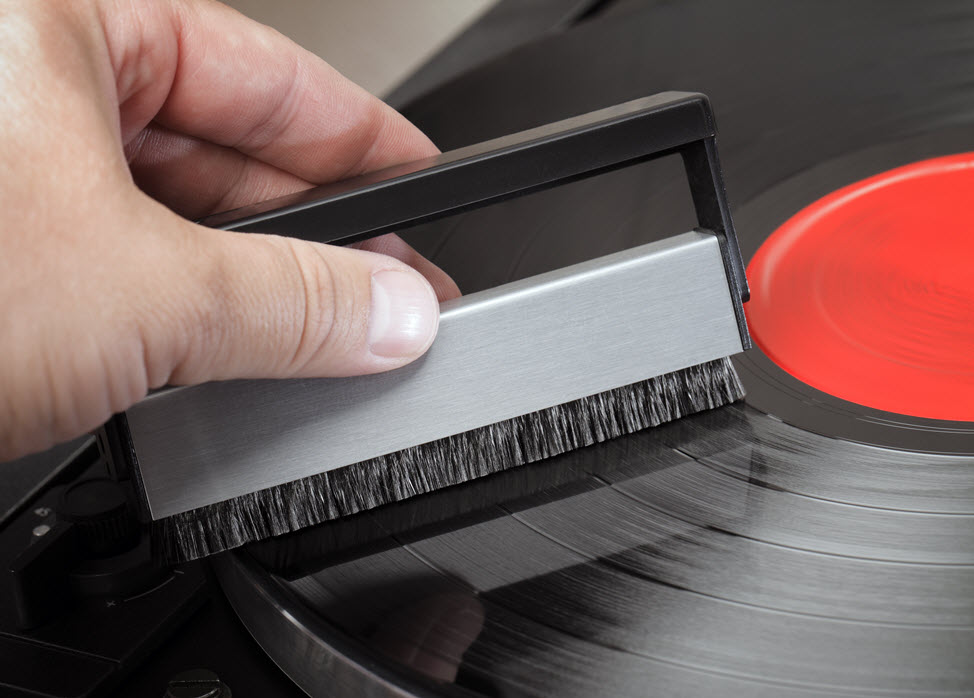
One day our manager told us that Corporate wanted us to sell more accessories — in particular, record cleaners. A record cleaner, for you youngsters, was a brush that would clean the dirt off a record before we played it.

record brush for upselling
Photo from Stocksnapper /dpc

Corporate wanted us to offer a record cleaner to each customer as they made their purchase.

Our initial reaction was negative — we weren’t going to let THE MAN tell us how to act behind the counter. But I got curious, and wondered what would happen if I tried it.

One day a woman walked up and laid an Al Jarreau album on the counter. I steeled myself, and spoke.

Me: Do you need a record cleaner to go with that?

Her: What’s a record cleaner?

I took one out of the box and showed her how it worked. She bought it, more than doubling the $7.99 transaction.

She bought it! 

I was so excited I asked the next patron. He declined. The one after that told me to shut up and bag his album. But the next one bought one.

Over time, I learned that one out of every four or five customers would buy a record cleaner — but only if I asked.

Terry Douglas of EnviroBrush concurs. People buy his product when someone shows it to them… sometimes even if they don’t have an immediate need.

Dealers report that when a customer replies that they do not require a paint brush with their paint purchase about 50% buy when shown the Envirobrush.  We even have consumers buying even when they are not painting yet.

If you sell on commission, the fastest way to give yourself a raise is by selling more to the folks who are already buying from you. You’ve already sold them on you, and on your station — all you have to do is convince them to buy one more thing.

When I sold radio, I  found that many customers — not all, but many — would consider an additional purchase priced at around 10% of what they’d just agreed to buy.

How can this work for you? A $5,000 per month radio or television schedule could easily be supplemented by an additional $500 per month digital plan.

If the relationship  is  already “tradigital” — your client is already using your traditional and online tools — you might enhance the plan by adding one more show to the mix.

“After all the toil and trouble to get to the target market, we do nothing more to leverage it. Here you are, finally, one-to-one with your target market and you do nothing more with it. In that call you have any number of opportunities to maximize the relationship.” Jim Domanski, Add-On Selling: How to Squeeze Every Last Ounce of Sales Potential From Your Calls

There’s money to  be made in add-on selling, but only if you ask.

Can you ask?

Will you?

[reminder]


The Most Powerful Confirmation Tool You’ve Never Tried

Why don’t customers show up on time for meetings?

sales skills: handwritten notes make meetings happen
photo by Gajus/dpc


Over the past week, I’ve spent nearly 90 minutes waiting for clients who weren’t at their offices or stores when we arrived.

  • One forgot about the meeting and stayed home from work.
  • One wrote 10:00 on his calendar when we thought it was at 9:30.
  • One told us he had been waiting for us at the appointed day and time — a week earlier.

The account executives who had arranged the meetings were frustrated and embarrassed. They’d all been in touch with their clients in the days leading up the the appointment — some by email, some by phone.

All had, at my request, called the clients on the phone the day before or the day of to confirm the meeting.

It wasn’t enough.

Sales Skills:
It’s Time to Bring Back a 19th Century Tool

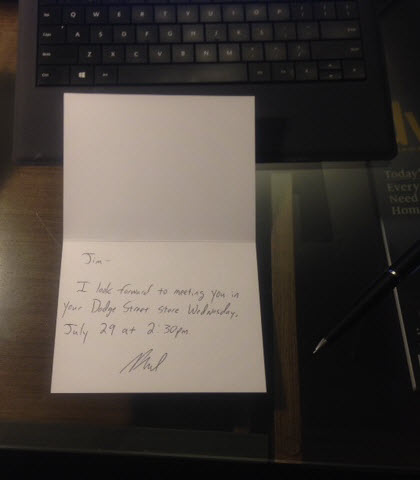
Those of us who remember selling in the 90’s or earlier were taught to send handwritten thank-you notes after meetings. I learned through experience that a handwritten note before a meeting increased the odds that the meeting took place.

It’s time to bring the handwritten note back.

The format is simple: one sentence that includes the date, time, and location of the meeting. It goes into an envelope with a stamp.

handwritten note to confirm a sales meeting
Photo by “Doctor” Phil Bernstein

Email is an ineffective way to confirm a meeting. Your prospects get dozens, and sometimes hundreds, of emails every day. They can’t read them all, and they don’t.

A phone message left with a gatekeeper has a 50/50 chance of being delivered.

As for voice mail… don’t get me started. An increasing number of otherwise-responsible businesspeople don’t bother listening to theirs.

The handwritten note beats email because it’ll be the only one your client gets that day. Unlike voice mail or email, your note will be noticed… and opened.

It gets past the gatekeeper and lands right on your prospect’s desk.

Three Tips To Get Maximum Power From Your Note

1. Send the note at least two days before the meeting. Even in town, it’ll take that long for the Postal Service to deliver it.

2. Always include a business card — in case your client has a conflict, the card gives her an easy way to contact you to reschedule.

3. Handwriting the address and putting a real stamp on the envelope makes it look more personal, and increases the chance it’ll get opened quickly.

It’s harder than ever to get your prospect’s attention and time these days. The handwritten note may be a 19th-century technology, but it’ll make a meeting happen in the 21st century.


[reminder]

How Media Sellers Can Profit From Supreme Court Rulings

Last month, the United States Supreme Court made same-sex marriage legal throughout the United States. If you sell advertising, there’s money in this.

Gay marriage is a media sales opportunity
Photo by tashatuvango/dpc

Before the ruling, Business of Fashion reported that the economic impact of gay marriage was huge:

Out Now Consulting, a marketing agency specialising in targeting gay and lesbian consumers, estimates that if same-sex marriage was legalised in all US states, it would generate over $1 billion of new matrimonial spending within one year. Out Now’s research also revealed that when civil partnerships were legalised in the UK in 2006, the spending impact of lesbian and gay marriages delivered a £130 million ($209 million) boost to the UK economy in the twelve months that followed.

Now it’s legal in all 50 states.

I’m not here to argue about religion or politics — if gay marriage goes against your religious or moral beliefs, that’s your department. But if you’re okay with this development, there’s a rapidly growing market for:

  • Jewelers
  • Wedding halls
  • Florists
  • Formal wear shops
  • Restaurants and caterers
  • Travel planners and hotels

During the same week as the gay marriage ruling, the Supreme Court solidified another media sales opportunity by preserving the Affordable Care Act. Now that ObamaCare appears to be the law of the land, businesses who were paralyzed by uncertainty can make plans and take action.

One category with significant potential: insurance brokers.

In South Carolina I recently met with two different companies who specialize in helping individuals and families qualify for insurance tax credits and subsidies. With those subsidies and credits now firmly in place, more companies are likely to move into the field.

Meanwhile, many insurance companies have announced plans for significant individual-market rate hikes in 2016. When the premium notices come out in a few months, they will cause a lot of people to start shopping for new policies.

All of these businesses will need to reach out to these new customers. Your traditional media and digital tools can put them in front of the right people — but only if you call them.

[reminder]


How to Put The Client’s Mind Behind The Wheel

In Montana, I once sent a television salesperson to a doctor’s office for a white coat.

sales skills: you can wear the white coat for a spec ad
Photo by Oleksandra Voinova/dpc

 We were working on a proposal for a doctor who wanted to market a procedure she had developed. I’d written a script in which the doctor would deliver the message herself on camera, and wanted to show her how the ad might look.

For that, we decided to produce a version of the commercial in advance of the presentation — a “spec ad”.

Of course, we couldn’t ask the doctor to appear in the spec — that would’ve spoiled the surprise. So the AE went to the doctor’s office and borrowed a lab coat.


Sales Skills: The Power of the Spec Ad

sales skills: spec ads put the client behind the wheel
Photo by ellisia/dpc

Spec ads are a very powerful way to move an advertising prospect toward a buying decision.

Why do they work so well? One of the best explanations comes from an old radio sales training recording by Jim Williams*:

What we’re doing is a thing called demonstration selling… it ranges from the tiny nibble of peach at your outdoor farmers market by the peach vendor to the one-ounce tube of shampoo they hang on your doorknob to the showy exhibition of all the uses from slicing and dicing of those famous knives on TV.

When you test drive a car, slip on new shoes and walk about or study the floor plan of an unbuilt home, you are involved in one of the many forms of demonstration selling.

When you enter your client’s office and play a cassette tape as part of your presentation you are doing demonstration selling. The words and sound that come from your tape recorder, regardless of content, are a demonstration of how radio works.

Thoughts come out of a small electric box and into the brain of the listener. That is the essence of radio. You are using radio to sell radio.

The tools have changed since Williams recorded those words. Cassettes are gone, replaced by digital files you can play for your client on an iPhone.

The principle is the same in the Age of the Smartphone as it was when we operated on tape: use radio to sell radio. Use TV to sell TV.

[bctt tweet=”Technology has changed. Human nature hasn’t. Spec ads should be in your sales arsenal.”]

In the demo we produced for the Montana medical clinic, the AE played the role of the doctor. It was not award-winning work — the station Production Department was very busy with paying clients, so they banged ours out quickly.

When we presented, production quality didn’t matter. The doctor immediately imagined herself in front of the camera. She went back to her office to make sure she had the money for the campaign, and signed the contract the same day.

Spec ads work for the same reason that test drives work on the car lot: customers are beginning to experience “ownership” of the product. You are putting them, mentally, behind the wheel.

You can’t make a commercial in advance for every proposal — production departments are busy and frequently undermanned. Pick your spots carefully, make them count, and take your Production Director to lunch every now and then.

Deployed properly, spec ads will move your prospects one step closer… a BIG step closer… to buying. Use ’em.

[reminder]

* A tip of the hat to my friend Rod Schwartz for introducing me to Jim Williams, whose work has held up quite well in the decades since it was recorded. Rod has digitized some of Williams’ material, and you can listen to it here.