How to Pack Your Briefcase for a First Sales Call

It’s finally time to leave the office and head for that first meeting with a direct prospect. You’ve done your research and confirmed the appointment. What should you bring to the call?

Choose sales materials for your briefcase carefully
Photo by Minerva Studio

There are five things you absolutely must have at the first meeting. And one thing you probably have with you that belongs back at the office. 

I’ll start with the thing you should leave at your office: your radio or television station’s Media Kit.

Leave the Media Kit pages on the big shelf. Stick the thing in a drawer. Burn it if you must. But do not bring it to a first meeting with a direct prospect.

Here’s why your Media Kit has no place on a first call: it was written by someone who has never met the client and knows nothing about them.

The Media Kit is about you. The client doesn’t care about you. The client cares about… the client.

That’s what the first meeting needs to be all about. 

Leave the packages and the rankers back at the office. You won’t need them today. This is about gathering information and positioning yourself for the presentation.

So only bring things that allow you to focus on the customer. Here are the five essentials

  1. A notepad. You must take notes. It shows respect for the client, and it’s crucial to making sure you remember the most important things you learn. You can have a legal pad, a reporter’s notebook or a Moleskine — whatever makes you comfortable. I take my notes on an iPad with a Brydge external keyboard. When the meeting’s over I upload the notes to Evernote, so that I can access them on my phone or computer. But I always bring paper as a backup in case the device crashes.
  2. A pen. I feel silly mentioning this, but I’ve sat next to enough salespeople who had to ask the client for a pen that I’ll include it here. Frankly, it wouldn’t be a bad idea to bring two, in case you run out of ink.
  3. Business cards. Bring extras — you never know who’ll be in the room with you. And make sure you get cards from everyone you meet.
  4. A list of questions you plan to ask. The list will keep you on track, and will make sure you don’t forget to ask something crucial. You are free to ask questions that aren’t on the list.
  5. Your appointment calendar. You’re going to want to schedule a follow-up meeting at the end of your conversation. The most efficient way to set that appointment is to do it when you’re sitting in the client’s office. They’ll have their calendar, so bring yours.

Finally, write down a a preliminary dollar goal for the account, and an objective for the meeting you’re about to have. In The Perfect Close: The Secret To Closing Sales, James Muir calls these the Sales Objective and the Call Objective.

Muir defines the Sales Objective as “the revenue (or outcome) you anticipate generating by closing this particular opportunity with this particular client.”

Muir has this advice on choosing a Sales Objective:

A well­ defined sales objective includes the following:

  1. It is related to a specific product or service.
  2. It is specific and measurable.
  3. It has a specific target date for completion.
  4. It should be realistic from the client’s perspective.”

A preliminary Sales Objective could be something like, “I plan to have this client agree to invest $48,000 over 12 months on our broadcast and digital tools. My objective is to close the sale within three weeks of today, and have them on the air by April 15.”

Before your first meeting, you’ll be guessing, and you’ll probably make an adjustment after you know more about the customer, their needs and their resources.

You may not have a specific product in mind until the meeting’s over. That’s okay — it’s a starting point, and over time it will be instructive to compare your initial objectives and the final outcomes.

Since it’s unlikely that you’ll close a deal on your first meeting, the second part of the process is to write down a Call Objective — defined by Muir as “an advance or commitment that is the desired outcome of this particular sales encounter with this particular person or group.”

In most cases, the Call Objective for the initial meeting is for the client to give you enough information for you to be able to recommend an advertising strategy, and for the client to agree to a presentation appointment. 

Write the objectives down in advance — that’s how you’ll keep yourself accountable.

Put the written objectives in your briefcase with your pre-meeting research, notepad, pen, question list, business cards, and appointment calendar, and you’ll have what you need for a successful first call.

[reminder]What are your best strategies for earning the right to come back for a presentation?[/reminder]

Why the Best Rehearsal Audience Might Be Your Dog

“Preparation with improvisation produces spontaneity.” — Michael Port

When I begin working with a new group of television salespeople, I tell them that part of preparing a winning presentation is rehearsal.

I tell them to say every word out loud in advance – it sounds different coming out of your mouth than it does in your head.

Some sales staffs get together and present to each other. Some Account Executives go home and present to their spouse or significant other.

One AE I worked with was too nervous to present to her co-workers, and didn’t have anyone at home to rehearse with – she lived alone with her dog.

So, she told me, she presented to the dog.

rehearse your next sales presentation with yout dog
Photo by Javier Brosch


I believe her – when she got up in front of me, her manager, and the client, she nailed her part.

I’ve told that story many times, and it generally gets a laugh. But it turns out that there may be something to her method.

The New York Times recently reported on a pilot project at American University in which nervous business school students practiced public speaking by presenting to canines:

The audience dogs, as they are called, are a pet project of Bonnie Auslander, the director of the Kogod Center for Business Communications, which helps students hone their writing and speaking skills. Given “the whole fever pitch of dogs in therapy” — pettable pooches routinely show up before finals on some campuses — Ms. Auslander decided to use dogs to help students with speech anxiety. The center booked about a dozen sessions last semester and employed six ‘locally sourced’ dogs, recruited for their calm personalities.”

 According to the University, the theory is that “addressing a friendly and nonjudgmental canine can lower blood pressure, decrease stress and elevate mood — perfect for practicing your speech or team presentation.”

My household doesn’t have any dogs. As an experiment I recently tried presenting to my one-year-old cat, Biscuit.

Photo by pdxknitterati

Results were mixed: she watched me for about 90 seconds, then started batting a pen cap around the room.

So I can’t recommend presenting to a cat. But if you’re nervous about getting up in front of a room full of people, a dog might just be the rehearsal audience you’re looking for.

[reminder]When has rehearsing your presentation really helped you. When has LACK of rehearsal hurt?[/reminder]

How to Get Your Email Opened: A Brilliant Political Example

When you donate money to a Presidential candidate, you wind up on a list. You start getting email — a lot of email. It’s a marketing master class.

“Enter the conversation already taking place in the customer’s mind.” — Robert Collier

I thought of Collier the other day when this email landed in my Inbox.

Sales letters ask for action

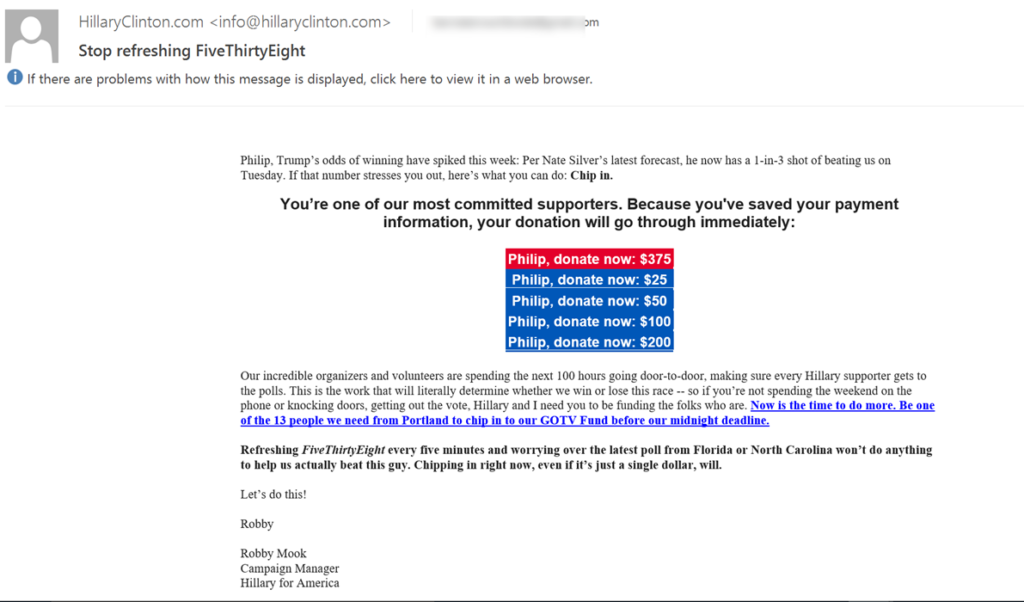
The first step in getting an email opened is the subject line, and this one’s brilliant:


Stop Refreshing FiveThirtyEight


FiveThirtyEight is a blog/website run by polling guru Nate Silver. Silver became a national legend when he called almost every state correctly in the 2012 Presidential election.

His “forecast” page makes a percentage prediction on the chances of each major candidate to win the election. As of this writing (early morning, Election Day), he gave Clinton a 71.6% chance of winning, and Donald Trump a 28.4% chance.

It was closer last week.

Democrats, in particular, have been visiting the site compulsively as anxiety has increased. I know — I’m one of them. At the time the letter landed, FiveThirtyEight had Clinton’s odds at about 65%, with Trump’s numbers improving daily.

When that email arrived, it entered the conversation in my head — I had just been to the site a few minutes before, and it wasn’t my first visit of the day. 

This email got opened.

Clinton Campaign Manager Robby Mook may or may not have written it himself. Whoever did so deserves an award. What followed was one of the best sales letters I’ve ever read.

[One note: it’s entirely possible that the Trump campaign has produced high-quality work as well. Because I’m not on their list, I haven’t seen any emails from them. If you’ve got a strong one, please forward it my way.]

The body copy got to the point in a hurry.

Per Nate Silver’s latest forecast, [Donald Trump] now has a 1-in-3 chance of beating us on Tuesday. If that number stesses you out, here’s what you can do — Chip in.

Then came the call-to-action: the letter explicitly asked for a monetary donation, suggested specific amounts, and gave readers an easy way to make it happen.

Closing paragraph reminded us why we opened the email in the first place, and what we were supposed to do:

Refreshing FiveThirtyEight every five minutes and worrying over the latest polls from Florida or North Carolina won’t do anything to help us actually beat this guy. Chipping in right now, even if it’s just a single dollar, will.

Let’s do this!”

While it will be tempting to try to forget this frequently-ugly campaign as soon as the results are in, there are lessons to be had. For direct-response copywriters, Robby Mook has given us a good one.

Are You Making This Embarrassing, Costly Voicemail Mistake?

Before your read the rest of this article, borrow someone’s cell phone and call your own.  Let it go to voicemail. What does your greeting sound like?

Salespeople should check their voice mail
Photo by Daniele DePascale

What you just heard is what your customers hear.

  • Is your name mentioned on the greeting?
  • Is your voice on the greeting?
  • Can callers leave a message?

If you cannot answer an unqualified “yes” to all three of these questions, it’s time to change your voicemail greeting.

In every market I visit, there is at least one Account Executive (and the occasional Sales Manager) whose greeting, delivered by a robot, sounds like this:

You’ve reached five, oh, three, four, seven, seven, four, nine, three, three. Please leave a message after the tone.”

A Dale Carnegie trainer once told me that at its core, working in sales is like having a series of job interviews, every single day.

The line stuck with me — every single day, we are trying to get local business people to hire us and our companies to solve their marketing problems.

How do the “hiring managers” — your clients — react to a robot voicemail greeting?

Here’s a hint from Lora Poepping, a recruiter and job search consultant in Seattle:

I will hang up when your voicemail doesn’t give your name.

Please, please have your name mentioned in your outgoing message. Why? Because I don’t want to leave a message about wanting to speak with you about a potential new job if I don’t even know if I’ve reached the right person. If you don’t want to record something, just default to using your name. You may have missed your chance to be considered for a position.

If R2D2 is answering your phone, you may have missed the opportunity to be considered for a buy.

At the bare minimum, your name should be on the greeting. Spoken by you, not the robot.

Not long ago I needed to reach an Account Executive with a question about a proposal we were developing. Her cell phone went to voicemail.

The robot recited a string of numbers (“You’ve reached five, oh, three, four, seven, seven, four, nine, three, three.”), invited me to leave a message for “the person you are calling”. It then informed me that the mailbox was full, and suggested that I call back later.

Not only did I not know if I was calling the right person — I couldn’t leave a message even if I wanted to.

Because her station was paying me a lot of money to work with her, I sent her a text. Eventually we connected.

Your customers will not go to the extra effort. They will hang up and call a competitor.

Sales Trainer Pat Bryson recommends using your outgoing message as an opportunity to make an impact:

Make your voice mail messages SELLING messages for you. Stress what you can do for the client. Make them bigger than life. You only have one chance to make a first impression!

(h/t Radio Sales Cafe)

The best example of “phone greeting selling” I’ve encountered came from J.R. Langlois, who owned The Safer Floor Store in Portland.

I met with Mr. Langlois in 2009 during my radio sales days, and had a question for him after our meeting. When I called, I got this message:

Hi, this is J.R. at the Safer Floor Store. I can’t come to the phone because I’m helping my customers prevent injuries and avoid lawsuits. Please leave a message and I’ll call you back as soon as I can.

Two lessons here:

1. J.R. knew that he wasn’t in the floor supply business — he was in the injury-and-lawsuit-prevention business.

2. He recognized that voice mail represents an opportunity — even when he was away from the phone, he could deliver his sales message to anyone who called.

When customers try to call you, do they know they got the right number? Can they hear your voice? Can they leave a message if they want to?

If you can’t answer yes to all of these questions, you are making an embarrassing, costly mistake.

It’s time to fix it.

What You Can Learn From “The Pickle Principle” In Action

“Big doors swing on little hinges.” – W. Clement Stone

The $11 Decision
A Small Customer Service Story

I needed some shirts laundered in London, Kentucky. It was the middle of a multi-week road trip, I was in a Hampton Inn, and it was time.

I knew the drill — the laundry form is always in the hotel room closet. Fill it out, bring the laundry to the front desk, and it’ll be back the next day.

I glanced at the form — $4.50 per shirt, two shirts, $9.00 total. I stuffed the shirts in a bag and brought them to the front desk.

They came back the next day, and I didn’t think of them again until I looked over the statement at the end of my stay.

The hotel had charged me $20.

Photo by Andy Dean
Photo by Andy Dean

I sent an email to Michelle Baldwin, the manager of the Hampton Inn London North, asking her to credit me $11.00 for what was —  obviously —  an overcharge.

She wrote back quickly, and as I began to read her response, I felt myself entering my Outraged Consumer state:

“The dry cleaners that we use decide the charge and bill us for that amount, then we bill the guest on their stay. There is a minimum charge of $20.00 that is highlighted on the laundry request sheet. That minimum charge is due to the delivery and pick up.”

This was outrageous, I thought. The dry cleaner, in cahoots with the hotel, had pulled a fast one on me. I was 2000 miles away, with no way to look at what I’d signed.

In my mind, I started writing an angry retort. Until I read further.

“I will go ahead and adjust account to reflect only the $9.00 because I know you weren’t aware of the policy. I will also send you a new receipt reflecting the change. Thank you for staying with us and I hope you enjoyed your stay.”

A couple of weeks later I was back in the Hampton Inn London North. After I checked in, I opened the room closet and took a peek at the laundry request slip.

The $20 minimum was right there on the ticket, in letters plenty big enough for me to see.

I’d missed it.

The hotel had been right the whole time. I was 100% in the wrong.

Photo by closertoinfinity

I thought of Bob Farrell and the pickle.

The Pickle Principle

Farrell, who ran the very successful Farrell’s Ice Cream Parlor chain, used to tell the story of a letter he received from a customer. The customer complained that had asked for an extra pickle to go with his hamburger… and the waitress tried to sell it to him.

The letter launched what he called The Pickle Principle:

I had a chance meeting with [the letter writer]  years later and I thanked him in person for his letter because it became the “war cry” of our young company, “Give ’em the Pickle.” When something happens with a customer and you’re not sure what to do? “Give ’em the Pickle!” Do what it takes to make things right!

Michelle Baldwin at the Hampton Inn could have just pointed out that the mistake was mine, and that she’d had to pay the dry cleaner in full. She could have told me to bug off.

Instead, she took the hit to make a customer happy.

The $11 refund was a small gesture… a pickle. I could’ve handled the loss, and so could she.

But big doors swing on little hinges. With this $11 investment, a hotel gained a raving fan.

I don’t often make it back to London, Kentucky — but when I’m there, I’ll go out of my way to stay at the Hampton Inn London North.

[reminder]What’s the most memorable small gesture you’ve made for a customer? What’s the most memorable gesture someone’s made for you?[/reminder]