A Facebook Hack Gets a Shoe Store Free Advertising

A few years ago I met with the owner of an upscale ladies shop in a southeastern state. The store sold a wide variety of women’s clothing, but the biggest revenue category was shoes.

Apparently, ladies buy shoes. Who knew?

Facebook social media advertising tip from a shoe store owner
Photo by MoustacheGirl


[UPDATE 4/14, 1PM PACIFIC]: As Susan Rich points out in the comments below, this technique can be even more powerful in Instagram.]

Our conversation had turned to social media. I asked the owner how effective his Facebook page was as a marketing tool. “It’s okay, I guess,” he said. “But I’ve got a much better way to use Facebook.”

That got my attention.

“How do you do that?” I asked.

 “My customers all have smartphones, which means they have a camera. Whenever a customer tries on a pair of shoes and decides to buy them, we ask if they’d like us to take their picture — with their phone. Women like to show off their new shoes, so most of them say yes.”

“Do they let you post those pictures on your Facebook page?” I asked.

“Some do, but that doesn’t really matter,” he replied. “The important thing is that as soon as they go home, they post the photo on their own Facebook page. And they usually mention that they got the shoes at my store.

So we just got a free Facebook ad, and it gets seen by 500 of her friends. Two or three times a week, someone will walk into my store and ask to try on a pair of shoes their friend posted on Facebook.

All of this costs us nothing – we don’t even pay for the camera!”

The store owner had stumbled on a great way to use Facebook in its most effective form – to accelerate word-of-mouth.

In the years since we had that conversation, it has become even harder for a business to get its posts seen without paying for it. The organic reach of a business Facebook post has sunk to an average of 2%.

The shoe store owner had come up with a way to beat the system on a small scale. It still works.

It’s a technique that can be used in a variety of consumer settings:

  • A furniture store can take pictures of a customer’s new couch, in the customer’s home.
  • A car dealer can shoot a photo of a happy couple standing next to the new SUV they just bought.
  • A window company can take pictures of a homeowner posing in front of her newly-installed windows.

The key is to take the picture with the customer’s phone, not yours.

Rather than begging people to “like” your Facebook page, you can intersect with existing consumer behavior. Happy customers love the show off the things they just bought… on Facebook.

Who knew?

[reminder]What’s your best traffic-building social media hack?[/reminder]



How to Handle a Client Who Won’t Listen

I wish advertisers always accepted my advice and did what I told them. Alas.

sales tip: sometimes the client won't listen
Photo by pathdoc/pdc

There are some furniture store owners and auto dealers who think they know more about advertising than I do.

Sometimes they’re right. But not often. I once considered telling a funeral director that I’d let him embalm the bodies as long as he let me write the copy.

Didn’t say it. Lost my nerve.

The Client Who Won’t Listen is a topic of much conversation among well-trained advertising salespeople.

You’re held accountable for results — if the advertising doesn’t deliver, you be blamed. But you’re also on commission — if the client doesn’t run with you, you don’t get paid.

How do you handle a client who won’t listen?

As Dan O’Day points out, much depends on how your customers perceive you:

If you want to provide your clients the most for their money, you need to:

1. Educate yourself to the point where you do have genuine expertise in radio advertising.

2. Make that expertise clear to the client at the beginning of and throughout your entire relationship.

As an Account Executive, I told stories about other clients who’d used my advice and got great results. I made a point of talking about the books I’d read, the CD’s I’d listened to, and the seminars I’d attended. 

I sent a monthly email newsletter to my clients that talked about marketing, not about my stations.

I started a blog in 2008 — the one you’re reading now.

In spite of the credentials I built up and trumpeted at every opportunity, I would sometimes find myself sitting across the desk from a business owner who was determined to write his own laundry-list commercial and run it on my competitor if I didn’t like it.

If you run into a situation like that, you have two choices:

1. Refuse the business. Tell the client that you would love to have the business, but cannot accept the order when you don’t think it will accomplish their goals.

2. Give the client the best advice you can, and then take the money.

Here’s the approach I settled on:

  • If the order was a little one, I’d refuse it. I set a minimum dollar figure (my “Evangelista Number“) below which the business wasn’t worth my time. If it was below the Evangelista Line, I was happy to let my competitor suffer.
  • If the dollar figure was substantial, and the only way to get the order was to air the ad my the customer insisted on running, I’d accept it — but only after saying this:

Advertising Sales Tip:
The “Two Responsibilities Gambit”

Mr. (or Ms.) Client, I have two responsibilities. The first one is to my station and my own checking account, and it’s this: if you want to give me your money, I am prepared to take it.

But I also have a responsibility to you to tell you if I think your plan isn’t going to work. And I don’t think it’ll work. If you still want to go ahead and do it, let’s go ahead.

Sometimes the campaign failed and the client ultimately agreed to try it my way. Results, and the customer’s perception of my expertise, generally improved when that happened.

Sometimes the campaign failed and the client just stopped advertising. In that case, I’d shrug and move on to someone else who was willing to listen to me.

Occasionally customer was right and the campaign worked after all. As Joaquin Andujar was fond of saying, you never know.

In a perfect world, you could walk away every time a client wanted to advertise the wrong way.

Unfortunately, the world ain’t perfect.

You have bills to pay, and a budget to hit.  Winning the argument might feel good, but allowing your competition to cash your commission check does not.

Under the right circumstances, the Two Responsibilities Gambit will allow you to cash the check and still sleep at night.

[reminder]What’s your best strategy for dealing with a client who won’t listen?[/reminder]

Sales Book Review: The Perfect Close by James Muir

The very first piece of advice James Muir gives is one you shouldn’t follow.

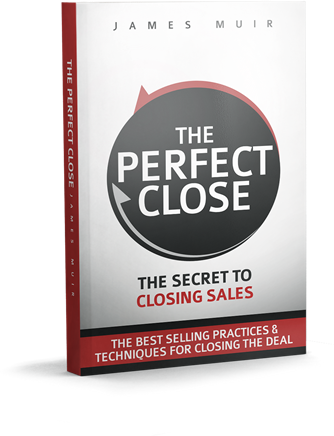
An excellent sales book -- The Perfect Close

In the introduction to The Perfect Close: The Secret To Closing Sales – The Best Selling Practices & Techniques For Closing The Deal, James Muir invites the reader to skip to Chapter 12. That’s where he reveals the two-question technique that forms the basis of the book.

I skipped to Chapter 12, and the best advice I can give you is: don’t skip.

Read the chapters in order.

For the same reason that you shouldn’t skip to the end of a great mystery novel to find out who did it, skipping to Chapter 12 means you miss everything that comes before. 

The good stuff is what comes before.

A great sales book: The Perfect Close by James Muir
Photo by LoloStock

For Muir, it starts with mindset — asking yourself why, exactly, you want a particular sale to close. If the only answer is that you’re under pressure to hit your April number, you’ve got a problem. 

For your ongoing relationship to work, the transaction needs to benefit your advertiser, and you should be able to articulate what that benefit is.

Otherwise, says Muir, you walk into the client’s office reeking of “commission breath.”

“Intent,” says Muir, “matters more than technique.”

If your intent is in the right place, you need to keep the sale moving forward. Muir advises writing down two objectives before each meeting:

  • A Sales Objective
  • A Call Objective

Muir defines the Sales Objective as “the revenue (or outcome) you anticipate generating by closing this particular opportunity with this particular customer.”

To qualify, says Muir, the objective needs to relate to a specific product or service that you offer. It must be measurable, have a target date by which it will happen, and be realistic for the client to be able to do.

Muir defines a Call Objective as “an advance or commitment that is the desired outcome of this particular sales encounter with this particular person or group.”

In other words — what do you want the client to do as a result of this particular meeting?

Muir lays out the difference between

  • A Close — when the customer firmly commits to buy  
  • An Advance“a significant action that requires energy by the client — either in the call or right after it — that moves the sale toward a decision”
  • A Continuation — “a situation where the sale will continue yet no specific action has been agreed upon by the customer to move the sale forward.”

There’s a huge gap in value between an Advance and a Continuation, and Muir’s book does an excellent job of helping the reader see the difference. The big distinction:

If the client is not taking an action, it is not an advance. If the action the client takes requires little or no energy, it is not an advance.”

If the client schedules a follow-up meeting, checks with Accounting to determine the budget,  and makes sure that all decision-makers will attend, it’s an Advance.

If the client just suggests that you give him a call some time next week, it’s a Continuation. 

Too often we as salespeople accept a series of Continuations. We put out all the effort, the client is passive, and the sale stalls. The Perfect Close is particularly good with advice on how to make sure the sale truly advances.

Which brings us to Chapter 12, when Muir finally gives us his two-question sequence for generating action.

Although he calls it “The Perfect Close”, I’d be more likely to call it The Perfect Advance. The questions can be deployed throughout the process to move the sale forward.

Like a football moving down the field, a series of true advances will move the ball over the goal line.

When I read Chapter 12 early, I was disappointed. When I got to it again after reading the previous chapters, it had much more meaning and value.

The Perfect Close will give you excellent, thought-provoking and actionable advice on how you can keep your sales advancing toward the conclusion you want. 

Just don’t skip to the end. 

[reminder]What’s the best sales book you’ve read in the past 12 months?[/reminder]

Huge Opportunity to Connect… Missed

Every now and then an ad makes me want to remonstrate the copywriter… and then rewrite it myself.

copywriting tip -- make the ad about the customer
Ad in The Oregonian 3-5-17

“First you need to enter the conversation going on in the prospect’s mind.”   — Robert Collier.

If your message doesn’t address something your target’s already thinking about, you’ve flunked the “So What” test.

The ad above was in my local newspaper the other day. What conversation does this sentence enter?

Silver Chef’s meal plans are carefully planned by a registered dietitian, then prepared by a highly skilled chef with a senior’s needs in mind.”

I mean… so what?

Silver Chef customers won’t care about Silver Chef…unless they think the company can help solve a problem. This message doesn’t help anyone solve a problem.

I’m in their target demographic — 50’s with an aging parent. As a potential customer, I’d shrug and turn the page.

But the professional copywriter in me suspected there was a better story to tell. So I went to their website, and learned that the company actually tackles a problem that many boomers may have.

What conversation is the family member of a senior citizen having? They may be worried their loved one is not eating properly, and looking for ways to help them stay independent.

What if the ad entered that conversation? What if it said something like this?

We Deliver Peace of Mind Right to Your Door

If someone you love could use some help with meals, call us. Each day we’ll prepare carefully-balanced individual meals  — breakfast, lunch, dinner and snack — and deliver them right to your loved one’s home. All they have to do is heat them up and serve. 

The headline I used was already on the Silver Chef website. I wrote the body copy myself, quickly (for money, I’d be happy to spend more time on it — call me, Silver Chef!). 

If you make your ad about you, you’ll flunk the “So What” test. Talk to your prospects about them, and you’ll pass. 

[reminder]

How to Pack Your Briefcase for a First Sales Call

It’s finally time to leave the office and head for that first meeting with a direct prospect. You’ve done your research and confirmed the appointment. What should you bring to the call?

Choose sales materials for your briefcase carefully
Photo by Minerva Studio

There are five things you absolutely must have at the first meeting. And one thing you probably have with you that belongs back at the office. 

I’ll start with the thing you should leave at your office: your radio or television station’s Media Kit.

Leave the Media Kit pages on the big shelf. Stick the thing in a drawer. Burn it if you must. But do not bring it to a first meeting with a direct prospect.

Here’s why your Media Kit has no place on a first call: it was written by someone who has never met the client and knows nothing about them.

The Media Kit is about you. The client doesn’t care about you. The client cares about… the client.

That’s what the first meeting needs to be all about. 

Leave the packages and the rankers back at the office. You won’t need them today. This is about gathering information and positioning yourself for the presentation.

So only bring things that allow you to focus on the customer. Here are the five essentials

  1. A notepad. You must take notes. It shows respect for the client, and it’s crucial to making sure you remember the most important things you learn. You can have a legal pad, a reporter’s notebook or a Moleskine — whatever makes you comfortable. I take my notes on an iPad with a Brydge external keyboard. When the meeting’s over I upload the notes to Evernote, so that I can access them on my phone or computer. But I always bring paper as a backup in case the device crashes.
  2. A pen. I feel silly mentioning this, but I’ve sat next to enough salespeople who had to ask the client for a pen that I’ll include it here. Frankly, it wouldn’t be a bad idea to bring two, in case you run out of ink.
  3. Business cards. Bring extras — you never know who’ll be in the room with you. And make sure you get cards from everyone you meet.
  4. A list of questions you plan to ask. The list will keep you on track, and will make sure you don’t forget to ask something crucial. You are free to ask questions that aren’t on the list.
  5. Your appointment calendar. You’re going to want to schedule a follow-up meeting at the end of your conversation. The most efficient way to set that appointment is to do it when you’re sitting in the client’s office. They’ll have their calendar, so bring yours.

Finally, write down a a preliminary dollar goal for the account, and an objective for the meeting you’re about to have. In The Perfect Close: The Secret To Closing Sales, James Muir calls these the Sales Objective and the Call Objective.

Muir defines the Sales Objective as “the revenue (or outcome) you anticipate generating by closing this particular opportunity with this particular client.”

Muir has this advice on choosing a Sales Objective:

A well­ defined sales objective includes the following:

  1. It is related to a specific product or service.
  2. It is specific and measurable.
  3. It has a specific target date for completion.
  4. It should be realistic from the client’s perspective.”

A preliminary Sales Objective could be something like, “I plan to have this client agree to invest $48,000 over 12 months on our broadcast and digital tools. My objective is to close the sale within three weeks of today, and have them on the air by April 15.”

Before your first meeting, you’ll be guessing, and you’ll probably make an adjustment after you know more about the customer, their needs and their resources.

You may not have a specific product in mind until the meeting’s over. That’s okay — it’s a starting point, and over time it will be instructive to compare your initial objectives and the final outcomes.

Since it’s unlikely that you’ll close a deal on your first meeting, the second part of the process is to write down a Call Objective — defined by Muir as “an advance or commitment that is the desired outcome of this particular sales encounter with this particular person or group.”

In most cases, the Call Objective for the initial meeting is for the client to give you enough information for you to be able to recommend an advertising strategy, and for the client to agree to a presentation appointment. 

Write the objectives down in advance — that’s how you’ll keep yourself accountable.

Put the written objectives in your briefcase with your pre-meeting research, notepad, pen, question list, business cards, and appointment calendar, and you’ll have what you need for a successful first call.

[reminder]What are your best strategies for earning the right to come back for a presentation?[/reminder]