Why You Should Run Hard Through The Tape

You never know how the final few yards of the race are going to go. Just ask Tanguy Pepiot, a University of Oregon distance runner:

Direct link to the video: https://www.youtube.com/watch?v=38fffcRexi4 

As Geoffrey C. Arnold of The Oregonian described it:

Pepiot was leading the steeplechase event by a wide margin and started celebrating his anticipated win with less than 100 meters remaining. Pepiot started waving his hands as he coasted toward the finish line.

He never saw Washington runner Meron Simon closing fast. Simon blew past Pepiot to win the race by a tenth of a second.

After the race, most of the chatter centered on Pepiot’s behavior. If he’d focused on running instead of celebrating, he might have held off the challenge.

But much credit should go to Simon, who launched a frantic kick when it looked like he had no chance of winning.

I thought of Pepiot and Simon when Donald Trump was declared the winner of the Presidential Election early on the morning of November 9.

Here’s the track-election parallel

On Sunday before the vote, Donald Trump made appearances in five different states: he flew to Iowa, Minnesota, Michigan, Pennsylvania, and Virginia.

He did this even though Barack Obama had won all five of those states in 2012.

The following day, he held rallies in Florida, North Carolina, Pennsylvania, New Hampshire, and Michigan.

Yes, he had a private plane and a full staff. Regardless, ten states in two days is a brutal schedule for anyone — especially for a 70-year-old man.

While he was doing this, almost every single poll showed him losing the race. He did it anyway.

You know the result. Barring a big surprise from the Electoral College in December, Donald Trump will be taking the oath of office on January 20, 2017.

Why did Trump push himself so hard? Here’s what he told another North Carolina audience:

I always say I don’t want to think back if only I had did one more rally I would have won North Carolina by 500 votes instead of losing it by 200 votes. 

For the record, I didn’t vote for the guy. And it’s worth noting that Clinton campaigned hard until the end. 

But as a sales trainer I see a big sales lesson in the track race and the election race, and feel compelled to pass it along here. 

The Sales Lesson:
Always Run Hard Through the Tape

When you make your case to a potential customer, you’ll often have fierce competition. Sometimes it will look like you’ve got no shot at winning. 

  • Your ratings are down. 
  • The competition is undercutting you on price
  • Your prospect has always preferred another medium, or another station.
  • Your competitor is the client’s best golf buddy.

But as Donald Trump and Meron Simon have demonstrated, you never know what conversations your prospects are having behind closed doors.

You never know when your competition might be celebrating just a little early. 

How to Get Your Email Opened: A Brilliant Political Example

When you donate money to a Presidential candidate, you wind up on a list. You start getting email — a lot of email. It’s a marketing master class.

“Enter the conversation already taking place in the customer’s mind.” — Robert Collier

I thought of Collier the other day when this email landed in my Inbox.

Sales letters ask for action

The first step in getting an email opened is the subject line, and this one’s brilliant:


Stop Refreshing FiveThirtyEight


FiveThirtyEight is a blog/website run by polling guru Nate Silver. Silver became a national legend when he called almost every state correctly in the 2012 Presidential election.

His “forecast” page makes a percentage prediction on the chances of each major candidate to win the election. As of this writing (early morning, Election Day), he gave Clinton a 71.6% chance of winning, and Donald Trump a 28.4% chance.

It was closer last week.

Democrats, in particular, have been visiting the site compulsively as anxiety has increased. I know — I’m one of them. At the time the letter landed, FiveThirtyEight had Clinton’s odds at about 65%, with Trump’s numbers improving daily.

When that email arrived, it entered the conversation in my head — I had just been to the site a few minutes before, and it wasn’t my first visit of the day. 

This email got opened.

Clinton Campaign Manager Robby Mook may or may not have written it himself. Whoever did so deserves an award. What followed was one of the best sales letters I’ve ever read.

[One note: it’s entirely possible that the Trump campaign has produced high-quality work as well. Because I’m not on their list, I haven’t seen any emails from them. If you’ve got a strong one, please forward it my way.]

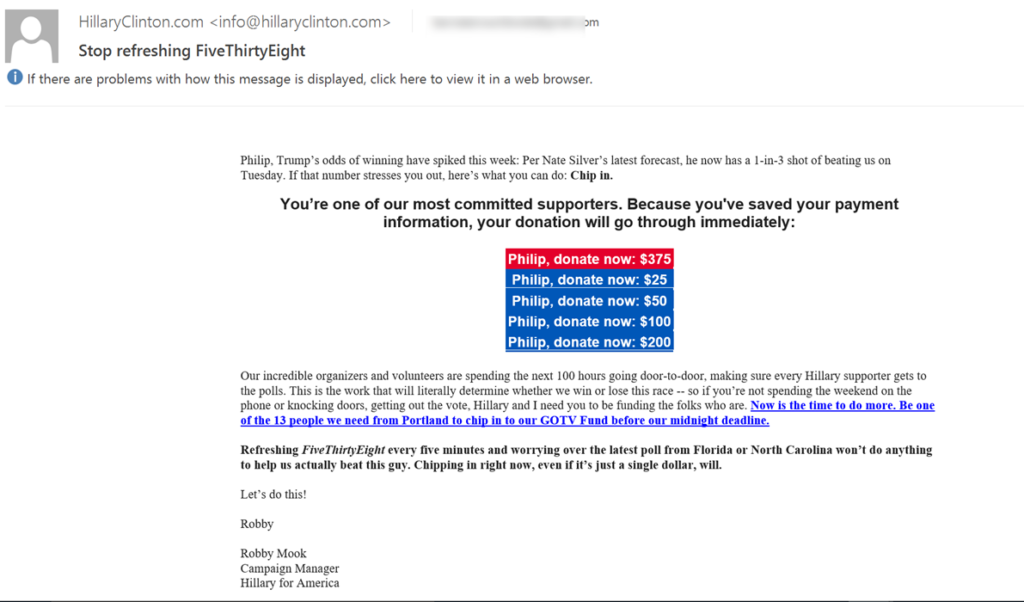
The body copy got to the point in a hurry.

Per Nate Silver’s latest forecast, [Donald Trump] now has a 1-in-3 chance of beating us on Tuesday. If that number stesses you out, here’s what you can do — Chip in.

Then came the call-to-action: the letter explicitly asked for a monetary donation, suggested specific amounts, and gave readers an easy way to make it happen.

Closing paragraph reminded us why we opened the email in the first place, and what we were supposed to do:

Refreshing FiveThirtyEight every five minutes and worrying over the latest polls from Florida or North Carolina won’t do anything to help us actually beat this guy. Chipping in right now, even if it’s just a single dollar, will.

Let’s do this!”

While it will be tempting to try to forget this frequently-ugly campaign as soon as the results are in, there are lessons to be had. For direct-response copywriters, Robby Mook has given us a good one.

How to Turn Sales Opportunity Into Defiance

“I keep trying to tell him how dumb his radio buy is, and he just won’t listen.”

insulting a client chhoice won't make you a sale
Photo by pathdoc

So said a television account executive as we prepared for a sales call with a window retailer. The owner was a long-time radio user, and my job was to convince him to start using TV and digital. The AE had been calling on him for more than a year.

“I’ve shown him all the research from TVB — people just don’t listen to the radio anymore, and he really needs to move over to television.”

“What does he tell you?” I asked.

“He gets defensive, and he tells me his radio’s working fine.”

Whatever medium we work in — television, radio, newspaper, outdoor, digital, — we see “research.” Some of it is independently done, but much of what we see is produced by our industry association. It can be helpful, but it’s designed in part to convince our customers that our medium works better than the other guys.

Television has TVB, the Television Bureau of Advertising. TVB has studies to show advertisers that TV works better than radio.

The radio industry has RAB — the Radio Advertising Bureau. RAB has charts and graphs to show advertisers that radio works better than TV.

When you’re new to the business, and all you see is your own industry’s research, it’s easy to convince yourself that you’ve got the only medium, or the only station within that medium, that works. From there, you can leap to the conclusion that anyone who uses the other guys is either misinformed or stupid.

But as Gregg Easterbrook once put it, “Torture numbers, and they’ll confess to anything.” Advertisers who have seen charts and graphs from competing media reps are inclined to believe none of them.

Trying to use those numbers to convince a prospect that the decision he’s made is a bad one is unlikely to have the desired effect. Even if you’re right, you’re wrong.

Anthony Iannarino, author of The Only Sales Guide You’ll Ever Need, puts it this way:

The weakest choice available when trying to create a compelling reason for your dream client to consider leaving their existing supplier (or partner, as the case may be) is to directly attack your competitor. This approach creates resistance, and you cause your prospective client to defend their existing supplier—and their choice.”

A much better approach is to carefully ask a question to see if there might be any doubt in the prospect’s mind already. The question I like to use for an advertiser who’s been using a competitor for a long time is this:

“Is [name of medium] working as well for you as it did five years ago?”

You can then tailor your approach to the answer.

I asked the window retailer that question. He thought about it for a few seconds, and then told me that his radio was still getting results, but there’d been a bit of a drop-off in the past couple of years.

I then asked him which of the four radio stations he was using worked best, and he told me that he thought that two were producing good results and two were not.
 
I advised him to stay with the two that were working and drop the other two. We came back with a plan to use that money on a television/digital strategy, and he agreed to do it.

Some prospects will insist that their advertising is working just as well as ever. No chart or graph will convince them otherwise, and they’re not going to cancel something they believe is making money for them. It can be very difficult to convince them to change.

But it’s not impossible — sometimes you can persuade them that using your products can open additional doors for them.

In formal PowerPoint presentations, I set aside a slide that commends them for their success. In big red letters, I say this:

You’re doing really well already without me.

Here’s how to make a strong campaign even stronger.  

From there, I detail a strategy that either adjusts their messaging slightly, or demonstrate that we can put that message in front of desirable consumers who aren’t seeing it now.

Does this work every time? No. There are plenty of times the client decides not to take action.

But it works much better than a direct attack, which will only alienate the client. Respecting your customer’s decision leaves the door open to further conversations… and business when they’re ready.

How To Blow The Sale: Lack of Rehearsal May Cost Trump the Presidency

The biggest buy of your career is up. You are one of two finalists.

The two of you will be presenting to a committee of 20.

Seven of them are solidly in your corner. Seven of them are determined to vote for your opponent no matter what.

The other six will decide who gets the business.

Are you going to rehearse your presentation, or just wing it?

No rehearsal means no sale in a presentation.
Photo by razihusin

Update, early morning 11/9/16: Never mind. 

“The wing-it days are over” — Jim Doyle

A quick disclaimer:  I am making no (public) judgments on which of them should be President of the United States. You go ahead and vote for your candidate, and I’ll vote for mine.

Going into the very first debate between Hillary Clinton and Donald Trump, the 2016 Presidential race was very close to a dead heat. As Nate Silver put it on his poll-tracking 538 Blog,

Our models have been on the move toward Trump for roughly six weeks. But with dozens of polls coming out over the past few days, he’s no longer much of an underdog at all. Hillary Clinton leads narrowly — by 1.5 percentage points — in our projection of the popular vote. But polling weakness in states that Clinton probably needs to win, particularly Colorado andPennsylvania, makes the Electoral College almost even.

The debate began at 9pm Eastern Time on September 26. 90 minutes later, the momentum had shifted from Trump to Clinton, and has stayed that way since.

The difference? Preparation.

Clinton and her team created a plan, and rehearsed that plan to a fault. Trump, according to multiple reports, decided to wing it.

Here is a snippet from one post-first-debate review, typical of many:

It was a commanding performance from the Democratic nominee. Clinton delivered a series of detailed answers on subjects ranging from race to the Middle East to tax policy…The Republican, on the other hand, was erratic, vague, and frequently appeared rude.

A “buying committee” of 80 million Americans was watching that night. It was Trump’s best chance to convince them that he was qualified to be President of the United States — to move them closer to buying his plan instead of his opponent’s.

He blew it.

Trump’s campaign went into a spiral that night, and has not recovered since. While there have certainly been several other unfortunate events for him, we can look back at September 26 as the night Donald Trump turned potential victory into probable defeat.

Barring a huge surprise in the next three weeks, the odds are overwhelming that Hillary Clinton is going to earn the business.

The Sales Lesson
You’ve Gotta Rehearse

Public speaking coach Michael Port, author of Steal the Show: From Speeches to Job Interviews to Deal-Closing Pitches, How to Guarantee a Standing Ovation for All the Performances in Your Life, contends that rehearsing your material actually allows you to be more spontaneous:

When you prepare for a pitch, meeting, speech, or negotiation, the goal is to know your material so well that you are free to be in the moment. This is an important condition for listening because it’s hard to allow yourself to improvise if you don’t know your material right down to the core.

Rehearsing gives you the confidence to respond to the events and reactions of the moment, knowing you can come back to where you want to go with your planned content.”

  • You need to say every single word of your presentation out loud. It will sound different coming out of your mouth than it does in your head. Once you hear how it sounds out loud, you can make adjustments, long before your client hears anything.
  • You need to know your material well enough that if the client challenges any of the points you’re making, you can back them up.

For major presentations, role-play with your managers or peers, running through potential questions, objections, and holes in your arguments.

I know, I know. You hate to role-play. So do I.

Do it anyway.

The military role-plays constantly, performing hundreds of drills so that soldiers know how to cope with unexpected situations.

NFL teams role-play all week long before games. They practice all sorts of scenarios so that the quarterback has some experience with a game situation in which his first and second passing options don’t work out.

You should be role-playing, too. If it’s good enough for the New England Patriots and the United States Army, it’s good enough for you.

No Preparation = No Sale

The nation got a terrific sales lesson over the course of three Presidential debates this year.

For the biggest sales presentation of their lives, one candidate did the research, established her plan, and role-played for weeks, making adjustments along the way.

The other one…didn’t.

We’ll see the result on November 8.

Have You Earned the Right to An Annual Commitment?

Are you putting your long-term advertisers on autopilot? Some clients have learned to fight back.

Salespeople need to earn long-term contracts
Photo by Nito

Not long ago I met with a very smart personal injury lawyer in the Southeast. He uses a lot of television, and has for more than a decade.

He made it clear to us during our first meeting that he was not going to sign an annual agreement. He told us that he never commits to longer than a quarter at a time, and has done it this way for years.

It’s not that he isn’t confident in the medium – he knows that television works.

He simply doesn’t want to be taken for granted.

A long time ago, I signed some long-term deals, and here’s what happened,” he told us. “The sellers thanked me for the business, made sure I gave them the proper commercials, and then forgot me.

“Well, that’s not exactly true,” he said. “I would hear from them again – 11 months later when it was time to renew the deal. Now I sign for a quarter at a time, and that means that I hear from my salespeople at least every three months.”

I didn’t have a comeback for that – there was a lot of truth in what he was saying. It’s easy, when you have a one-year deal in your pocket, to direct your attention to the next prospect, and focus on those things that are urgent.

What this lawyer has figured out is that there’s a way to direct some urgency his way, by refusing to sign year-long contracts.

Think about the way you treat your annual customers.

Are you in regular touch with them, sending them articles, bringing them new ideas, checking in to make sure they are getting the results they expect from your broadcast and digital tools?

Or have you moved on to other things, with a note on your calendar to call them when the contract is about to expire?

If you’ve got them on autopilot, it’s going to cost you sooner or later.

To earn the right to a long-term customer, you need to treat them as if the contract is up for renewal every month.

[reminder]What do you do to make sure your customers don’t feel you’re taking them for granted?[/reminder]