Here is a terrific example of advertising that enters the conversation America is already having in its head.
What are we thinking about on October 30, 2014? Ebola and Halloween, that’s what. Many fine American entrepreneurs are offering “Ebola costumes” this year.
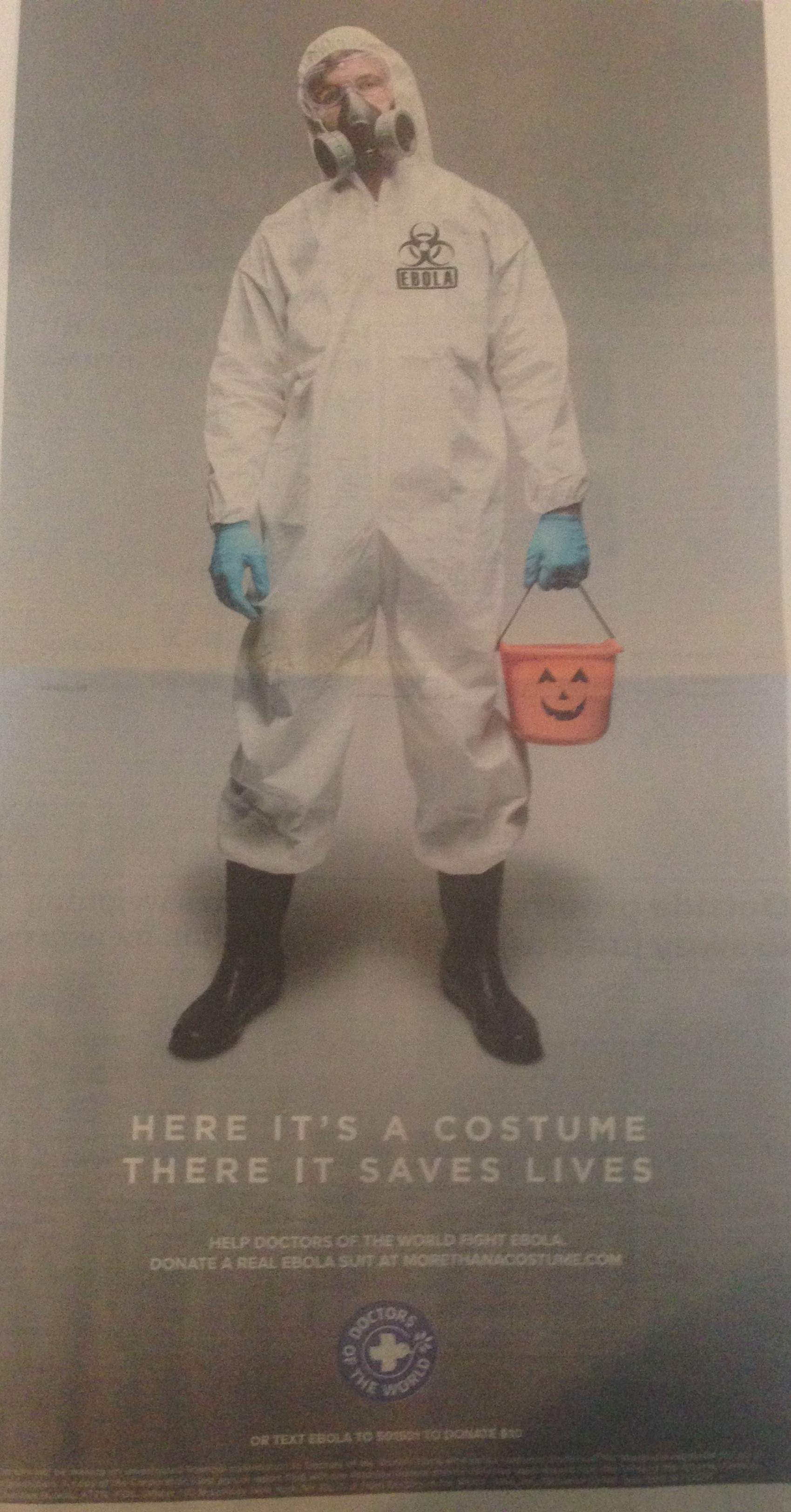
An organization called Doctors of the World* has set up a fundraising landing page at www.MoreThanACostume.com, and is using the current American zeitgiest to raise some money and do some good.
They have cleverly tied donation levels to particular pieces of equipment — you can “donate gloves” for a buck, goggles for $10, etc. At the high end, you can “donate a doctor” for $2500.”
The ad below appeared in USA Today on October 30. It is awesome.
Ad appearing in USA Today October 30, 2014
*I am not familiar with this organization, which claims to be “fighting Ebola in Liberia and Sierra Leone, engaging with local communities to prevent Ebola’s spread, raise awareness and deliver essential protective equipment” and am not endorsing it in any way. Except for their advertising approach, which I endorse as heartily as it is possible to do so.
The nation’s reaction to the arrival of Ebola contains a powerful marketing lesson. While statistics get ignored, stories compel people to act.
When Ebola began spreading across West Africa a few months ago, there were some stories in the American press, but the public as a whole didn’t take much notice.
Americans began to pay attention when they heard the story of a Liberian man named Thomas Duncan, who landed in Dallas on a flight from Liberia and wound up dying of Ebola in Texas Health Presbyterian Hospital .
We got nervous when we heard the story of Nurse Nina Pham, who contracted Ebola while treating Duncan.
When we heard the story of Amber Vinson, another Texas Health Presbyterian Hospital nurse who flew from Ohio to Dallas while experiencing Ebola symptoms, we sprang into action. As I write this (and yes, this could change), we have a total of two people who are confirmed to have contracted Ebola in this country. Here’s what’s happened:
The plane she was on was taken out of service, and the crew was put on three weeks of paid leave.
Reports surfaced online of significant numbers of airline passengers wiping down their trays and armrests.
…at least six schools in Texas and Ohio said they were shutting their doors because students or staff members had been on Ms. Vinson’s flight, or had flown on the same plane after she had. In Akron, Ohio, the Resnik Community Learning Center was closed for cleaning until Monday because a student’s parent had spent time with Ms. Vinson, school officials said.
The facts, at least those known as I write this, would argue against this sort of panic. We’re dealing with a virus that is contagious only under very specific circumstances. The odds of catching Ebola by sitting on a plane, or attending one of those schools, is incredibly tiny. The stories of these three people trump the statistics.
At the risk of trivializing what could still turn out to be a genuine national emergency, here’s the marketing lesson for those of us who make our living persuading people to act:
Nothing generates action more effectively than a good story.
I checked into the Cedar Rapids hotel on a Sunday night in early October, and settled in for the week.
Monday morning, before heading to the TV station, I went down to the hotel restaurant for breakfast. Glancing at the menu, I decided to order oatmeal. I don’t always eat properly on the road, but I can usually get in a healthy breakfast before my self-discipline breaks down.
When the oatmeal arrived at my table, it was anything but healthy. The top layer was some kind of custard, and the rest of it was loaded with sugar and other stuff. It tasted quite good, but it did not mean good things for my cholesterol count.
I called the waitress over and asked her whether the restaurant offered just plain oatmeal. She told me that this was the way the restaurant always did it. Then she paused, and asked me how long I was staying at the hotel. I told her I would be there all week.
“My name’s Jackie,” she said. “When you come down tomorrow, ask for me, and I’ll have the chef just make you a bowl of regular oatmeal.”
Tuesday morning I came down to the restaurant and asked for Jackie. “You mentioned you might be able to get me some regular oatmeal,” I said. “Let me see what I can do,” she replied. 10 minutes later she brought me a bowl of plain oatmeal.
Wednesday morning, I waved to her as I sat down. “Oatmeal, and a to-go cup of coffee with the check?” she asked. “Yes,” I replied, surprised that she had remembered about the coffee. Thursday and Friday, we didn’t even have to discuss it. As soon as she saw me, she put the order in with the kitchen. And when she brought the check, the to-go cup of coffee was right there with it.
Three weeks later, I was back in Cedar Rapids at the same hotel. Monday morning, when Jackie saw me she said, “Welcome back, Mr. Bernstein! Plain oatmeal, right?”. The first day, I had to ask for the coffee-to-go; the rest of the week it all went like clockwork.
The reason I was able to get this special treatment is that I stayed in the same place for an extended period of time, and ate at the same restaurant every morning. Seeing the same faces every day, I got to know them and they got to know me. Over time, one of the waitresses got to know exactly what I wanted, and I didn’t have to start over each morning.
While I was at the hotel, I met another business traveler who was in Cedar Rapids for a couple of days. From there, he was going to Des Moines for two days, and then to St. Louis. He was also having his breakfasts in a hotel restaurant – but every couple of days it would be a different restaurant. He had to take whatever was on the menu.
Here’s the advertising lesson:
With limited resources, you have a choice when you decide to advertise:
You can spread your budget out, and try to reach as many people as possible by doing a little bit of a lot of things. You will be advertising frequently. Lots of people will see you, but they won’t remember you.
Or you can take your limited resources and focus them into a small number of places. You will be advertising with frequency. You will reach fewer people — but the people you reach will respond.
The other business traveler — with a couple of days in Cedar Rapids, a couple of days in Des Moines, and a brief stop in St. Louis — had the equivalent of a “media mix.” A little TV, a little radio, a couple of bus sides. He was seen by more people than I was, but he didn’t get to know them and they didn’t get to know him. When he sat down for breakfast, he got what everyone else got.
I had the same resources — five days — but I spent them all in one place. The same people saw me over and over again, and by the end of those five days the wait staff knew me.
The other guy was eating out frequently; I was eating out with frequency. Which one of us did better?
A few years ago I was presenting an advertising plan to a dentist in Montana. I had met with him a couple of weeks before, and he had been open, enthusiastic, and eager to hear my ideas. In a week of 27 presentations, this one seemed to be in the bag — he was ready to do something, and I had the perfect plan for him.
Now it was a different story. He argued with me about my overall marketing philosophy, didn’t like the strategy I proposed, and called my script “simple-minded”. His demeanor was dismissive, bordering on rude. At the end of the meeting, he told us he’d “think about it”, and left before we could ask him anything more.
I was shaken. Usually when a meeting goes bad I know what went wrong. This time a big opportunity had blown up, and I had no idea why.
The next day his wife, who’d been at both meetings, called the station Account Executive to apologize. A few hours before our presentation, the dentist had met with his accountant and learned that there was more than $100,000 missing from the practice’s bank account. He wasn’t going to buy anything from anyone for a while.
Ever since that day, I start every presentation this way:
Before we begin, I need to ask a quick question. Has anything changed since our last meeting?
Most of the time, nothing has, and I can launch things without a problem. But over the past five years, by asking that question I’ve learned that between the last meeting and this one:
The owner has just decided to sell the business.
The company has agreed to merge with a competitor, all decisions are on hold for the next six months, and the guy we’re meeting with will be leaving the company.
The store has picked up a new product line, and will be retooling its marketing substantially.
The medical practice has just hired an advertising agency.
Knowing this information before diving in has allowed me to make adjustments on the fly, some of which have utterly changed the strategy I recommended. On two occasions, we even agreed to cancel the presentation — it was going to be a waste everyone’s time.
Things happen quickly in business, and the questions you asked on Tuesday could have completely different answers the following Monday. Asking if anything’s changed before you dive in can save you enormous heartache.
“When a dog bites a man, that is not news, because it happens so often. But if a man bites a dog, that is news.” — Alfred Harmsworth,
The Ice Bucket Backlash is now underway.
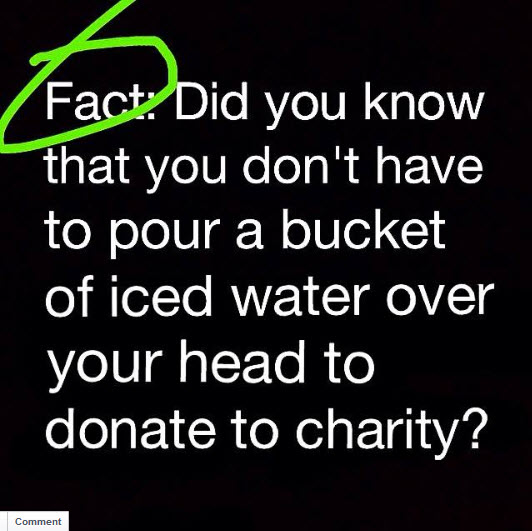
After several weeks of viral videos and millions of dollars raised, my Facebook news feed (and likely, yours too) is now filled with people questioning the wisdom and appropriateness of the campaign.
…I’m proposing what is sure to be an unpopular alternative to the #IceBucketChallenge. It’s called the no ice bucket challenge, and it works like this:
1. Do not fetch a bucket, fill it with ice or dump it on your head.
2. Do not film yourself or post anything on social media.
3. Just donate the damn money, whether to the ALS Association or to some other charity of your choice.
My take? I’m willing to concede, without doing any research, every fact he cites in his column.
The possibility exists the origin story put forth by the ALS Association is at least somewhat fictional, and that the Ice Bucket Challenge does not “belong” to the ALS Association or anyone else, for that matter.
We are all capable of making a donation to ALS or any other charity without using ice water, a video camera, or anyone else.
Having conceded all that, I believe that Oremus’ conclusion is wrong. As a marketing program, the ALS version of the Ice Bucket Challenge is superb.
It is distinctive – different from any other charity fundraising campaign out there.
It is a great example of Cialdini’s example of “social proof” as a persuasion technique – all of our friends are doing it and posting video on Facebook. We’d better do it too if we want to be accepted by the group.
It gives people distinctive instructions: dump a bucket of ice water on your head, or donate $100 to ALS. Not everybody fully understands the instructions — I’m sure there are lots of people dumping ice water on their heads without making donations. That’s okay. Most people get it.
It has raised public awareness about the effects of a horrible disease. Not everybody who posted a challenge video talked about this, but the donors to ALS are going to get plenty of mail from the Association, and that will educate at least some of them.
Yes, it’s possible to donate to the charity of your choice, and ask anybody else to donate, without using an ice bucket. That’s “Dog Bites Man”. by incorporating a simple bucket of ice water, the ALS Association has gotten the man to bite the dog, to the tune of $88 million. Bravo.