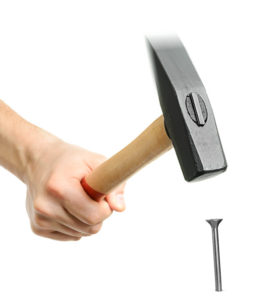
“A bed with a single nail sticking up will penetrate you the second you lie down. But a thousand nails can’t penetrate anything. The pressure of each nail is completely diffused by all the others around it.” — Bill Schley
Photo by Полина Выдумчик
If you spend any time watching television or listening to the radio, you won’t have to wait long to encounter a “laundry list” commercial — a 30- or 60-second recitation of claims:
A law firm lists every single area of practice, in the hope that one of them will interest a potential client.
A restaurant attempts to cram the entire menu into the commercial.
A dental practice wants the public to know that “we do it all!” — so checkups, implants, and laser treatments all get a mention.
When I meet an advertiser who’s running a campaign like this, I’ll ask how this “bed of nails” approach is working. In almost all occasions, it’s not working. The sales message is lost in the clutter.
[shareable]The best way to penetrate your target’s mind with a sales message is to pick a single nail.[/shareable]
For six years during my radio sales days, my biggest client was a Portland auto dealer. I wrote all of the commercials for all seven of his stores. And for most of the time during our relationship, we fought about the copy.
The dealer wanted lots of information in each commercial. He wanted a used car offer, and a new car offer, a mention of his service department, and, of course, the friendly staff.
I wanted one offer and a call to action.
Photo by ashumsky
For six years, the auto dealer fought to put more into the copy, and I fought to take details out. One day he got fed up with me and said, “Why don’t you just have the announcer talk faster?”
I said, “Joe, with our software I can make the announcer talk faster by pressing a button. But I can’t make the audience listen any faster.”
When you write a script for radio, television, or online video, think of each detail as if it’s a tennis ball.
If you toss one ball to a listener or viewer, they can probably catch it.
But if you fling a whole bucket of balls at your audience, they’ll miss ’em all.
Photo by WavebreakMediaMicro
When too much stuff flies at their heads, their minds shut down. It’s too much work.
Advertising’s the same way. Your targets are busy, tired, and distracted. They don’t have the energy or desire to wade through a bunch of details to find the one that matters to them. Too much detail makes the mind shut down.
Want an example of one-tennis-ball marketing? Think of McDonald’s.
As a restaurant, you may love it or hate it. But as a marketing company, McDonald’s has a brilliant, long-term track record of success. They know how to motivate a customer to get off the couch, drive past Burger King, Wendy’s and Taco Bell, and spend their money with them.
McDonald’s has a lot on their menu. Big Macs. Quarter Pounders. Chicken McNuggets. Egg McMuffins. Fries. Coffee.
But when you see a McDonald’s ad, it won’t be about the Bic Mac and the Quarter Pounder and the Chicken McNuggets and the Egg McNuggets.
It’ll be 30 seconds about a single product. One thought per commercial. Like this:
“The narrower you focus, the wider your message goes.”
“The more features you show, the less you are seen. The more details you provide, the more vaguely you communicate…
By capturing undisputed leadership in a single important benefit, you are most likely to be noticed, remembered, and associated with a series of other great benefits, made all the more credible because you have reached prominence in one meaningful specialty.”
Your goal, as an advertiser, as a business, is to determine what your one thing is…
Try to be as specific as possible. Think about your business, your company, and what separates you from the competition. For some of you reading this, the answer is obvious. Your company has some distinct advantage that makes you the better choice. For most reading this, the answer isn’t so obvious. You will struggle trying to pinpoint your ‘one thing.’
Answering these types of question should help you:
What do we do that no one else in our category does?
What can we claim that no one else can claim (or hasn’t yet)?
What special skill do we possess?
What piece of equipment do we have that no one else in our competitive landscape has?
What line do we carry exclusively in our market?
What’s our singular focus?
What’s our special offer?
What major designation have we achieved that none of our competitors have?
Simply put, why should someone come see you vs. anyone else in your competitive landscape?”
With so many things on their minds and so many distractions, your target won’t search the bed for the nail they’re interested in. Pick a single nail, and start pounding.
Every business exists to solve someone else’s problem.
Paperwork in the office by Photographee.eu
A mattress store can solve the “my back hurts” problem.
An HVAC dealer can solve the “it’s too cold in the house!” problem.
A restaurant can solve the “I’m hungry and don’t want to cook” problem.
As media salespeople, we can solve problems, too. The key is offering to solve a problem your client cares about. Sometimes that takes a little research and thought.
We can learn a great deal from Ford’s efforts to position their soon-to-be-released F-150 Hybrid. In the passenger car market, many buyers choose a hybrid to save money on gasoline, or to help protect the environment.
People who buy F-150s don’t much care about fuel economy. It ranks No. 28 on their list of priorities, way below pickup essentials like durability and reliability, even the roominess of the cab.
According to Bloomberg, environmental concerns don’t drive buying behavior in this group, either. So Ford had to come up with another problem to solve.
By spending a lot of time with their customers, they learned about an unmet need for portable power:
“We would see our customers just literally buying generators from Home Depot and strapping them down in their truck beds,” [Ford product development chief] Hau Thai-Tang said.
There was the welder in Texas who lugged his generator in and out of the bed whenever he needed it for work. Then there was the builder in Denver who didn’t own one, relying on a jumble of extension cords that he stretched to an outlet to operate his saw. “He told us, ‘Access to power in any shape or form would absolutely help me do my job,’ ” [Ford research team leader Nadia] Preston said…
…To coax devotees into the greener future, the company won’t be stressing the benefits of cutting back on carbon-dioxide emissions or the costs of tanking up. Instead, the marketing will go something like this: The battery in the hybrid F-150 not only feeds the electric motor, it’s a mobile generator that can keep the beer cool at a tailgate party, charge your miter saw and run the coffee maker on a camping trip.
There are two lessons for those of us in the persuasion industry:
For copywriters: What problems can the client solve for its customers? Which of those problems is most important to new customers? You need to make an effort to find out before you start writing — the answer may not be the first one that comes to mind.
For media salespeople: What problems do your clients have that advertising with you can solve? Unless you’re dealing with an advertising agency media buyer, it’s probably not the “I want to buy a cheap spot package” problem, or the “I want to see an 18-49 ranker” problem.
Here are some of the more common business problems you can solve:
“I don’t have enough traffic at my south side location.”
“My prices are great, but everyone thinks the big box stores are cheaper.”
“We’ve got the best Philly Cheesesteak in town, and nobody knows it.”
The best way to find out what problems are on a prospective advertiser’s mind? Ask.
What questions should you ask? My book, Breakthrough Prospecting, can help you solve that problem — Chapter 14’s got a whole bunch of thoughtful questions to ask.
Each week, as my boss and mentor Jim Doyle points out, thousands of Americans go to a hardware store to buy a 1/4-inch drill bit. But they don’t want a drill bit — what they want is a 1/4-inch hole.
So take Jim’s advice — sell the hole, not the drill bit.
That’s how The Crow Road by Iain Banks opens. The narrator has returned home for a funeral; Chapter One begins in the chapel of a crematorium in Scotland.
Although this is from a novel and not a commercial, it’s a great example of an opening line that compels the reader — or listener, or viewer — to stick around to hear what you’ve got to say.
In a print ad, it’s the headline. In a radio or television commercial, it’s the first sentence of your ad. Copywriting guru Dan O’Day calls it the “commercial for the commercial.”
If your opening line is good enough, the viewer or listener will stay put to hear the rest of your sales message.
The opening line has to grab the your target’s attention, and give them a reason to continue to pay attention. You either need to surprise them, intrigue them, or offer them, up front, a significant benefit.
If all you’ve got to say is “Family owned and operated since 1991,” they’ll change the station.
Photo by SeanPavonePhoto
That’s Copywriting Lesson #1 of The Crow Road. The first line was so good that I absolutely had to keep reading until I found out exactly how Grandma blew up. It took 22 pages to get to the detonation.
I was hoping for an epic blast, but the actual grandmother-explosion turned out to be a minor pop.
Before I got to Page 50, I put the book down. I never opened it again.
This brings us to Copywriting Lesson #2: Your opening line is a promise, and you’d better deliver on it.
As you read this article, somebody is watching television somewhere in the United States. The show they’re watching has just gone into a commercial break. In the next five seconds, they will decide to either
1. Pay attention to the first ad,
or
2. Tune the whole thing out and update their Facebook status.
If it’s your commercial they’re watching… how strong is your opening line?
[reminder]What’s the best opening line you’ve ever seen or heard?[/reminder]
In the advertising sales game, few things are worse than an unexpected cancellation.
The agreement was signed with great fanfare a few months ago. The ad looked great, the digital campaign’s performing well, and you’ve settled in for a good, long relationship.
Then the email comes out of the blue. “It’s not working. We need to go dark for a while.”
If “it’s not working” comes as a surprise, you may need to take a look at how you communicate results.
Your perception of the campaign matters less than the advertiser’s. Does the client believe it’s working?
Sham surgery is a research technique in which patients (who are informed about and consent to this) are led to believe they are undergoing a surgical procedure. The procedure is supposed to treat a real medical issue such as back pain or asthma.
The malady is genuine; the surgery may not be. Some patients get the real surgery; others just get anesthetic and an incision.
A 2014 review of 53 trials that compared elective surgical procedures to placebos found that sham surgeries provided some benefit in 74 percent of the trials and worked as well as the real deal in about half…
…Such findings show that these procedures don’t work as promised, but they also indicate that there’s something powerful about believing that you’re having surgery and that it will fix what ails you. [Orthopedic Surgeon Stuart] Green hypothesizes that a surgery’s placebo effect is proportional to the elaborateness of the rituals surrounding it, the surgeon’s expressed confidence and enthusiasm for the procedure, and a patient’s belief that it will help.
If the patient thinks it worked, it worked.
It’s much easier to keep an advertising client when the client believes the campaign is working. Ensuring this is up to you…and the elaborateness of your rituals.
It starts with managing expectations.
What is the advertiser hoping to achieve with the campaign? Are their goals measurable? Are they realistic?
Do you know what they are?
Find out. Before the campaign starts.
If it’s an increase in sales, what sales? How much of an increase? By when? Doubling sales is great, unless the client expects sales to triple.
If it’s traffic to the website, how much traffic? To which page? How much are they getting now? Is there a mechanism on the page to take prospects to the next step in the buying process?
Are you checking in regularly with the advertiser to to see how the campaign is producing?
Don’t be afraid to ask — the client already knows (or thinks they know) whether it’s working. You’ll be in a much better position to address the issue if you know what they’re thinking.
Are there any unusual, emotional or quirky ways the client is measuring results? For example:
A savvy TV rep on the West Coast told me that when clients see their own commercial, they’re much more likely to feel like its producing. He makes a point of asking new advertisers, “What’s your favorite show?”
.
If the client is a loyal viewer of one particular program, the AE always figures out a way to squeeze a spot or two into that show.
For years, I wrote all the radio commercials for a big home improvement contractor. Sales were important to him, but even more important was the good-natured ribbing about his commercials from his friends at the country club.
.
Business could be up 20%, but if the other guys at the club didn’t tell him how funny he was on the radio, he truly believed the advertising wasn’t working.
.
My eventual conclusion: it was his money, this was how kept score, and Job 1 was to make his golf buddies laugh. I wasn’t proud of this, but seven years of commission checks helped ease the pain.
You’ve got a much better chance of building a long-term relationship if you make sure your customers see the results of the campaign.
Because if the client doesn’t believe it’s working… it’s not working.
The question came from a television station AE in the Southeast.
His customer was an HVAC contractor who wanted to sell more maintenance service agreements. The TV ad had been on the air for about three months. There had been little response.
Many heating and air dealers and auto repair shops I’ve worked with have are big fans of service plans — they are an excellent source of steady, ongoing revenue.
But the most successful ones have told me new customers aren’t particularly interested in a service agreement. The best candidates for these plans are existing repair customers.
People don’t buy prevention, they buy a cure for their existing problem. If you want to sell it, it’s much easier to sell it as part of a cure than trying to convince someone who’s never had the problem in the first place.”
Photo by Rasulov
The principle applies to many categories:
When are we most likely to sign up for automated computer backup? Right after our laptop crashes.
Many of us don’t make the effort to exercise or eat right… but we’ll pay thousands for the crash diet plan to shed the weight we gained through poor nutrition and inactivity.
This fall, hundreds of thousands of Americans won’t bother to get a flu shot… but they’ll head right to the doctor and demand antibiotics once they get sick.
As we discussed strategy for the HVAC campaign, I gave the Account Executive some advice a very smart heating-and-air guy once gave me:
The most reliable trigger for a service contract purchase is an emergency repair.
The best time to sell a service contract is when we’re in the customer’s home, working on their broken air conditioner.”
Advertise for emergency repair customers, and the service contracts will almost sell themselves.