
5 Great Books Every Advertising Salesperson Must Read (Or Re-read) in 2017

We work in the persuasion industry. As advertising sellers, first we must persuade a prospect to meet with us… and then consider our proposal… and then buy. Then we must design a campaign that persuades our client’s prospects to take action.

Here are five books that will help you develop the sales skills to persuade… and sell.
5 Great Advertising, Marketing and Sales Books

The Accidental Salesperson by Chris Lytle: I read the original version of this book more than a decade ago. It was early in my selling career. I was looking for anything that could teach me the sales skills I needed.  This book taught me enormous amount. When the new edition came out, I took it out of the library — being a cheapskate, I didn’t feel like paying for it a second time. Two chapters in, I returned the library copy and bought my own. I wanted to read it and highlight the hell out if it. For example, this:

If you work on straight commission, you prospect for free. You do a customer needs analysis for free. You do the research for free. Then you write the proposal for free… At least you don’t have to pay to make your presentation to the prospect.

What if you did have to pay to make your presentation? You obviously would put more time and thought into it. You probably would even rehearse it a few times…”

I’ve gone from being a salesperson to a combination salesperson/sales trainer role.  I have read that passage repeatedly to groups of radio and television advertising sellers all over the country. It gets through.

Slow Down, Sell Faster! by Kevin Davis: This is one of the rare sales skills books that has actually given me a new perspective on the process of selling. The author’s contention is that we spend so much time focusing on our needs and our timetable that we forget what’s important to the client. He sums it up this way:”Every sales leader wants fast sales; the trouble is, there aren’t many fast buyers…They are unlikely to change their buying process to match your selling process, so your only option is to be the one who switches.”

Influence: The Science of Persuasion by Robert B. Cialdini A classic in the field — enough science to demonstrate that the author knows what he’s talking about, but accessibly written for salespeople (like yours truly) who didn’t pay attention in science class. Cialdini, who holds professorships in Marketing and Psychology at Arizona State University. The principles he teaches in this book will help you do a better job convincing clients to buy, and can also help make you a better marketer and copywriter.

Advertising Headlines That Make You Rich by David Garfinkel: Although this book is aimed at those who sell with the written word — direct mail, print publications, and web pages — the techniques can help marketers in any medium. However your prospects see or hears your sales message, you have a very short window in which to convince them to pay attention. The headline in a print ad, or the opening five seconds of a radio or TV commercial, will cause your target to either pay attention to the rest of the message or tune you out. Garfinkel gives you a series of headline templates that have worked for selling a wide range of products and services, discusses why each one has been effective, and lists several variations on each headlines. When I’ve hit a wall while writing copy, I’ve gone to this book to help get unstuck.

Dan O’Day’s Guaranteed 5-Step System For Creating 30-Second Radio Commercials That Get Results: Another good cure for (copy)writer’s block, and an excellent companion to the Garfinkel book. I bought this when I was working in radio; now that my primary platforms are television and digital, I still use it regularly. Like Garfinkel, O’Day teaches a headline-based approach to designing a campaign. Besides the headlines, the true benefit of O’Day’s system is in the exercise of settling on a Unique Selling Proposition before starting the script. It’s not a long book, but it’s a powerful one.

[reminder]What’s the best advertising, marketing, or sales book you’ve read in the past 12 months?[/reminder]
What a Nigerian Prince Can Teach You About Marketing

If you have an email address, you have undoubtedly received several variations of the “Nigerian scam” over the years. This is a message purporting to be from someone representing a high official in that African nation. There is a big pot of money hidden somewhere, and they need your help in getting it out of the country. They also need your Social Security and bank account numbers.

Since you read Portland’s Finest Advertising Blog, you are certainly too smart to respond to something like that. I know that, and you know that.

But here’s something that may surprise you: according to Roger Dooley at the Neuromarketing Blog, the scammers don’t want you to respond. In fact, they deliberately make the message so ridiculous that you will make fun of it and then delete it.

The reason? Smart people are a waste of their time. Citing a a study by Microsoft Cybercrime Researcher Cormac Herley, Dooley puts it this way:

For the scammers to make money, they will ultimately have to convince their targets to wire them money and perhaps even travel to Africa. Needless to say, these are steps that few prospects will find appealing. Even gullible targets will get suspicious as the demands increase, and most will drop out of the process. And each prospect requires individual attention in the form of emails, replies, phone calls, etc…

This labor-intensive process means that if more potential skeptics are knocked out of the conversion funnel at the outset, the density of potential victims goes up in the smaller pool of prospects. The scammer wastes less time and can convert more victims to maximize profit. Even if a few good prospects are lost by by using a less plausible pitch, the higher density of victims in the final pool makes the entire process more profitable. As Herley notes,

“By sending an email that repels all but the most gullible the scammer gets the most promising marks to self-select, and tilts the true to false positive ratio in his favor.”

 The lesson for you as a (presumably) honest businessperson is this: it might make sense for you to attract fewer prospects rather than more prospects. Here’s why:

Every customer interaction has at least some marginal cost. There is the time that your staff spends talking to each customer on the phone or in person – time they could be spending on something else. There’s the cost of brochures, postage, gasoline, paper… the list goes on.

Any of this time or material spent on a customer who doesn’t buy is wasted.

Rather than trying to attract the widest possible audience, Dooley recommends that you consider shrinking your sales funnel and focusing your resources on the people most likely to buy from you.

Jim Doyle, owner of the marketing consulting firm Jim Doyle and Associates (and my boss) puts it this way: “The scarcer your resources, the more narrow should be your focus.”

For best results, take a lesson from “Chief Oyinbolowo Eko” and “Barrister Mike Okoye, lawyer to Mrs. Mariam Abacha”: ignore the people who are not predisposed to buy, and focus your scarce resources on people who look like, act like, and think like the people who do business with you now.

Want to email Phil Bernstein? Do it here.

If you like what you’re reading, there’s more! Sign up for Phil Bernstein’s free advertising and marketing e-newsletter here. As a bonus, I’ll send you a copy of my newly-revised and expanded e-book, The Seven Deadly Mistakes of Advertising and How to Fix Them when you subscribe.

You can become a Facebook Fan of “Doctor” Phil Bernstein, Portland’s Advertising Expert  here.

If you like this post, share it — click the “Share” button below.

Why Subtlety Doesn’t Work Anymore

A couple of years ago, author/public speaker/comedian Andy Nulman wrote a blog post discussing his challenges as he gets up in front of an audience:

“The Internet has changed everything. It has contracted attention spans to an almost ridiculously-microscopic measure, and has sung the swan song for the concept of subtlety. For example, the old ‘speaker’s adage’ used to be:

  • Tell ’em what you’re gonna tell ’em
  • Tell ’em
  • Tell ’em what you told ’em

These days, the audience fidgets through the preamble, tweets during the middle and are out the door before the recap.”

Nulman wrote this in 2010. A recent article on emarketer.com details how, two years later, the rise of the smart phone has affected what your customers do while you’re commercial plays:

A May 2012 report authored by the IAB and Ipsos MediaCT, which drew on data from three surveys of US consumers, found that internet-enabled devices were not displacing other media-related activities, but adding to them. According to the Ipsos MediaCT LMX survey, the average amount of time that respondents spent engaging with media each day climbed to 9.6 hours in 2011, from 9 hours in 2009.

Time spent online or on a computer jumped to 3.1 hours from 2.5 hours over the same period. But the amount of time respondents spent watching TV held steady, at 3.4 hours. eMarketer estimates that US adults spent an average of about 11.5 hours per day consuming media content in 2011…

Here’s what this means to you: no matter what medium you are using to deliver your sales message to potential customers —  this applies to radio and newspaper in addition to TV — your customers now have a smartphone, and a choice. They can pay attention to your message, or:

  • They can check their e-mail, or send a text,
  • They can update their status on Facebook, or send a tweet.
  • They can watch a cat video on YouTube.

In fact, it is likely that they are doing one of these things as they are watching, listening to, or reading your ad. This means you have got to get to the point in a hurry. You need to deliver a benefit statement and capture attention immediately. Nulman put it this way: “No salad, just the main course”.

If, instead, you decide to “ease into it” you may find that the only thing your prospects remember later is Baby Monkey Riding on a Pig.

How NOT To Do an Email Campaign

I’m a member of a local Toastmasters group in my hometown of Portland, Oregon, and recommend Toastmasters to anyone who wants to get better at public speaking or presentation skills.

Toastmasters International has, over the years, come up with a very effective formula for helping its members get better at oral communication. Unfortunately, there is some evidence that they haven’t quite figured out online communication yet.

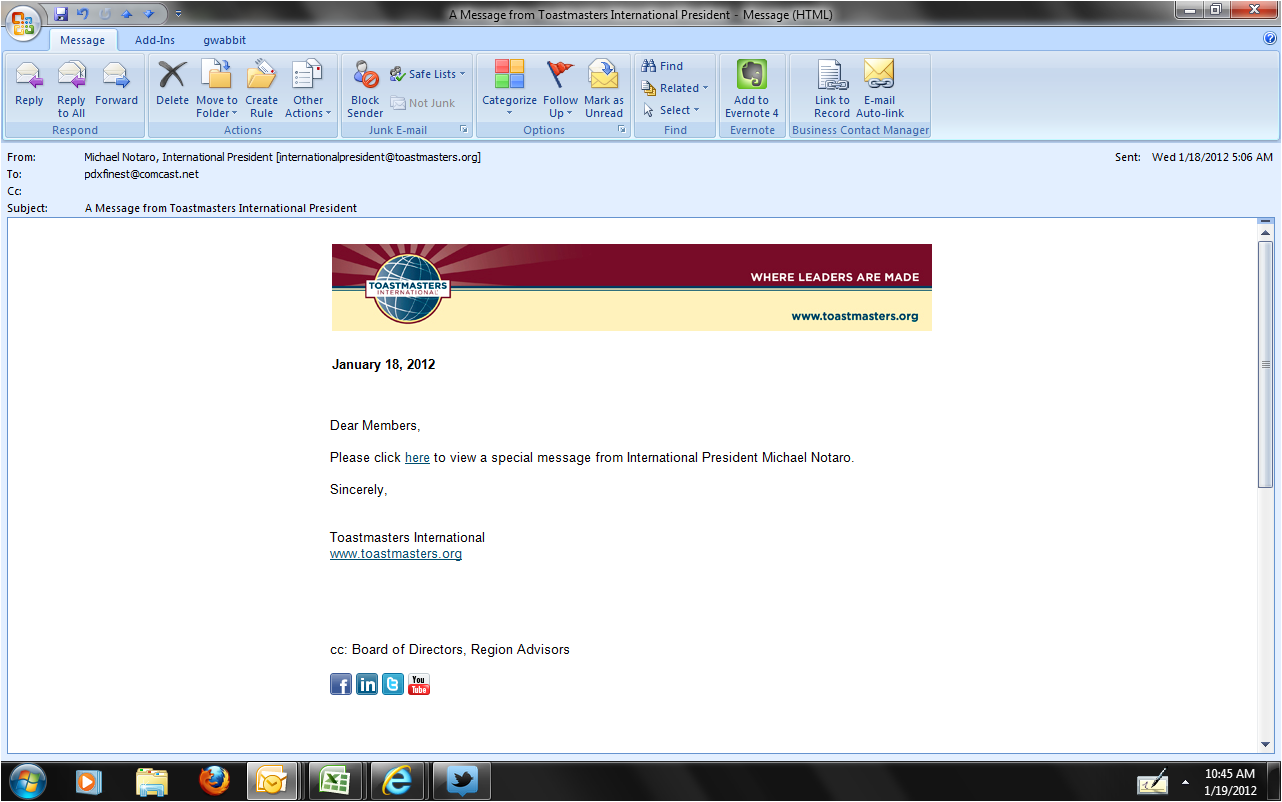
For example, there’s an email I received from the head office. Here’s the whole thing:

The pitch, in its entirety: “Please click here to view a special message from International President Michael Notaro.”

What did the message say? I have no idea — I didn’t click on it. And neither, I’ll wager, did many of the 270,000 members who received it. Whoever wrote the email did not offer me a compelling reason to click on the link.

Any time you attempt to communicate with a client or prospect, you are in the “attention-rental” business. You offer information to the recipient, who “pays” for that information with a very scarce resource: his or her attention.

What would prompt your target to open a message from you? Here are three examples:

•A discount on a product or service
•A free e-book or information kit
•An invitation to an exclusive members-only event

Make sure that when you ask for a prospect’s attention, you are offering true value in return.

__________________________________________________________________________

Email Phil Bernstein here.

Like what you’re reading? There’s more! Sign up for Phil Bernstein’s free advertising and marketing e-newsletter here. As a bonus, I’ll send you a copy of my newly-revised and expanded e-book, The Seven Deadly Mistakes of Advertising and How to Fix Them when you subscribe.

Become a Facebook Fan of “Doctor” Phil Bernstein, Portland’s Advertising Expert  here.

If you like this post, share it — click the “Share” button below.

Phil Bernstein on Susan Rich’s “Your Marketing Plan”

Last week I was interviewed by marketing expert and copywriting pro Susan Rich on her internet radio show, Your Marketing Plan.

We discussed the seven deadly advertising mistakes that businesses make, and how they can fix them. Topics ranged from copywriting to media buying to how long it takes for a campaign to work.

Click here to listen to the full interview.

And if you want a free copy of my e-book The Seven Deadly Advertising Mistakes and How to Fix Them, all you need to do is subscribe to my e-newsletter. Here’s the link to subscribe.

__________________________________________________________________________

Email Phil Bernstein here.

Like what you’re reading? There’s more! Sign up for Phil Bernstein’s free advertising and marketing e-newsletter here.

Become a Facebook Fan of “Doctor” Phil Bernstein, Portland’s Advertising Expert  here.

If you like this post, share it — click the “Share” button below.