3 Who Did It Right: A Year-End Customer Service Salute

I’ve spent some time on bad customer service lately — Best Buy, Ocean Marketing and Penny Arcade, and, of course, SuperBookDeals have offered plenty of material.

So it’s only fair to salute three companies — two national, one local — who did some small things that made things just a little bit nicer. In December alone:

  • The folks at the Lloyd Center Mens Wearhouse in my hometown of Portland called me last week to remind me that I had a $150 credit that would expire at the end of the year. Yesterday I went to the store and burned $149.49 of it.
  • ZipCar sent me an email reminding me that my drivers license was about to expire. I’d received a notice from the Oregon Department of Motor Vehicles about a month ago, and had forgotten about it. Since I’m a ZipCar member, they had my license info on file. Somebody was smart enough to realize that this kind of reminder would be quite valuable, and made it part of their automated database program. My license is now up to date.
  • And finally, a thank you goes out to Phil Schlaadt, who runs the Portland MyDoor Dry Cleaning franchise. MyDoor does dry-cleaning pickup and delivery, one of the great time-saving inventions of modern life.

    Phil Schlaadt had given his customers plenty of warning that there would be no pickup or delivery the week after Christmas. At least one of his customers (umm… Phil Bernstein) had forgotten this until late last week. I emailed him asking for a recommendation for a cleaner who’d be open.

    He had one, and went me one better — he picked up my bag of laundry last Friday and dropped it off for me at a local shop he uses. Yesterday I went by that shop and picked my laundry up. Crisis averted.

Yes, Virginia, there are people out there doing it right, and they don’t get nearly enough credit. Thank you, and Happy New Year — see you in 2012.

__________________________________________________________________________

Email Phil Bernstein here.

Like what you’re reading? There’s more! Sign up for Phil Bernstein’s free advertising and marketing e-newsletter here.

Become a Facebook Fan of “Doctor” Phil Bernstein, Portland’s Advertising Expert  here.

If you like this post, share it — click the “Share” button below.
Public Relations Pros: How Would You Help Best Buy?

You are a public relations professional, specializing in crisis management. Your client, Best Buy, took a whole bunch of orders online, and now can’t deliver.

What advice would you give them? Comment below.

___________________________________________________________________________________

Email Phil Bernstein here.

Like what you’re reading? There’s more! Sign up for Phil Bernstein’s free advertising and marketing e-newsletter here.

Become a Facebook Fan of “Doctor” Phil Bernstein, Portland’s Advertising Expert  here.

If you like this post, share it — click the “Share” button below.

More Choice = Less Action

I recently walked into a McDonald’s in Orlando, Florida carrying a simple set of instructions: return to the hotel with three Egg McMuffins and three orders of hash browns.

I walked up to the counter and placed my order.

Me: Three Egg McMuffins and three orders of hash browns, please.

Woman at counter: Our Egg McMuffins are $2.59 each or two for $3.00.

Me: Okay, give me four.

Woman: How about the hash browns? They’re a dollar each or two for $1.50.

Me (thinking furiously): Umm… okay, I’ll just take two.

A few minutes went by, and then she was back.

Woman: We’re short one round egg, and cooking one will take a few minutes. Or you can have a folded egg now.

Me: I’ll take the folded egg.

When she brought out my food she threw a couple of apple turnovers into the bag at no charge — “for the inconvenience.”

Two thoughts occurred to me as I returned to the hotel:

1. I had just gotten a screamin’ deal: four Egg McMuffins, two orders of hash browns, and two apple turnovers for about nine bucks.

2. The next time I’m in Orlando, I will go out of my way to avoid that particular McDonald’s.

The woman behind the counter probably believed that she was helping me by offering the discounts.

In reality, she was making my life difficult. I wanted a nice, simple transaction, and instead I got something complicated.

The experience stuck in my mind a few days later when I was asked to evaluate a TV commercial for an aesthetic medicine practice. The ad suggested two possible actions: call on the phone for an appointment, or log onto the practice’s web site.

I advised the clinic to simplify the message and just give viewers instructions to call on the phone. Advertisers often find that just making this simple change significantly increases the response from the campaign.

The strategy seems counter-intuitive, but the reasoning is sound: a viewer faced with a phone number and a web address in 30 seconds won’t have the time or mental bandwidth to write down both. Faced with a decision about which one to remember, many people wind up remembering neither.

In “The Paradox of Choice”, Barry Schwartz discussed a series of studies in which car buyers were offered an array of choices:

Even though their decision was purely hypothetical, participants experienced substantial negative emotion when choosing between Cars A and B. And if the experimental procedure gave them the opportunity, they refused to make the decision at all. So the researchers concluded that being forced to confront trade-offs in making decisions makes people unhappy and indecisive.

Participants in these studies showed the pattern of reluctance to make trade-offs whether the stakes were high or low. Confronting any trade-off, it seems, is incredibly unsettling. And as the available alternatives increase, the extent to which choices will require trade-offs will increase as well.

What, then, do people do if virtually all decisions involve trade-offs and people resist making them? One option is to postpone or avoid the decision.

The last thing you want when you advertise is for your prospect to postpone or avoid a decision. Paradoxical though it may seem, offering one choice instead of two will increase the likelihood that your prospect will actually take action.

__________________________________________________________________________________

Email Phil Bernstein here.

Like what you’re reading? Sign up for Phil Bernstein’s free advertising and marketing e-newsletter here.

Become a Facebook Fan of Phil Bernstein, Portland’s Advertising Expert  here.

Crackberry’s Sales Prevention Department

Here’s a story of what happens when a cranky customer and an inflexible merchant meet: both sides lose.

I’m a Blackberry user, willing (so far) to put up with the slow browser, lack of features, and iPhone envy. In return I get a physical keyboard and a comforting sense of the familiar.

I also have to deal with the fact that most of the really cool apps don’t come in a Blackberry version. So when I read about a travel app called Flightcaster, and learned that they make it for my dowdy old phone, I went right online to find and order it.

My search took me to a place called Crackberry. I pulled out my credit card and put through a $2.99 order at the Crackberry Store.

The next day I received an email which read, in part:

We are anxious to ship your order, however we need some additional information to complete the order process.

To ensure that only the authorized cardholder placed the order, we would like to verify the supplied billing information. Your order has been placed on hold until this verification is completed.

The following information is requested to ensure that the authorized cardholder placed the order. Please email or fax at least two of the following:

– Top portion of the most recent credit card billing statement showing, name, billing address and last four numbers of the credit card
– Photo copy of your driver license
– Photo copy of the front and back of the credit card before the order can be filled (optionally block out all numbers except first and last four)

My initial reaction was that this couldn’t possibly be real. It was clearly a phishing attempt from some nefarious individual intent on stealing my identity. But when I went on the Crackberry website, I found the same message in the “order status” section.

So I fired off an email to Crackberry Support:

…if you truly want a photo copy of my driver’s license and/or my credit card statement just to put through a $2.99 order – please cancel the order. Amazon doesn’t ask for this information. Zappo’s doesn’t ask for this information. Delta Airlines doesn’t ask for this information I spend a couple of thousand dollars on airline tickets. And I’m not sending it to you, either.

Before we go further, I’ll stipulate something that is probably obvious to the dispassionate observer: I didn’t need to go my-way-or-the-highway quite quickly. I could have politely asked for an explanation first. Noted.

But the support staff for an online retailer should be equipped to deal with the occasional customer who is quick to take offense.This one wasn’t.

I received an email from Jim B., a Crackberry “customer service specialist”, this morning:

Hello,

We have received your email request for the cancellation of your order. Your order has been canceled and a confirmation email has been sent.

Thank you,

Jim B.
Customer Service Specialist
Toll Free (888) 599-8998

On one hand, I’ve got to respect them. Crackberry has rules, and if a customer doesn’t want to follow those rules, they’d apparently prefer not to have the business.

But here’s what could have happened: Jim B. could have explained the situation (rampant fraud? a problem with my card number? something?), started a dialog, and tried to see if there was some way to accommodate a customer.

If we’d worked something out, and I got the app, we’d have a relationship going forward. Crackberry might have received further orders from me in amounts much larger than $2.99.

In addition, I’d have been a great referral source: I’d have shown off Flightcaster to my colleagues who travel, and told them where I bought it. More customers, and more revenue, for Crackberry.

Instead, it stops here. I don’t have the app;  Crackberry doesn’t have my money, future business, or referrals. We both lose.

Are there “customer service specialists” on your staff? How do they handle cranky customers?

__________________________________________________________________________________

Email Phil Bernstein here.

Like what you’re reading? Sign up for Phil Bernstein’s free advertising and marketing e-newsletter here.

Become a Facebook Fan of Phil Bernstein, Portland’s Advertising Expert  here.

Delta’s New Campaign Misses The Point

I’m a Delta Airlines frequent flyer. Not quite George-Clooney-“Up In The Air”-frequent, but I average two round-trips a month on the airline, have managed to hit Gold Medallion status, and have an outside shot at Platinum.

A week ago, I was one of 180 passengers who had to hike from one terminal to another at Minneapolis-St. Paul airport because Delta had parked its plane at the wrong gate. This was the third time in 2010 this has happened to me on a Delta flight.

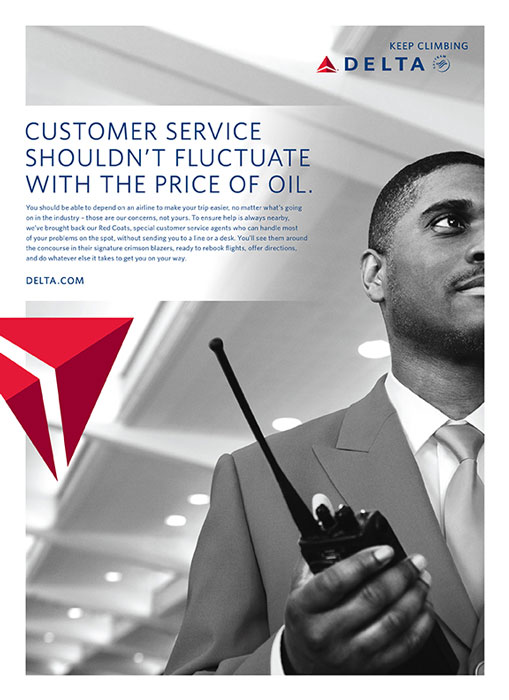
So I was amused and astonished to see  see this ad in today’s morning paper:

The substance of the message is terrific: Delta is bringing back their “Red Coat” agents to assist passengers who need help rebooking or otherwise solving problems. This is a good thing.

The problem with the ad is its self-congratulatory tone, which directly contradicts the experience of anyone who’s ever flown Delta.

You should be able to depend on an airline to make your trip easier, no matter what’s going on in the industry — those are our concerns, not yours.

Well, yes.

But this is not some secret information that only Delta knows. In fact, there is considerable evidence that in terms of dumping the industry’s problems on their customers, Delta has been one of the worst offenders for years.

Delta has consistently ranked near the bottom in national customer-satisfaction surveys. Their Skymiles frequent-flyer program is considered one of the very-worst in its availability of free tickets. Google “Delta Sucks”, and you’ll find page after page of horror stories.

Passengers really don’t like Delta Airlines.

There is significant evidence that Delta’s senior management recognizes the problem, and is taking steps to address it. The return of the Red Coats is certainly a signal of that. If the campaign told its customers, “We heard you, we know we have a problem, and we’re fixing it”, Delta would deserve applause.

Instead, this ad attempts to position Delta as if they’ve always led the charge for good service. Which reminds one of Judge Judy Sheindlin’s timeless advice:

Don’t pee on my leg and tell me it’s raining.”

Until Delta proves to its passengers that it is committed to improvement, this is one message that will be met with derision.

______________________________________________________________________________________________________

Got a question? Wanna argue? Email Phil Bernstein here.

Sign up for Phil Bernstein’s free advertising and marketing e-newsletter here.

Become a Phil Bernstein Portland’s Advertising Expert Facebook Fan here