“Showrooming” in Reverse How Online Shopping and Research Can Benefit a Bricks-and-Mortar Business

One of the biggest threats to brick-and-mortar retailers in 2012 is “Showrooming”: consumers who walk into a store with a smartphone to look at merchandise and make use of the expertise of the staff… and then make their purchase online from Internet retailer at a lower price.

Conventional wisdom holds that because of the “Showrooming” phenomenon, the Internet is a huge threat to bricks and mortar retailers. There is a great deal of validity to this argument, but an interesting counter-argument has emerged:

Dan Kennedy’s marketing newsletter tipped me off to an article in Internet Retailer Magazine about the opposite phenomenon. The article discusses Patagonia, who saw a great deal of traffic to their iPad app without a corresponding jump in sales via the tablet. Mark Shimahara, Patagonia’s Internet Marketing Manager, initially thought that there was a problem with the app itself.

 “But after talking with store managers,” he says, “we realized that people were using the phone application to do their window shopping and would show up at our stores with the device in hand and product on their screens, saying, ‘Do you have this in stock?’ It’s a great example of how we are entering the age of omnichannel marketing.”

Staples Inc. faces a similar situation, though involving small-business owners, the office supply chain’s core customers, says Brian Tilzer, vice president of e-commerce and business development. He says small businesses increasingly use Apple and Android smartphones and even tablets to research products, check inventory and otherwise prepare for what he calls the “in-store shopping experience.”

30% of consumers, the article reports, begin their product search and research on Amazon.com, while another 13% begin that search on Google. Some will buy online, but others will wind up into an honest-to-goodness bricks and mortar store. Maybe yours.

Conclusion? For local business, Internet shopping is both a threat and an opportunity. To make it pay off, you need to have:

  • A strong online presence. Even if you are not selling over the Internet, you need to be easily found on the Internet.
  • The inventory, staff expertise, and customer centric mindset necessary to convert those Internet window shoppers into paying customers when they walk into your store.
  • The ability, and the willingness, to aggressively capture customer contact information when they visit your business in person or call on the phone.
  • The ability, and the willingness, to follow up with those customers after you have captured their contact information.

__________________________________________________________________________

Email Phil Bernstein here.

Like what you’re reading? There’s more! Sign up for Phil Bernstein’s free advertising and marketing e-newsletter here. As a bonus, I’ll send you a copy of my newly-revised and expanded e-book, The Seven Deadly Mistakes of Advertising and How to Fix Them when you subscribe.

Become a Facebook Fan of “Doctor” Phil Bernstein, Portland’s Advertising Expert  here.
Why Subtlety Doesn’t Work Anymore

A couple of years ago, author/public speaker/comedian Andy Nulman wrote a blog post discussing his challenges as he gets up in front of an audience:

“The Internet has changed everything. It has contracted attention spans to an almost ridiculously-microscopic measure, and has sung the swan song for the concept of subtlety. For example, the old ‘speaker’s adage’ used to be:

  • Tell ’em what you’re gonna tell ’em
  • Tell ’em
  • Tell ’em what you told ’em

These days, the audience fidgets through the preamble, tweets during the middle and are out the door before the recap.”

Nulman wrote this in 2010. A recent article on emarketer.com details how, two years later, the rise of the smart phone has affected what your customers do while you’re commercial plays:

A May 2012 report authored by the IAB and Ipsos MediaCT, which drew on data from three surveys of US consumers, found that internet-enabled devices were not displacing other media-related activities, but adding to them. According to the Ipsos MediaCT LMX survey, the average amount of time that respondents spent engaging with media each day climbed to 9.6 hours in 2011, from 9 hours in 2009.

Time spent online or on a computer jumped to 3.1 hours from 2.5 hours over the same period. But the amount of time respondents spent watching TV held steady, at 3.4 hours. eMarketer estimates that US adults spent an average of about 11.5 hours per day consuming media content in 2011…

Here’s what this means to you: no matter what medium you are using to deliver your sales message to potential customers —  this applies to radio and newspaper in addition to TV — your customers now have a smartphone, and a choice. They can pay attention to your message, or:

  • They can check their e-mail, or send a text,
  • They can update their status on Facebook, or send a tweet.
  • They can watch a cat video on YouTube.

In fact, it is likely that they are doing one of these things as they are watching, listening to, or reading your ad. This means you have got to get to the point in a hurry. You need to deliver a benefit statement and capture attention immediately. Nulman put it this way: “No salad, just the main course”.

If, instead, you decide to “ease into it” you may find that the only thing your prospects remember later is Baby Monkey Riding on a Pig.

How NOT To Do an Email Campaign

I’m a member of a local Toastmasters group in my hometown of Portland, Oregon, and recommend Toastmasters to anyone who wants to get better at public speaking or presentation skills.

Toastmasters International has, over the years, come up with a very effective formula for helping its members get better at oral communication. Unfortunately, there is some evidence that they haven’t quite figured out online communication yet.

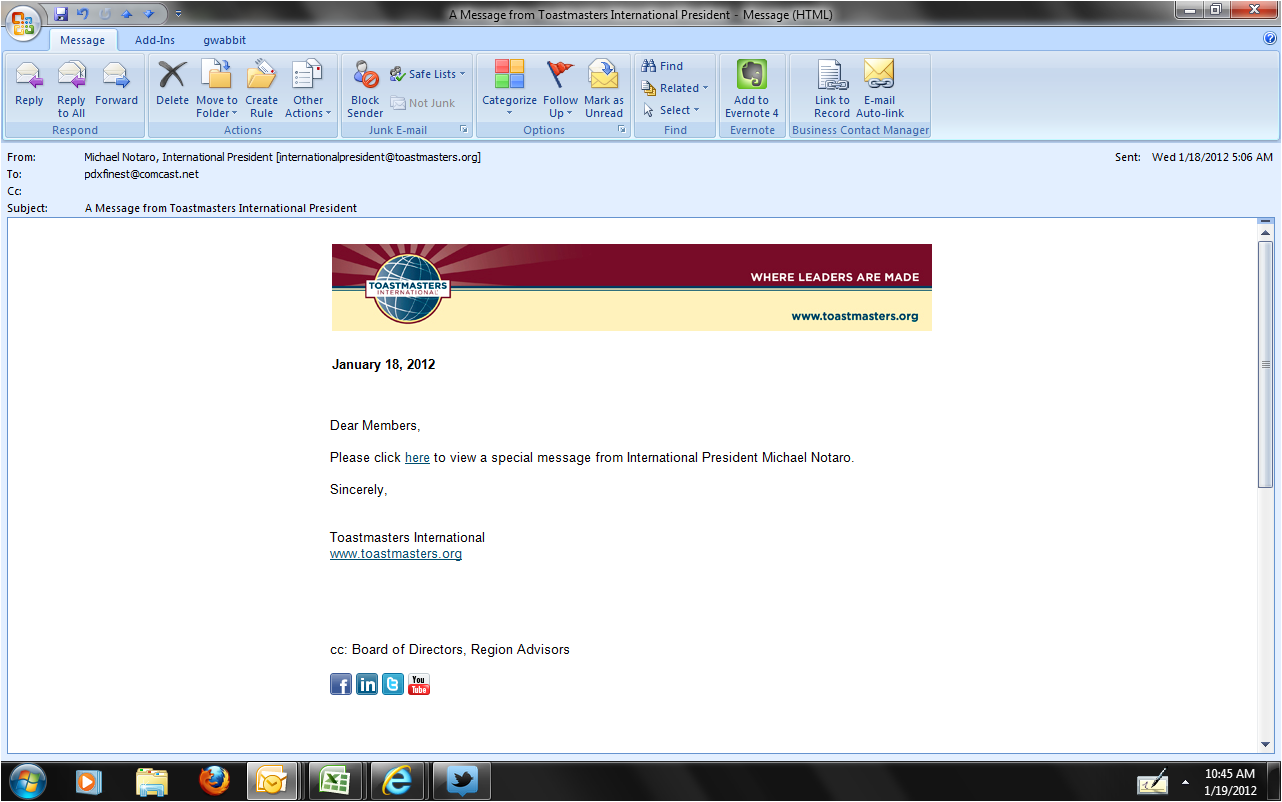
For example, there’s an email I received from the head office. Here’s the whole thing:

The pitch, in its entirety: “Please click here to view a special message from International President Michael Notaro.”

What did the message say? I have no idea — I didn’t click on it. And neither, I’ll wager, did many of the 270,000 members who received it. Whoever wrote the email did not offer me a compelling reason to click on the link.

Any time you attempt to communicate with a client or prospect, you are in the “attention-rental” business. You offer information to the recipient, who “pays” for that information with a very scarce resource: his or her attention.

What would prompt your target to open a message from you? Here are three examples:

•A discount on a product or service
•A free e-book or information kit
•An invitation to an exclusive members-only event

Make sure that when you ask for a prospect’s attention, you are offering true value in return.

__________________________________________________________________________

Email Phil Bernstein here.

Like what you’re reading? There’s more! Sign up for Phil Bernstein’s free advertising and marketing e-newsletter here. As a bonus, I’ll send you a copy of my newly-revised and expanded e-book, The Seven Deadly Mistakes of Advertising and How to Fix Them when you subscribe.

Become a Facebook Fan of “Doctor” Phil Bernstein, Portland’s Advertising Expert  here.

If you like this post, share it — click the “Share” button below.

Phil Bernstein on Susan Rich’s “Your Marketing Plan”

Last week I was interviewed by marketing expert and copywriting pro Susan Rich on her internet radio show, Your Marketing Plan.

We discussed the seven deadly advertising mistakes that businesses make, and how they can fix them. Topics ranged from copywriting to media buying to how long it takes for a campaign to work.

Click here to listen to the full interview.

And if you want a free copy of my e-book The Seven Deadly Advertising Mistakes and How to Fix Them, all you need to do is subscribe to my e-newsletter. Here’s the link to subscribe.

__________________________________________________________________________

Email Phil Bernstein here.

Like what you’re reading? There’s more! Sign up for Phil Bernstein’s free advertising and marketing e-newsletter here.

Become a Facebook Fan of “Doctor” Phil Bernstein, Portland’s Advertising Expert  here.
If you like this post, share it — click the “Share” button below.

Are You Making These 7 Deadly Advertising Mistakes?

The short version: subscribe to the Phil Bernstein on Advertising Newsletter here, and I’ll send you a copy of my newly-revised-and-expanded report, The Seven Deadly Advertising Mistakes and How to Fix Them.

The newsletter is free, it comes out by email twice a month, and you can unsubscribe any time you want to.

Here’s the long version:

There are seven common mistakes that companies make when they advertise. If you’re making any of them – and many businesses make more than one – the odds of success plummet, and your marketing dollars are wasted.

Correct these mistakes and your advertising could become 30 to 60 percent more effective – in many cases, without spending any more money.

I’ve spent thousands of dollars of my own money, and tens of thousands of hours, studying the work of the smartest and most successful copywriters, marketing gurus, and salespeople. Claude Hopkins, Dan O’Day, John Carlton, Perry Marshall, Dan Kennedy, Jim Doyle… I’ve bought their books, listened to their CD’s, and attended their seminars.

For the past eighteen years, I’ve put their theories and methods to work on behalf of hundreds of local businesses. From car dealers and real estate agents to window retailers to a school for troubled adolescents, I’ve designed campaigns to bring them new customers.

Has every campaign been a huge success? No. Some had just okay results, and a few were outright bombs.

But I discovered that the bombs had elements in common, and so did the home runs. And that it was possible to take a floundering campaign and make it successful by fixing some very simple and common mistakes.

Among them:

  • Too much information
  • No call-to-action
  • Flunking the “So What” test

If you want the whole list, plus actionable advice about what to do, here’s a free way to get it:

I’ve written a white paper called The Seven Deadly Advertising Mistakes and How to Fix Them. If you want it, I’ll send it to you at no charge. All you need to do is subscribe to the Phil Bernstein on Advertising eNewsletter, which is also free.

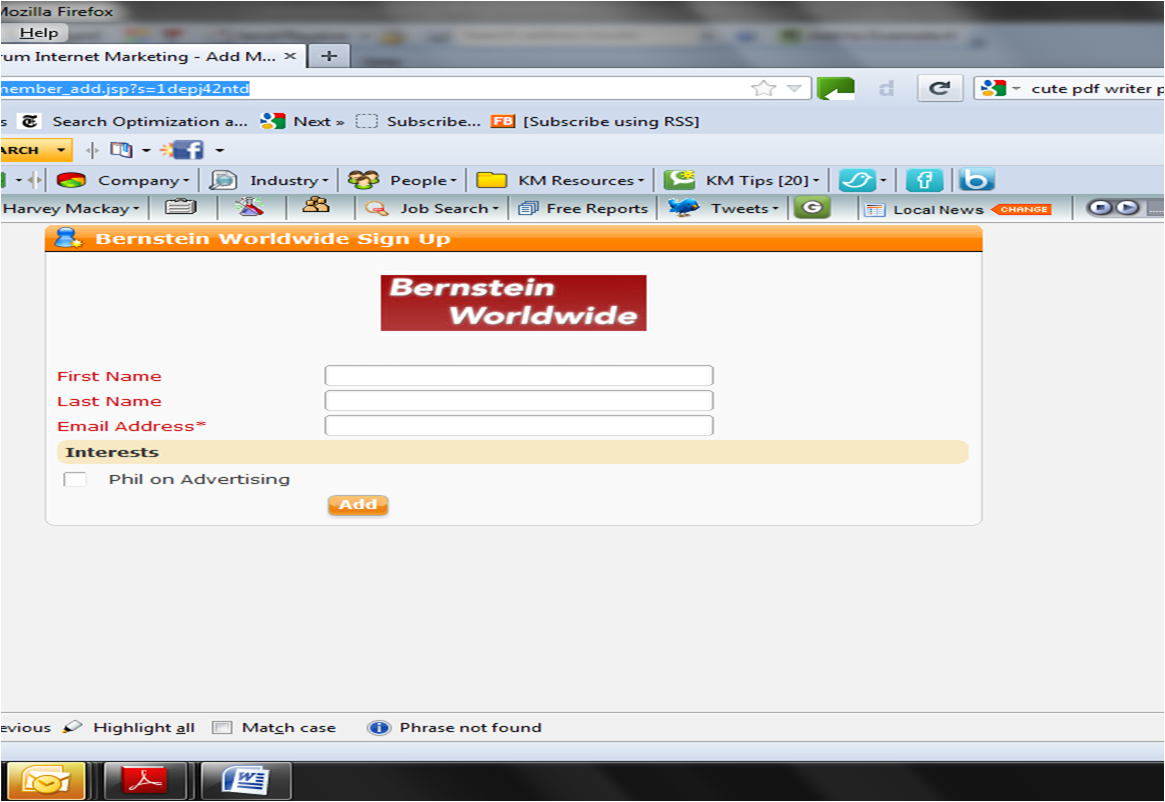
Click this link to subscribe, and I’ll send you the white paper. The link will take you to something that looks like this:

You’ll automatically get a copy of the current newsletter, and as soon as I see your name in the subscriber list I’ll email you a copy of the report.

__________________________________________________________________________

Email Phil Bernstein here.

Like what you’re reading? There’s more! Sign up for Phil Bernstein’s free advertising and marketing e-newsletter here.

Become a Facebook Fan of “Doctor” Phil Bernstein, Portland’s Advertising Expert  here.

If you like this post, share it — click the “Share” button below.