
How to Make Money on Google’s New Mobile Policy: Opportunity for Media Salespeople

It’s not news that more and more searches are being done on mobile devices. Nor is it news that many of our clients have not gotten around to making their websites mobile-friendly.

The time to do something about that is now — and that creates opportunity for those of in television, radio, or digital sales.
radio sales tip: sell mobile media
photo by tuomaslehtinen/dpc

 In August of 2014, Comscore released a study showing that a majority of US digital consumption now takes place on mobile apps. According to Telecrunch:

U.S. users are now spending the majority of their time consuming digital media within mobile applications, according to a new study released by comScore this morning. That means mobile apps, including the number 1 most popular app Facebook, eat up more of our time than desktop usage or mobile web surfing, accounting for 52% of the time spent using digital media. Combined with mobile web, mobile usage as a whole accounts for 60% of time spent, while desktop-based digital media consumption makes up the remaining 40%.

Here is some news that might give your clients a reason to mobile-optimize their websites now: beginning April 21, 2015, Google’s will start giving extra ranking credit to the websites that it considers mobile-friendly. In other words, even if your client’s site ranked well before, it could drop in the rankings if it doesn’t meet Google’s mobile standards.

This round will only apply to mobile search, so desktop search rankings will not be affected… yet.

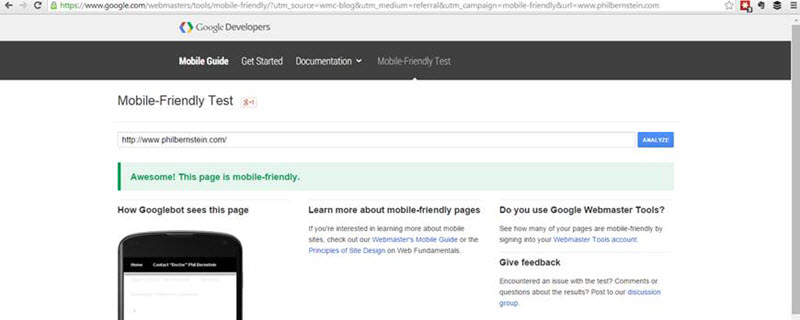
How can you find out if a site passes? Google has a free tool that allows you to test any site. You can find the tool here: https://www.google.com/webmasters/tools/mobile-friendly/

A mobile-friendly page will bring back a result that looks like this:
radio sales tip: sell mobile media
My advertising, marketing and sales training blog passed!

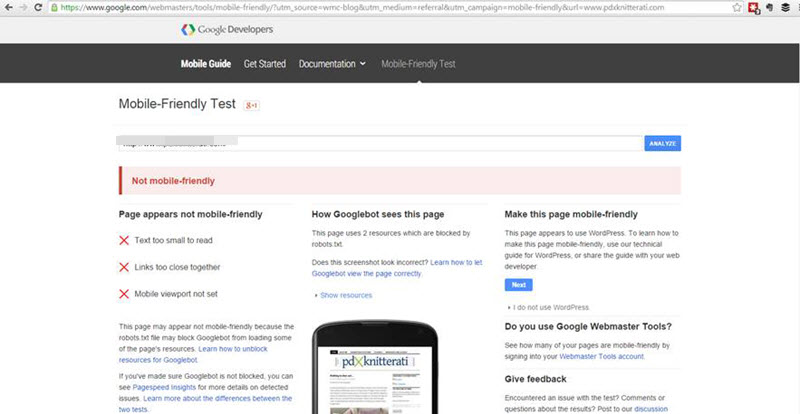
A page that doesn’t pass Google’s test will look like this:
Another tip for radio salespeople: sell mobile media
This blog failed Google’s test

How You Can Make Money On This Right Now

[bctt tweet=”Before every sales call, run the client’s website through Google’s Mobile-Friendly Test.”]

·       If it doesn’t pass, print out a copy of the result in color.

·       Take a screen shot of the client’s site on your mobile phone, email it to yourself, and print the image out in color.

·       Talk to your company’s digital department. Can your station offer help – for money — in making a site mobile-friendly?

·       If so, prepare a proposal. The proposal should include the results of Google’s test and the mobile screen shot of their site.

·       If not, bring the Google results and screen shot out to your client anyway. Doing this will help position you as a true consultant rather than a package peddler.


Keep the conversation going — share this post on Facebook, LinkedIn and Twitter!

Should You Burn Your Media Kit?

The human heart creates enough pressure when it pumps out to the body to squirt blood 30 feet. This information can be found at a website that is full of useless facts.

You know what else might be full of useless facts? Your station’s Media Kit.

Radio advertising sales tip: burn your media kit
PHOTO BY ILYA AKINSHIN/DPC


We tend to grab pages from the Media Kit without thinking much about the information we’re passing along. Before your next sales call, take a cold hard look at what’s in the folder. How much value is it really providing?

A few weeks ago, I was working with a television station sales department in a Midwest market. We’d had a great week of needs analysis calls, and I had finished the first drafts of all the proposals. It was up to the account executives to add the television and digital advertising plans, along with information about why their television station was the best choice for the client.

I opened a revision from salesperson, and in the “Why Our Station ” section was a page that said, “WXXX was recently chosen the Best Local TV Station by the readers of Springfield Magazine.” (Call letters and market name have been changed to protect the guilty).

I’m going to go out on a limb here and state that nobody cares what the readers of Springfield Magazine think of the TV station.

The viewers don’t care.

The employees of Springfield Magazine don’t care.

The customers weren’t going to care, either. This information was not going to move anyone any closer to spending money on the station.

And yet, there it was… in that proposal and four or five others from the same staff. It was in there because someone in the station marketing department had made that page and put in the media kit. The path of least resistance was to copy that page and paste it into the proposal.

HUGE MISTAKE

Slapping media kit pages into your presentation is the easiest thing to do, and it’s a huge mistake. Media kits are often written by somebody who’s never met your station’s clients, and has no idea what customers really want to know. Without major modification, media kit pages do not belong in your proposals.

Here are some common media kit subjects that your clients don’t care about:

·       The “Award-Winning News Department.” News awards are like youth soccer trophies: everybody gets one. All of your competitors have “award winning news”, too.

·        The station’s share of adults 25 to 54… when the client’s customers are all 55+.

·        A pie chart showing that 56% of some survey’s respondents believe that your medium is “the most influential”.

Here’s what the clients will care about: bringing new customers to their businesses and making more money.  Your clients and prospects care about themselves. 

When it comes time to do an important presentation for major dollars, burn the media kit. Take the extra time to write each page from scratch — make it about your customer, not about you.

Before including any piece of information in the proposal, ask yourself: “If I were the client, would this information cause me to want to buy the plan we’re proposing?”

Be ruthless about this. If the answer is no, leave it out.

[reminder]Agree? Think I’m crazy?[/reminder]

How to Reach “The Right People” With Your Advertising

When you work on a marketing campaign, how can you make sure you’re targeting “the right people” with your message – the people who are most likely to do business with you?

Radio advertising sales tip: television reaches the right people, too.
Photo by creative soul/dpc

Advertising salespeople have access to a variety of research tools to make some educated decisions about the kind of people who are listening to, reading, watching, or logging onto their media. And a lot of time, effort and money are spent in trying to pick the vehicle that reaches The Right People.

Here’s a tip:  the problem with this approach is that nobody has an exclusive on The Right People.

The Right People are watching television — a whole lot of television. They are on the Internet — sometimes on a laptop, often on a mobile devise. They listen to the radio. They see billboards. Some still read the newspaper on paper.

Any advertising medium you decide to use will reach some of your target customers, and will miss others.

Further complicating the picture is the fact that very few people make decisions by themselves. People talk to each other and influence each other’s choices. The end user may or may not be the person who decides what to buy.

In large companies, office equipment may be used primarily by administrative personnel. But the sales order may be issued by someone in the purchasing department. And orders over a certain size may need the blessing of the controller or even the CEO. All of those people may even seek advice from colleagues at other companies. When you’re marketing office equipment, what target do you choose?

A few years ago, a Wall Street Journal article revealed how the Phi Beta Kappa college honor society solicits members:

You get a letter during junior or senior year, with congratulations and a request to pay an initiation fee (generally $50 to $90). If you don’t respond, some chapters send a follow-up letter to your parents.”

Who makes the decision to enroll in Phi Beta Kappa – the student or the parents? 

In 2013, the Obama Administration needed to convince adults under 35– the so-called “Young Invincibles” — to buy health insurance. They spent some time and effort targeting them directly, but they also went after their moms.

It might seem counterintuitive that adults, many of whom have left home and started their own families, would be convinced by their aging parents to buy health insurance. But research shows that today’s 20 and 30-somethings — sometimes referred to as “millennials” — are closer to their parents than were adults from earlier generations and still rely on them for important career and other decisions…

“They have just recently left their parents to go to college, they’ve just kind of left the nest, but they’re still very close to their parents and specifically moms,” Brown said. And, even more importantly, “many of these young people are still in some part financially dependent on their parents. That’s when especially the mom enters these decisions.”

You can spend a lot of time agonizing over the question. The beauty and the curse of marketing is that there’s no one right answer. The odds are pretty good that whatever media choice you make (“Elizabeth Warren for President” on  Fox News being a possible exception), you’ll reach a significant number of The Right People, and you’ll miss some others.

Make sure that the people you do reach hear your message often – the more often you talk to someone, the better the chance he’ll give you a call when he has a need.

Then, using the time you saved by not agonizing over your media choice, agonize over your message. Make sure that your story matters to your prospects, that you tell it well, and that you tell it often.

[reminder]How do you decide who The Right People are for your business?[/reminder]

Why Isn’t Your Advertising Working? (Don’t Blame The Media)

Some reasons to ponder come courtesy of a Roy Williams’ Monday Morning Memo essay, from way back in 2008. Read the whole thing here. Every point he makes is still valid today. Here are a couple:

 2. reputation.
Consider the people who don’t buy from you. Are they buying elsewhere because they haven’t heard about your company, or is it because they have? I’ve never met a business owner willing to believe their company had a bad reputation…
 

7. media myths.
Are you anxious to find a more effective media? If so, you’ve got really bad ads. I’ve never seen a company fail because they were using the wrong media or reaching the wrong people. But I’ve seen thousands fail because they were saying the wrong things. A powerful message will produce results in any media.

Radio Advertising Sales Tip: Television Works!
Photo by Aurelio/dpc

In my advertising sales/consulting practice, I meet with about 200 local businesses each year.

  • They hear from television advertising salespeople, telling them to get out of radio because radio doesn’t work.
  • They hear from radio advertising salespeople, telling them to get out of newspaper because newspaper doesn’t work.
  • They hear from social media “experts” telling them to get out of radio, newspaper and television because traditional media doesn’t work.

Here’s the dirty little secret I pass along to them:

There are plenty of potential customers who watch television, listen to the radio, read the newspaper, and consume media online every single day. When I hear that the advertising isn’t working, it’s generally one (or more) of three problems:

1. They didn’t get the message right. You’ve got to tell a story your audience cares about, and give them a good reason to do business with you.

2. They aren’t delivering the message often enough, or consistently enough. Customers will buy when they’re ready and not a moment before. You need to keep reminding them.

3. They don’t deliver on the promises their advertising makes, and the audience doesn’t believe them.


If you tackle the issues above, you’ll get the advertising to work. If you don’t, switching media isn’t going to help.

[reminder]


Are You Making This Embarrassing Mistake With LinkedIn?

Ani DiFranco once said that every tool is a weapon if you hold it right. LinkedIn can be a very powerful sales weapon — but it will backfire if you don’t use it correctly.

the wrong way to use a radio advertising sales tool
Photo by apops/dpc

LinkedIn has become a powerful tool for researching and making contact with new prospects. But like any other tool, there’s a right way and a wrong way to use it. I’ve received a couple of egregious “wrong way” examples in the past couple of weeks.

Both came from members of LinkedIn Groups I’m also part of. The writers have figured out that being part of these groups gives them the ability to contact complete strangers who are also members. They have not figured out how to use that ability.

The first one started like this:

Hi Doctor

Hope you’re doing well.

I wanted to take a few minutes from you today to mention how “hosted” video conferencing is changing real time collaboration. Although most of us know what video conferencing is, the only difference here is the word “Hosted”. Like every technology, now video conferencing is available on demand on cloud.

Here is a whitepaper that will tell you why this technology is spreading like a wildfire.

She wanted to “take a few minutes from me today”, but she offered no reason to give her those precious minutes. It would have been helpful if she’d “taken” a few minutes of her own to learn something about me before sending the message out.

The other one went like this:

Hi,

I saw your profile and felt you might fit the profile of what we look for in our company (Elite Sales experience to the SME/Enterprise Space)

Can you please review this YouTube video of our company and what we offer, and then give me your feedback on interest level?

No, I can’t. Or, more accurately, I can, but I won’t.

Any time you attempt to communicate — on the phone, in an email, or a LinkedIn message — with a client or prospect, you are in the “attention-rental” business. You offer information to the recipient, who “pays” for that information with a very scarce resource: his or her attention.

You must offer a compelling reason for your target to give you that attention. It starts with giving some indication that you know something about them.

I suspect that the folks who sent me those messages were attracted by the ability to blast out hundreds of them with the click of a button. It’s fast, it’s easy, and requires very little thought.

It’s also spam, and they’re running the risk of having their LinkedIn accounts suspended.

With great power there must also come great responsibility. — Spiderman’s Uncle Ben

Membership in a LinkedIn Group gives you the ability to find common ground with complete strangers and build relationships with them. But it’s only an effective weapon if you hold it right.