
Why You Should Be “The Salesperson Who Can Write Copy”

Recently I got an email out of the blue from a real estate guy in California, looking for help with a radio script.
salespeople should know how to write
photo by aleksandr/dpc

I’d never met him before, and asked how he found me. It turned out that he’d Googled “Best Real Estate Radio Ads”, and that took him to a video testimonial I’d recorded years ago after attending Dan O’Day’s Radio Copywriting Masters Class in Los Angeles.

I’d forgotten about the testimonial, but I’m reminded almost every day of the benefits that coming with being “The Salesperson Who Can Write Copy”.

5 Reasons Why You Should Be “The One Who Can Write Copy”

  1. Your competitors can’t do it.  Face it: there are a whole lot of advertising salespeople. Every day your clients and prospects are hearing from other radio, television, digital, print, and transit/outdoor sellers. If you learn to write an effective advertising message, you are likely to be the only one who doesThis will immediately set you apart.
  2. It changes the conversation. While everyone else bores your client with rankers, graphs, and fire-sale packages, you’ll be talking with them about something they care about — telling their story and making more sales.
  3. Better Copy = Better Results = Renewals. You will talk to a lot of business people who have tried, and cancelled, lots of different media… because it didn’t work. If you bring them something that actually delivers results, they’ll stay with you forever. Renewals are where you make the real money.
  4. Other doors will open for you. Your clients will refer you to other businesspeople they know. And the competition will think of you when they have openings at their properties. Even if you’re happy where you are, it never hurts to have other options.
  5. It may bring you some outside income. As I became known around town as The Salesperson Who Could Write Copy, outside opportunities to write for money came my way. I was careful not to take on jobs that represented a conflict of interest — at the time I was, first and foremost, an employee of Clear Channel Radio — but over the years I picked up some nice checks on copywriting projects.

These days my time is limited, but I still take on freelance projects from time to time…because I can.

Listening to that testimonial (Dan interviewing me), I was reminded I’d spent over $2500 out of my own pocket — tuition, airfare, and hotel — to attend that class. I made a profit within a week of my return by presenting a script idea to a Portland real estate firm and banking the commission on an $18,000 new direct sale.

I’m still making money with those skills today.

You can listen to the interview here — it took place in 2007, when I was still a salesperson for Clear Channel:
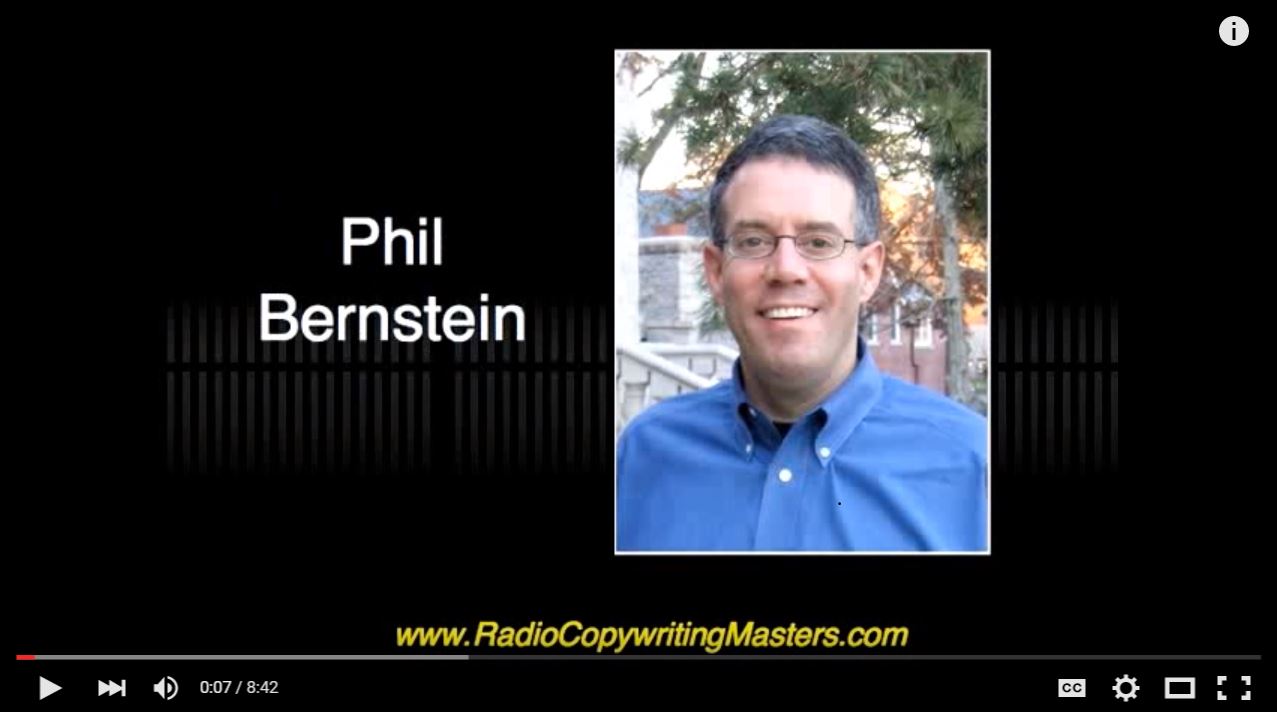
copywriting masters youtube

[reminder]What are your best sources for copy ideas?[/reminder]

 

What a Mattress Guy Taught Me About Advertising In the Dead Times

This conversation happened nearly 20 years ago, but it fits 2016 just fine. It’s a radio story but it applies perfectly to television advertising… or newspaper advertising… or transit advertising… or digital advertising.

Mattress advertising sells mattresses all year long
Photo by Pavel Losevsky/dpc


There is a large mattress chain on the West Coast called Sleep Train, founded in Sacramento by Dale Carlsen. They were a customer of mine when I worked in Portland radio.

When Sleep Train first came to Portland — probably in the mid to late 90’s —  Dale used to buy the media himself. Once a year he would fly from Sacramento to Portland and meet with every station in town. He would choose the stations he wanted to work with and negotiate a 52-week contract with each one.

You either got 52 weeks or nothing. I always got 52 weeks. As a commissioned salesperson, I liked this arrangement a great deal.

It took me two years to work up the nerve to ask him a question. He was in town and we were having lunch.

I asked him what the store’s worst month of the year was.

He answered, “December. We can’t compete with Santa Claus – December’s always horrible.”

I screwed up my courage and plunged ahead. “You’re going to be on the air every week in December, just like the rest of the year. Why do you do it if customers aren’t buying mattresses then?”

His reply has stuck with me for nearly two decades:

“Our research shows that people buy mattresses every 7 to 10 years. They’re usually ‘in the market’ for three days. They wake up one day and their back hurts… out of town visitors are coming and they need a bed for the guest room… they are moving into a new home.

“Whatever the reason, they’re going to buy a mattress from someone within three days. If it’s not my store, I have to wait another 7 to 10 years to have another shot at them. I want to talk to them every single week, so whenever they decide to shop for a mattress their car drives to Sleep Train by itself.”

That’s the value of advertising of advertising “out of season” – advertising makes an impact even if people are not in the market right that second.

I’ve long since lost touch with Dale Carlsen, but last year I read that he’d sold Sleep Train for $425 million. Not bad for what started as a single store in Sacramento, with Carlsen delivering mattresses in his pickup truck.

Not everyone has the money to do 52 weeks the way Sleep Train did, but many can be on the air consistently, 12 months a year. You just need to give them a good reason to do it.

Making a car drive by itself just might be that reason.

What to Do When They Hate Your Idea

Recently I presented a carefully-thought-out campaign idea to some people who run an auto dealership. They didn’t like it.

radio tv sales tip: you can recover if they hate your idea
Photo by DDRockstar/dpc

It was at the end of a week in which I’d already made 16 presentations, and gotten a positive reaction to my recommendations on the vast majority.

But I missed on this one. Big time.

The head of the dealership politely but emphatically explained that my idea did not fit the personality of his stores. It did not project the image that he wanted the public to have of his already-very-successful-business.

I was offering a strategy to aggressively go after new markets. He was happy with what he already had, and didn’t want to mess with a winning formula.

Sales Skills:
What Do You Do When The Client Hates Your Idea?

It’s never fun when your idea bombs. But there are steps you can take to get the conversation back on track:

Ask some questions to make sure you fully understand the objection. It’s not enough to know that the client doesn’t like something. You need to know what they’re not comfortable with, and why. This will help you determine if your idea can be tweaked, or if you need to start over.

Explain the rationale behind the strategy you chose. If you still believe in your idea after you’ve probed the objection, take a moment to defend it and show how it fits for them. Sometimes it turns out that the client didn’t understand your initial explanation.

Seek common ground. It might be possible to modify your idea in a way that addresses their concerns and still delivers the right result.

Don’t get defensive, and don’t argue.   Jeb Blount, author of the book Fanatical Prospecting, puts it this way:

Scores of salespeople try to argue their prospects into changing their minds — to prevail with debate. This is why prospects lie to us. They expect when they say no that they’ll face a battle and be disrespected.

…Overcoming doesn’t work. There is a universal law of human behavior: You cannot argue another person into believing they are wrong. The more you push another person, the more they dig their heels in and resist you.

Be willing to look for another solution. The fact that your client disagrees with you doesn’t mean they’re stupid. The concerns may have merit. There may be another way to attack the problem. As Jeb Blount recommends, “If the horse is dead, dismount.”

Recognize that sometimes “No” gives you the tools to get to “Yes.” There are cases where the fastest way to learn what clients want is to first find out what they don’t want. In Ask, his book about online surveys, Ryan Levesque discusses a struggle we’ve all been through:

Think about the last time you and a group of friends were hanging out and thinking about where to go out to eat. You are all sitting around and someone says, “Hey, anybody hungry? What you all feel like doing for dinner?”

What’s the most common response? “I don’t know, what do you want?”

Sometimes that conversation goes around in circles – endlessly.

Why? Because, at the end of the day, people don’t know what they want.

However, if you’re hanging out with that same group of friends, you can ask a different sort of question: “Well, is there anything you don’t feel like eating for dinner tonight?”

Interestingly, people are much better at answering that type of question.

Your friends might say, “I don’t feel like pizza because I’m trying to eat gluten-free.” Or “I don’t want to do sushi because I’m allergic to shellfish.”

People are really good at telling you what it is they don’t want.

Similarly, you can also ask each of your friends one by one, “What did you have for dinner last night?” People are also very good at answering that question as well.

The reason why is because people essentially are only good at answering two basic types of questions when they don’t know what they want: what is they don’t want, and what they’ve done in the past.


In the end, that’s what saved my meeting with the car dealers.

Learning what they didn’t like opened up a conversation that offered us some strong clues on what they would like. The head of the store and one of his managers tossed out several suggestions that made a lot of sense. We are working on crafting those suggestions into a new strategy to put in front of them.

When the meeting’s over, see what you can learn from the experience. I’ve gone back through my notes of the initial needs analysis, trying to figure out what I missed. I’m convinced that there’s a question or two I could have asked at the first meeting that would have taken me down a different, and better, path.

[reminder]How do you handle it when a proposal bombs?[/reminder]

Why a Little Dabbling Will Doom Ya

A West Coast Toyota dealer delivered a great lesson to a TV salesperson recently. And I got to watch.

Media sales tip: make sure they eat enough
photo by puhhha/dpc

The dealer was a loyal, consistent radio user — in fact, he told us that he spent nearly $50,000 a month, every month, on radio. He’d done this for years.

He would occasionally advertise on the TV station I was working with. On those occasions, he’d average about $3-4000 a month, generally for a couple of months.

On radio, he runs local ads making a strong offer. On TV, he’d use the manufacturer’s creative — 25 seconds about the Camry with a 5-second dealer tag at the end.

I asked him: “Which works better for you — radio or TV?”

His reply: “Radio’s always worked for us. We’ve dabbled in TV, but it’s never worked as well as radio has.”

This was a needs analysis call, and I have a rule on needs analysis calls — no arguing. So I bit my tongue until the AE and I were back in the car.

  • He spends 50 grand a month on radio, 12 months a year, using copy that sells for his dealership.
  • When he “dabbles” in TV, it’s with less than 10% of his radio investment, for a couple of months at a time, using national image ads.

Of course radio works better for him!

This applies to all media choices. Over the years I’ve seen plenty of cases where the investment levels were reversed — advertisers making a genuine commitment to television and dabbling in radio. Those advertisers invariably decide that TV works better.

I’ve watched major long-time advertisers on TV or Radio Station A  give Station B a small short-term “test”. Inevitably, they conclude what they “knew” all along — Station B just doesn’t work as well as Station A.

As media sellers, we get mad at these clients for not giving our medium a fair shake, but some of the blame belongs with us. Because we let them do it.

Every time we accept a small order from a big advertiser…

Every time we let them “test” our station for a month…

Every time we let them dabble when we know that they need to make a real commitment…

…we create another client who tells everyone that “I tried [name of medium here] and it didn’t work.”

Don’t let ’em dabble.

[reminder]How do you convince new clients to make a real commitment?[/reminder]


Don’t Sell Prevention — Sell the Cure

“Why isn’t the service contract campaign working?”

sell the cure, not prevention
Photo by Syda Productions/dpc

The question came from a television station Account Executive in the Southeast. He was working with an HVAC contractor who wanted to promote maintenance service agreements. The commercial had been running for about three months and had generated very few calls.

I’ve met with more than a few heating and air dealers and auto repair shops who have done very well with service plans — they are a terrific source of predictable, ongoing revenue.

But the most successful ones have told me that the general public isn’t particularly interested in a service agreement. The best source of leads for such plans are existing repair customers.

Why?

Perry Marshall, author of 80/20 Sales & Marketing, explains it this way:

People don’t buy prevention, they buy a cure for their existing problem. If you want to sell it, it’s much easier to sell it as part of a cure than trying to convince someone who’s never had the problem in the first place.”


This applies many categories:

  • When are we most likely to sign up for automated computer backup? Right after our computer crashes.
  • Many of us don’t make the effort to exercise or eat right… but we’ll pay for the gym membership or diet plan to get rid of the weight we gained through poor nutrition and inactivity.
  • Hundreds of thousands of Americans will not bother to get a flu shot… but they’ll head right to the doctor and demand antibiotics once they get sick.

As we strategized about the heating-and-air campaign, I  gave the Account Executive some advice that a very smart HVAC guy once gave me:

The best time to sell a service contract is when we’re in the customer’s home, working on their broken air conditioner.”

The best way to generate more service agreements? Go after emergency repair customers. That’s the advertising target.

Sell the cure.