Is Your Website Killing Your Campaign?

Is your website working against the rest of your advertising? A poorly-conceived site can stop the traffic dead in its tracks.
Old Window Grid

Photo Credit: Free HDR & Photomanipulations – www.freestock.ca
via Compfight cc


I met recently with a personal injury attorney in the south. His practice handles the usual PI stuff — car wrecks, product liability, medical malpractice, etc. But he has a special expertise in one particular area: oilfield injuries.

He graduated college with a degree in petroleum engineering, and spent several years working on the rigs before going into law. An oil worker injured on the job might be very interested in an attorney who knew the industry, and this guy knows it.

The attorney’s TV commercial does a great job telling the story. He appears in a workshirt and hard hat. There are powerful images of oil rigs, workers in baskets hanging from a crane, helicopters.

The commercial invites viewers to go to his website to find out more. And that’s where everything he’s gained with the TV ad begins to evaporate.

  • Instead of oil rigs, there’s a picture of a generic courtroom.
  • Instead of workers hanging in baskets, there’s a photo of a gavel.
  • Instead of the story of a guy who worked on the rigs right out of college, there’s a generic “About Our Firm” page.

The TV ad was working — it drove people to the website — but that’s where the traffic stopped. Viewers wanted to hire the guy in the hardhat, but the guy in the hardhat was nowhere to be found. I’ve advised him to work with his web developer to make sure the message on the site matches the message on the TV ad.

By contrast, Doctors of the World recently did a fabulous job of matching offline and online marketing. As I discussed in this space last week, the humanitarian organization tapped into the “Ebola Costume” craze by encouraging people to donate money to buy real Ebola gear for real doctors. The print ad looked like this:
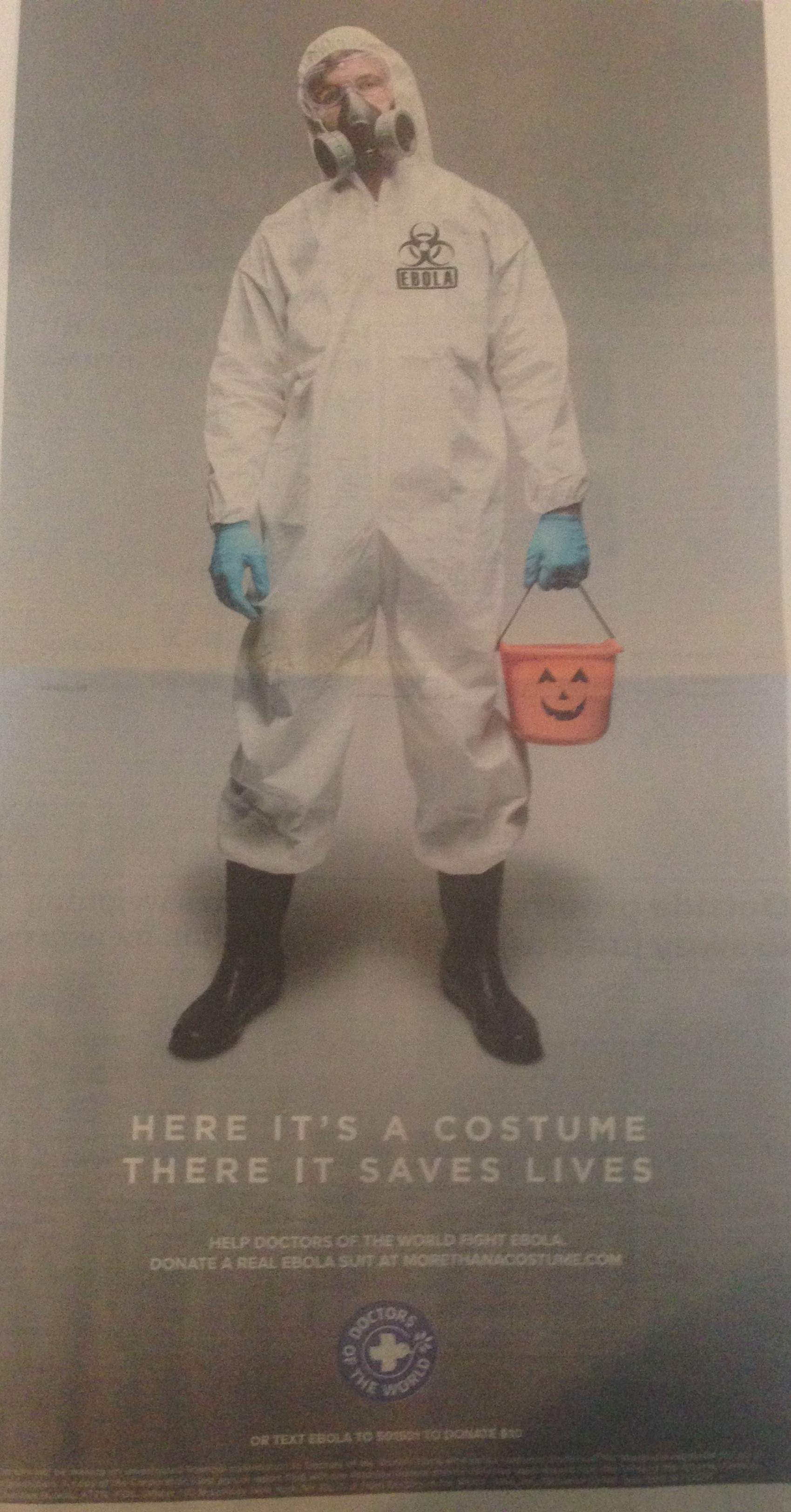
Ad appearing in USA Today October 30, 2014

Ad appearing in USA Today October 30, 2014


Readers were directed to an online direct-response landing page. You can see it below.
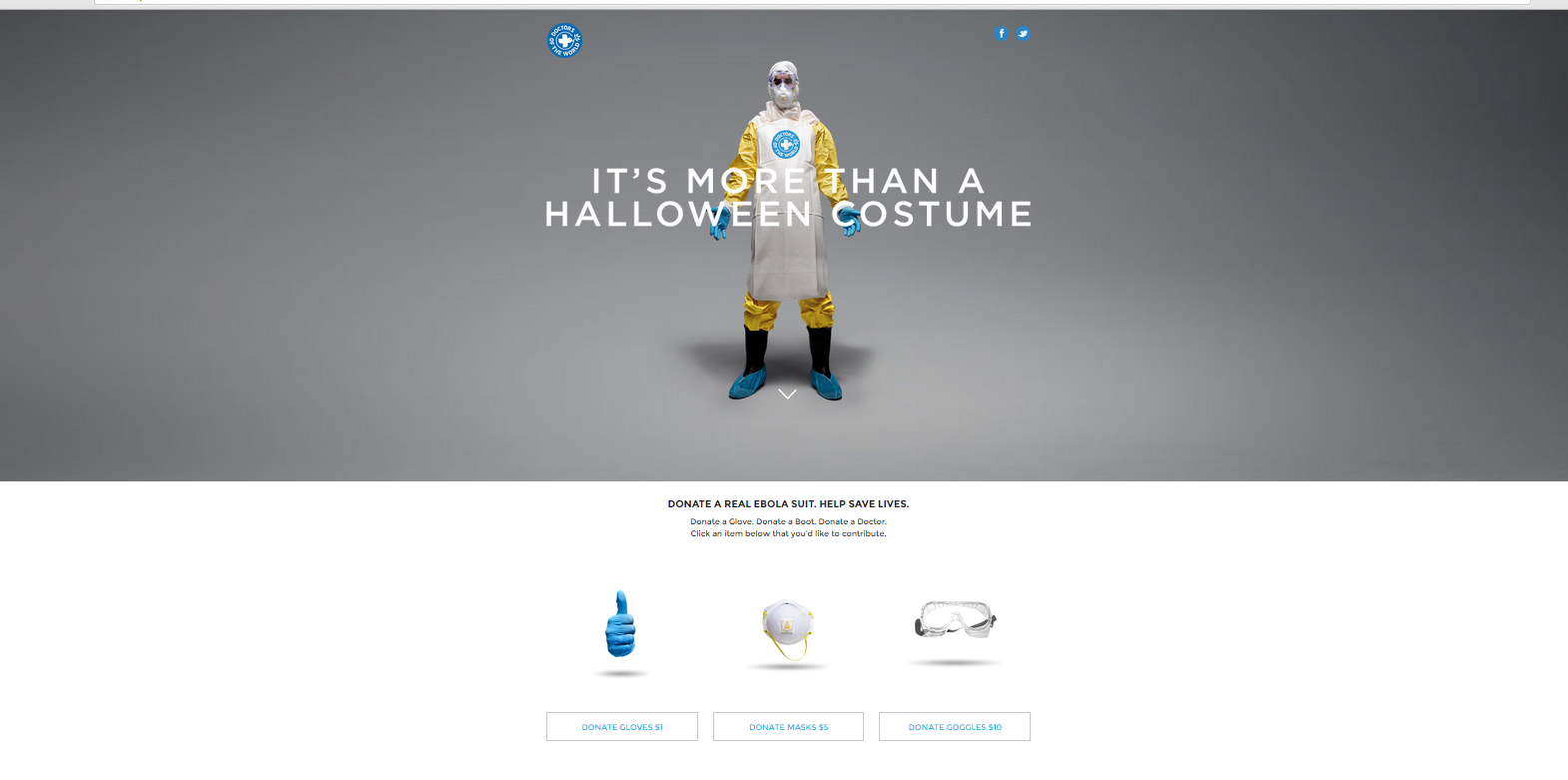
 Doctors of the World Ebola landing page.

The photo on the site immediately notifies readers they’ve come to the right place. Below the photo is an easy way to take action — a simple set of “click to donate” buttons with amounts cleverly matched to specific pieces of equipment.

[reminder]What’s the best message-matching website you’ve encountered? What’s the worst?[/reminder]
How to Raise a Buck on Halloween and Ebola

Here is a terrific example of advertising that enters the conversation America is already having in its head.

What are we thinking about on October 30, 2014? Ebola and Halloween, that’s what. Many fine American entrepreneurs are offering “Ebola costumes” this year.

An organization called Doctors of the World* has set up a fundraising landing page at www.MoreThanACostume.com, and is using the current American zeitgiest to raise some money and do some good.

They have cleverly tied donation levels to particular pieces of equipment — you can “donate gloves” for a buck, goggles for $10, etc. At the high end, you can “donate a doctor” for $2500.”

The ad below appeared in USA Today on October 30. It is awesome.


Ad appearing in USA Today October 30, 2014


*I am not familiar with this organization, which claims to be “fighting Ebola in Liberia and Sierra Leone, engaging with local communities to prevent Ebola’s spread, raise awareness and deliver essential protective equipment”  and am not endorsing it in any way. Except for their advertising approach, which I endorse as heartily as it is possible to do so.

Ebola and the Power of Stories: A Marketing Lesson

The nation’s reaction to the arrival of Ebola contains a powerful marketing lesson. While statistics get ignored, stories compel people to act.

When Ebola began spreading across West Africa a few months ago, there were some stories in the American press, but the public as a whole didn’t take much notice.

Photo Credit: EU Humanitarian Aid and Civil Protection via Compfight cc

Photo Credit: EU Humanitarian Aid and Civil Protection via Compfight cc

Americans began to pay attention when they heard the story of a Liberian man named Thomas Duncan, who landed in Dallas on a flight from Liberia and wound up dying of Ebola in Texas Health Presbyterian Hospital .

We got nervous when we heard the story of Nurse Nina Pham, who contracted Ebola while treating Duncan.

When we heard the story of Amber Vinson, another Texas Health Presbyterian Hospital nurse who flew from Ohio to Dallas while experiencing Ebola symptoms, we sprang into action. As I write this (and yes, this could change), we have a total of two people who are confirmed to have contracted Ebola in this country. Here’s what’s happened:

  • The plane she was on was taken out of service, and the crew was put on three weeks of paid leave.
  • Reports surfaced online of significant numbers of airline passengers wiping down their trays and armrests.
  • According to the New York Times:

…at least six schools in Texas and Ohio said they were shutting their doors because students or staff members had been on Ms. Vinson’s flight, or had flown on the same plane after she had. In Akron, Ohio, the Resnik Community Learning Center was closed for cleaning until Monday because a student’s parent had spent time with Ms. Vinson, school officials said.

The facts, at least those known as I write this, would argue against this sort of panic. We’re dealing with a virus that is contagious only under very specific circumstances. The odds of catching Ebola by sitting on a plane, or attending one of those schools, is incredibly tiny. The stories of these three people trump the statistics.

At the risk of trivializing what could still turn out to be a genuine national emergency, here’s the marketing lesson for those of us who make our living persuading people to act:

Nothing generates action more effectively than a good story.

Frequency: How a Waitress Can Teach You to Make Your Marketing Message Stick

A waitress gave me a powerful advertising lesson a few years ago.

 ibm4381 via Compfight cc
ibm4381 via Compfight cc

I checked into the Cedar Rapids hotel on a Sunday night in early October, and settled in for the week.

Monday morning, before heading to the TV station, I went down to the hotel restaurant for breakfast. Glancing at the menu, I decided to order oatmeal. I don’t always eat properly on the road, but I can usually get in a healthy breakfast before my self-discipline breaks down.

When the oatmeal arrived at my table, it was anything but healthy. The top layer was some kind of custard, and the rest of it was loaded with sugar and other stuff. It tasted quite good, but it did not mean good things for my cholesterol count.

I called the waitress over and asked her whether the restaurant offered just plain oatmeal. She told me that this was the way the restaurant always did it. Then she paused, and asked me how long I was staying at the hotel. I told her I would be there all week.

“My name’s Jackie,” she said. “When you come down tomorrow, ask for me, and I’ll have the chef just make you a bowl of regular oatmeal.”

Tuesday morning I came down to the restaurant and asked for Jackie. “You mentioned you might be able to get me some regular oatmeal,” I said. “Let me see what I can do,” she replied. 10 minutes later she brought me a bowl of plain oatmeal.

Wednesday morning, I waved to her as I sat down. “Oatmeal, and a to-go cup of coffee with the check?” she asked. “Yes,” I replied, surprised that she had remembered about the coffee. Thursday and Friday, we didn’t even have to discuss it. As soon as she saw me, she put the order in with the kitchen. And when she brought the check, the to-go cup of coffee was right there with it.

Three weeks later, I was back in Cedar Rapids at the same hotel. Monday morning, when Jackie saw me she said, “Welcome back, Mr. Bernstein! Plain oatmeal, right?”. The first day, I had to ask for the coffee-to-go; the rest of the week it all went like clockwork.

The reason I was able to get this special treatment is that I stayed in the same place for an extended period of time, and ate at the same restaurant every morning. Seeing the same faces every day, I got to know them and they got to know me. Over time, one of the waitresses got to know exactly what I wanted, and I didn’t have to start over each morning.

While I was at the hotel, I met another business traveler who was in Cedar Rapids for a couple of days. From there, he was going to Des Moines for two days, and then to St. Louis. He was also having his breakfasts in a hotel restaurant – but every couple of days it would be a different restaurant. He had to take whatever was on the menu.

Here’s the advertising lesson: 

With limited resources, you have a choice when you decide to advertise:

  • You can spread your budget out, and try to reach as many people as possible by doing a little bit of a lot of things. You will be advertising frequently. Lots of people will see you, but they won’t remember you.
  • Or you can take your limited resources and focus them into a small number of places. You will be advertising with frequency. You will reach fewer people — but the people you reach will respond.

The other business traveler — with a couple of days in Cedar Rapids, a couple of days in Des Moines, and a brief stop in St. Louis  — had the equivalent of a “media mix.” A little TV, a little radio, a couple of bus sides. He was seen by more people than I was, but he didn’t get to know them and they didn’t get to know him. When he sat down for breakfast, he got what everyone else got.

I had the same resources — five days — but I spent them all in one place. The same people saw me over and over again, and by the end of those five days the wait staff knew me.

The other guy was eating out frequently; I was eating out with frequency. Which one of us did better?

Sales Skills for Reluctant Salespeople — A Portland Networking Event

I’m delighted to announce that I’ll be speaking at the Katie Kelley Networks Fall Soiree in Portland, Oregon on Tuesday, October 7. My topic:

Sales Skills for Reluctant Salespeople

Date: Tuesday, October 7

Time: 6:00-8:30pm

Place: Opal 28, 510 NE 28th Ave, Portland, OR 97232

Register here

Questions: contact Katie Kelley at Katie@KatieKelleyNetworks.com or call (503) 616-6112

Sales Skills for Reluctant Salespeople
Photo by Nanagyei, Creative Commons

Whether you’re a rookie seller paid on a formal commission plan, an entrepreneur struggling to find customers, or you’re  just trying to get your small business to the next level, knowing how to sell can be the difference between hitting your goals and shutting your doors. I’ll give you some techniques to battle call reluctance, strategies to handle rejection, and some ways to make sure you’re fully prepared for that crucial first meeting.

Doors open at 6 pm for networking and mingling. Light food is provided as well as a cash bar. The formal presentation as well as audience announcements takes place from 7:00-8:00 pm. You then have until 8:30 to introduce yourself to anyone whom you haven’t yet met and the event comes to an end at 8:30. Street parking is available.

Tickets can be purchased in advance here.

If you have any further questions about this event, contact Katie Kelley at Katie@KatieKelleyNetworks.com or call (503) 616-6112.

The Katie Kelley Networks Fall Soiree

Katie Kelley Networks brings together a premier group of Portland’s male and female business leaders from the corporate, civic and entrepreneurial realms to collectively raise the bar for networking done right. The only prerequisites for attendance are a love for business and community building. At these events, you will enjoy a jovial cocktail party atmosphere, expand your local network and learn fresh business skills. What’s not to love about that?