No Escape: Guess Where Advertisers Will Find You Now?

Advertising on men’s room walls is not uncommon. But Michigan’s Office of Highway Safety Planning has moved their messaging just a little bit lower. According to the Detroit News, Michigan officials are distributing 400 Interactive Urinal Communicators — in layman’s language, talking urinal cakes — to 200 bars and restaurants throughout the state.

If you are a guy in Michigan, it’ll work like this: After you’ve done your best to process the advertising  coming at you from the neon signs, napkins, coasters, your visit to the bathroom  will activate the following message:

Listen up. That’s right, I’m talking to you. Had a few drinks? Maybe a few too many? Then do yourself and everyone else a favor: Call a sober friend or a cab. Oh, and don’t forget to wash your hands.

The cakes are produced by a company called Wizmark.

If you are an advertiser trying to deliver your pitch to a male, bar-visiting target, you are now competing with this. Bon appetit!

Where is the strangest place you’ve encountered advertising?

__________________________________________________________________________

Email Phil Bernstein here.

Like what you’re reading? There’s more! Sign up for Phil Bernstein’s free advertising and marketing e-newsletter here. As a bonus, I’ll send you a copy of my newly-revised and expanded e-book, The Seven Deadly Mistakes of Advertising and How to Fix Them when you subscribe.

Become a Facebook Fan of “Doctor” Phil Bernstein, Portland’s Advertising Expert  here.

If you like this post, share it — click the “Share” button below.
The Portland Media Documentary

To start with, a disclosure — an interview with me appears in this documentary.

The American news media world underwent some seismic changes between 2009 and 2011. These changes happened everywhere… big markets and small markets; big companies and small companies; radio, TV, and newspaper. The catalyst for all this… the hero or the villain depending on your point of view, was the Internet.

Bret Bernhoft has set out to document and interpret these changes as they affected the media in his hometown of Portland, Oregon.

As part of the project, he interviewed more than 20 players in the Portland media world: journalists, editors, announcers, production directors, salespeople, consultants, advertising agents, and more. Each of these people had a front row seat for a modern-day revolution.

Bernhoft has just released The Portland Media Documentary, an in-depth audio look at how the Internet has changed the news media in Portland. Over the next few months, Bernhoft will be releasing this documentary in segments. As I write this, three segments are available for listening and downloading:

  • The Independent Media in Portland
  • Multimedia in the Newsroom
  • Social Media and the News Industry

You can listen to and download each segment at no charge by clicking here. You should also bookmark the link, because each week two new segments will be released. To find out more about the Portland media documentary and other projects, feel free to contact Bret.

Click here to listen to the Portland media documentary now.

__________________________________________________________________________

Email Phil Bernstein here.

Like what you’re reading? There’s more! Sign up for Phil Bernstein’s free advertising and marketing e-newsletter here. As a bonus, I’ll send you a copy of my newly-revised and expanded e-book, The Seven Deadly Mistakes of Advertising and How to Fix Them when you subscribe.

Become a Facebook Fan of “Doctor” Phil Bernstein, Portland’s Advertising Expert  here.

If you like this post, share it — click the “Share” button below.
 

Why Subtlety Doesn’t Work Anymore

A couple of years ago, author/public speaker/comedian Andy Nulman wrote a blog post discussing his challenges as he gets up in front of an audience:

“The Internet has changed everything. It has contracted attention spans to an almost ridiculously-microscopic measure, and has sung the swan song for the concept of subtlety. For example, the old ‘speaker’s adage’ used to be:

  • Tell ’em what you’re gonna tell ’em
  • Tell ’em
  • Tell ’em what you told ’em

These days, the audience fidgets through the preamble, tweets during the middle and are out the door before the recap.”

Nulman wrote this in 2010. A recent article on emarketer.com details how, two years later, the rise of the smart phone has affected what your customers do while you’re commercial plays:

A May 2012 report authored by the IAB and Ipsos MediaCT, which drew on data from three surveys of US consumers, found that internet-enabled devices were not displacing other media-related activities, but adding to them. According to the Ipsos MediaCT LMX survey, the average amount of time that respondents spent engaging with media each day climbed to 9.6 hours in 2011, from 9 hours in 2009.

Time spent online or on a computer jumped to 3.1 hours from 2.5 hours over the same period. But the amount of time respondents spent watching TV held steady, at 3.4 hours. eMarketer estimates that US adults spent an average of about 11.5 hours per day consuming media content in 2011…

Here’s what this means to you: no matter what medium you are using to deliver your sales message to potential customers —  this applies to radio and newspaper in addition to TV — your customers now have a smartphone, and a choice. They can pay attention to your message, or:

  • They can check their e-mail, or send a text,
  • They can update their status on Facebook, or send a tweet.
  • They can watch a cat video on YouTube.

In fact, it is likely that they are doing one of these things as they are watching, listening to, or reading your ad. This means you have got to get to the point in a hurry. You need to deliver a benefit statement and capture attention immediately. Nulman put it this way: “No salad, just the main course”.

If, instead, you decide to “ease into it” you may find that the only thing your prospects remember later is Baby Monkey Riding on a Pig.

How NOT To Do an Email Campaign

I’m a member of a local Toastmasters group in my hometown of Portland, Oregon, and recommend Toastmasters to anyone who wants to get better at public speaking or presentation skills.

Toastmasters International has, over the years, come up with a very effective formula for helping its members get better at oral communication. Unfortunately, there is some evidence that they haven’t quite figured out online communication yet.

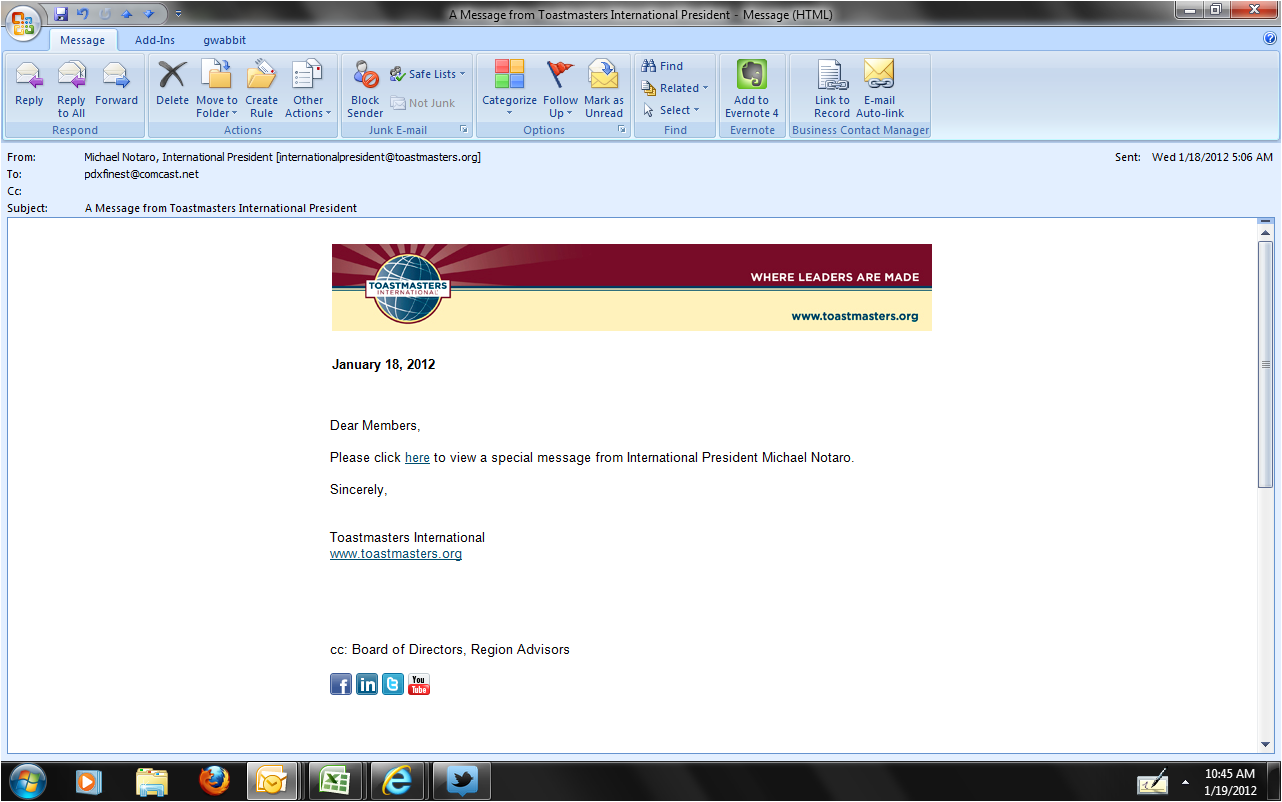
For example, there’s an email I received from the head office. Here’s the whole thing:

The pitch, in its entirety: “Please click here to view a special message from International President Michael Notaro.”

What did the message say? I have no idea — I didn’t click on it. And neither, I’ll wager, did many of the 270,000 members who received it. Whoever wrote the email did not offer me a compelling reason to click on the link.

Any time you attempt to communicate with a client or prospect, you are in the “attention-rental” business. You offer information to the recipient, who “pays” for that information with a very scarce resource: his or her attention.

What would prompt your target to open a message from you? Here are three examples:

•A discount on a product or service
•A free e-book or information kit
•An invitation to an exclusive members-only event

Make sure that when you ask for a prospect’s attention, you are offering true value in return.

__________________________________________________________________________

Email Phil Bernstein here.

Like what you’re reading? There’s more! Sign up for Phil Bernstein’s free advertising and marketing e-newsletter here. As a bonus, I’ll send you a copy of my newly-revised and expanded e-book, The Seven Deadly Mistakes of Advertising and How to Fix Them when you subscribe.

Become a Facebook Fan of “Doctor” Phil Bernstein, Portland’s Advertising Expert  here.

If you like this post, share it — click the “Share” button below.

Are You Making These 7 Deadly Advertising Mistakes?

The short version: subscribe to the Phil Bernstein on Advertising Newsletter here, and I’ll send you a copy of my newly-revised-and-expanded report, The Seven Deadly Advertising Mistakes and How to Fix Them.

The newsletter is free, it comes out by email twice a month, and you can unsubscribe any time you want to.

Here’s the long version:

There are seven common mistakes that companies make when they advertise. If you’re making any of them – and many businesses make more than one – the odds of success plummet, and your marketing dollars are wasted.

Correct these mistakes and your advertising could become 30 to 60 percent more effective – in many cases, without spending any more money.

I’ve spent thousands of dollars of my own money, and tens of thousands of hours, studying the work of the smartest and most successful copywriters, marketing gurus, and salespeople. Claude Hopkins, Dan O’Day, John Carlton, Perry Marshall, Dan Kennedy, Jim Doyle… I’ve bought their books, listened to their CD’s, and attended their seminars.

For the past eighteen years, I’ve put their theories and methods to work on behalf of hundreds of local businesses. From car dealers and real estate agents to window retailers to a school for troubled adolescents, I’ve designed campaigns to bring them new customers.

Has every campaign been a huge success? No. Some had just okay results, and a few were outright bombs.

But I discovered that the bombs had elements in common, and so did the home runs. And that it was possible to take a floundering campaign and make it successful by fixing some very simple and common mistakes.

Among them:

  • Too much information
  • No call-to-action
  • Flunking the “So What” test

If you want the whole list, plus actionable advice about what to do, here’s a free way to get it:

I’ve written a white paper called The Seven Deadly Advertising Mistakes and How to Fix Them. If you want it, I’ll send it to you at no charge. All you need to do is subscribe to the Phil Bernstein on Advertising eNewsletter, which is also free.

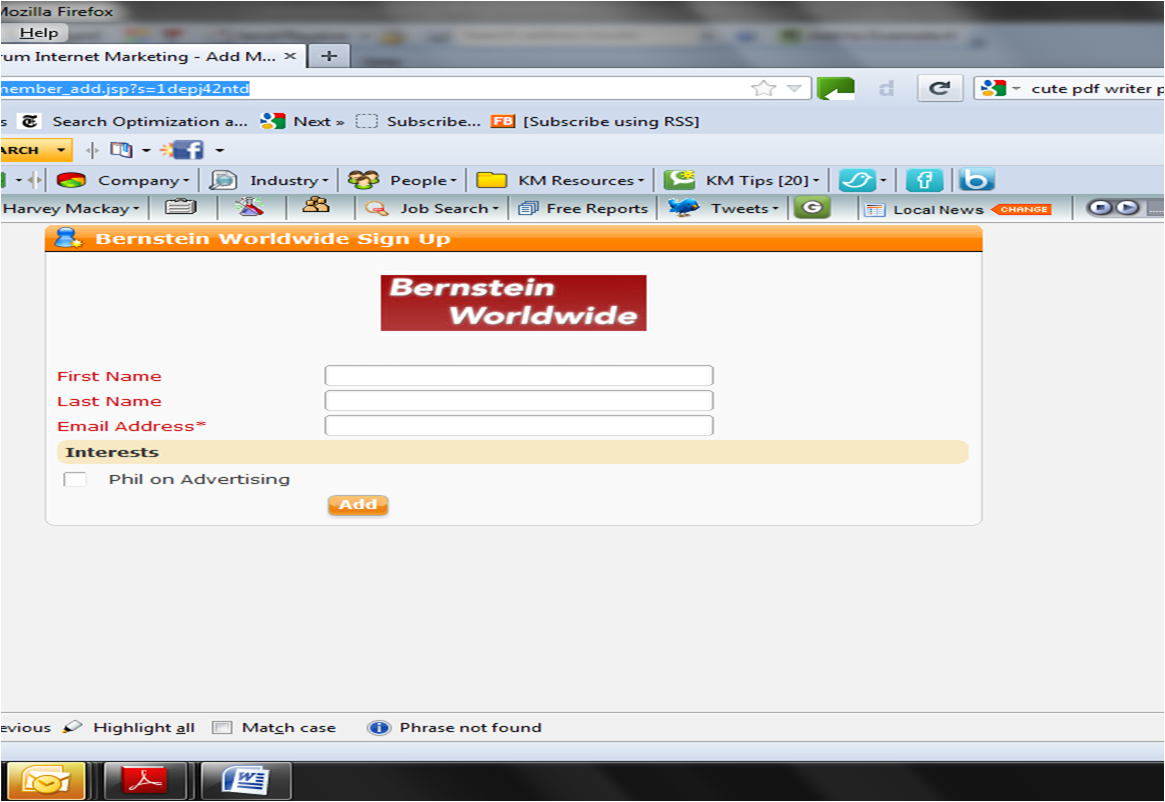
Click this link to subscribe, and I’ll send you the white paper. The link will take you to something that looks like this:

You’ll automatically get a copy of the current newsletter, and as soon as I see your name in the subscriber list I’ll email you a copy of the report.

__________________________________________________________________________

Email Phil Bernstein here.

Like what you’re reading? There’s more! Sign up for Phil Bernstein’s free advertising and marketing e-newsletter here.

Become a Facebook Fan of “Doctor” Phil Bernstein, Portland’s Advertising Expert  here.

If you like this post, share it — click the “Share” button below.