How To Grade a Website: Will It Flunk “The Mom Test”?

Have you ever gone to a client’s website and gotten lost? What did you do about it? If you’re a media advertising salesperson, it’s your responsibility.
radio advertising sales tip: radio salespeople should look at client websites

 Photo by iQoncept/dpc

I spent last week on the West Coast meeting with advertisers in partnership with a television station sales department. Preparing for the week, I spent time looking at each client’s website — 25 in all. Here’s what I found:

  • A lawyer’s site had the wrong address and phone number — she had moved to a different office.
  • A real estate agent’s site had no contact information at all.
  • A sporting good store’s site had drop-down menus for a variety of categories. “Baseball”, for example, had links for gloves, bats, balls, and helmets. But there was no information at any of the links.
  • A pet supply store’s website was down. That’s not the bad part. The bad part was that the station Account Executive had looked at it a week earlier, and it had been down then. The odds are good that it had been down for at least a week, and the client had no idea.

IN THIS NEXT PART, I AM BORROWING A CONCEPT FROM A RECENT ARTICLE AIMED AT BLOGGERS.
UNFORTUNATELY, I CAN’T REMEMBER WHO WROTE IT*

Pretend to be your mom — a generation older than you, able to use the Internet but not all that comfortable with it — and take a look at your blog. Could your mom find your subscription sign-up box? Would she know what to do?

If not, fix it. — Name Not Remembered

If you are an advertising salesperson — radio, television, newspaper, or any other media — you are now expected to have a good working knowledge of digital marketing. If you put together a program that drives traffic to your client’s website, and that traffic never turns into money, you have failed.

Don’t just shrug your shoulders and blame the advertiser. You are an Account Executive. Your job is to execute. If the campaign fails and the client cancels, it’s on you.

So give your client’s website The Mom Test.

If your mom  — a generation older than you, and not all that comfortable with the Internet — saw a television commercial, or heard a radio promotion, or read a newspaper ad, or clicked on a banner, and the ad took her to your client’s website, would she know what to do next? Could she figure it out quickly?

If Mom couldn’t figure out how to give your client her money, the website is a barrier that is driving money away from your client. You need to show your client how to fix it. Now.

Fortunately, your company has developed some great digital tools to help you do that. It’s time to find out what they are.

Three Ways An Advertising Salesperson Can Apply This This Today

1.  Pull up the websites of every client you’ll be meeting with in the next couple of days. Give each one The Mom Test. If any of them flunk, show the sites to the head of your digital department, and develop a strategy to fix it. Attach a price tag to the strategy and build a proposal.

2. Bring the proposal to the client. Explain The Mom Test. Show the client exactly what happened when “Mom” went to the website. Demonstrate how your strategy will fix the problem. Get a signature.

3. Share this post on Facebook, LinkedIn and Twitter. You can find the Share buttons at the top and at the bottom of the post. So can Mom.

* This, or something like it, was in somebody’s content marketing blog within the past month. I could have sworn that I’d saved the quote, but it’s not in my records. I thought it was from Ann Handley, but I searched her blog and couldn’t find it. If you know where it came from, let me know and credit will be willingly and cheerfully given.

Are You Making This Embarrassing Mistake With LinkedIn?

Ani DiFranco once said that every tool is a weapon if you hold it right. LinkedIn can be a very powerful sales weapon — but it will backfire if you don’t use it correctly.

the wrong way to use a radio advertising sales tool
Photo by apops/dpc

LinkedIn has become a powerful tool for researching and making contact with new prospects. But like any other tool, there’s a right way and a wrong way to use it. I’ve received a couple of egregious “wrong way” examples in the past couple of weeks.

Both came from members of LinkedIn Groups I’m also part of. The writers have figured out that being part of these groups gives them the ability to contact complete strangers who are also members. They have not figured out how to use that ability.

The first one started like this:

Hi Doctor

Hope you’re doing well.

I wanted to take a few minutes from you today to mention how “hosted” video conferencing is changing real time collaboration. Although most of us know what video conferencing is, the only difference here is the word “Hosted”. Like every technology, now video conferencing is available on demand on cloud.

Here is a whitepaper that will tell you why this technology is spreading like a wildfire.

She wanted to “take a few minutes from me today”, but she offered no reason to give her those precious minutes. It would have been helpful if she’d “taken” a few minutes of her own to learn something about me before sending the message out.

The other one went like this:

Hi,

I saw your profile and felt you might fit the profile of what we look for in our company (Elite Sales experience to the SME/Enterprise Space)

Can you please review this YouTube video of our company and what we offer, and then give me your feedback on interest level?

No, I can’t. Or, more accurately, I can, but I won’t.

Any time you attempt to communicate — on the phone, in an email, or a LinkedIn message — with a client or prospect, you are in the “attention-rental” business. You offer information to the recipient, who “pays” for that information with a very scarce resource: his or her attention.

You must offer a compelling reason for your target to give you that attention. It starts with giving some indication that you know something about them.

I suspect that the folks who sent me those messages were attracted by the ability to blast out hundreds of them with the click of a button. It’s fast, it’s easy, and requires very little thought.

It’s also spam, and they’re running the risk of having their LinkedIn accounts suspended.

With great power there must also come great responsibility. — Spiderman’s Uncle Ben

Membership in a LinkedIn Group gives you the ability to find common ground with complete strangers and build relationships with them. But it’s only an effective weapon if you hold it right.


Embed Sites on Your Website with Embedly: Tech Tool Tuesday for Salespeople

When is a link to an article more than just a link? When you can embed it into your web page.

radio salespeople gain knowledge with sales training
Photo by Rawpixel/dpc

I recently discovered an online tool called Embedly that can embed an article onto a web page. From the looks of the Embedly website, it can do more than that; I’ve only been using it for a few days, and this feature is cool enough to write about.

It started when I wound up, in a feat of lucky timing, on national television (you can read about that adventure here). After the story ran, NBC Nightly News posted it on the show’s website. I wanted to post the video on my blog, but (unlike YouTube), NBC has blocked embedding — if you want to watch one of their clips, they want you to do it on their site.

I didn’t want to just post a link; a round of Google searching took me to Embedly. The process is pretty simple:

  1. Plug in the URL of the site you want to embed. Embedly generates some HTML code, and shows you how the image will look.

  2. Copy the code, and paste it in your website.

A quick demonstration video:

https://www.youtube.com/watch?v=smuF_CO6e50
Here’s how the NBC Nightly News clip looks when I embed it on my blog.

Only in Portland Would the Airport’s Carpet Reach Cult Status

A few other examples I tried as I experimented follow.

A television advertising sales training program website:

Jim Doyle & Associates

Information about knitting patterns:

Coming soon: Criss Cross Hat, Beret, Mitts
A New York Times article:

SkyMall Stumbles as Airlines Hone Their Sales Pitches

You can also “pretend  embed” the video into an email. The example below is not a true embed: I took a screenshot of the image, copied it into my email, and then established a hyperlink.

email with embedded article


Although Embedly offers several paid plans, everything I did above came from their “free” service.

[reminder]Is there a tech tool you’d like me to try and write about? [/reminder]

My #PDXCarpet Moment on NBC Nightly News

How a spur-of-the-moment selfie created a chance encounter that put me on national television.

How a radio advertising sales trainer got on TV
Screenshot by pdxknitterati

I travel a lot on business, training advertising salespeople at television stations across the United States. This means I spend a lot of time at Portland International Airport (PDX), standing and walking on the airport’s carpet.

For reasons difficult to explain to those who don’t live here, our airport’s carpet — known as #pdxcarpet throughout social media — is kind of a big deal around these parts. The airport’s decision to replace the carpet has created a significant local hullaballoo.

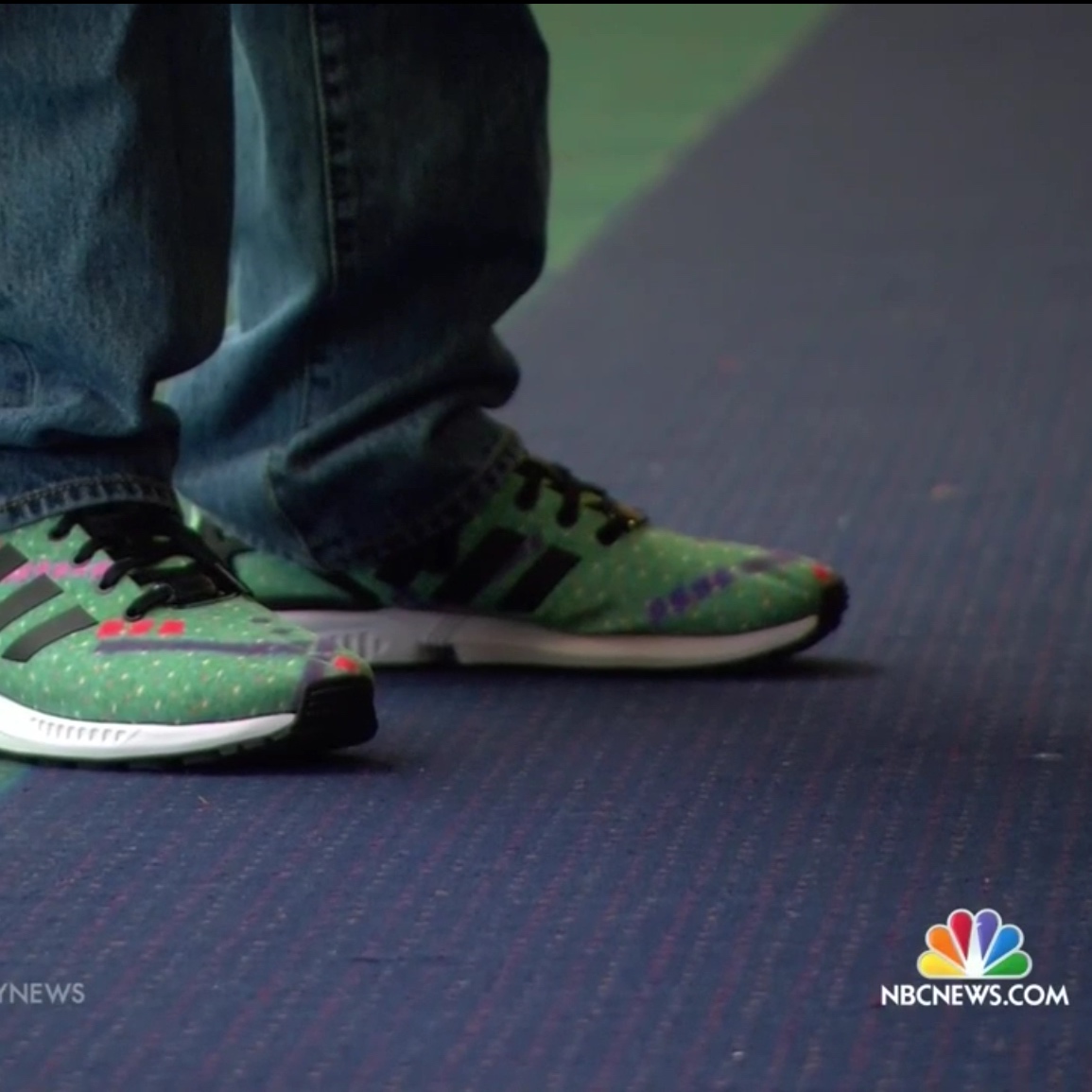
My wife, the lovely and talented pdxknitterati, took a photo of the carpet and used it to custom-design some shoes for my birthday. (You can read about how she did it, using Adidas’ iPad app, here).

On a recent Tuesday afternoon, we went to the airport to take a photo of my new shoes on that old carpet while it was still intact.

Photo by pdxknitterati

After getting the shot, we noticed a television cameraman near the ticket counters. He was on one knee with the camera on his shoulder, panning the carpet. I walked over and stuck my foot in front of his camera. He looked up at me, said, “You’re kidding,” and called his producer over.

The producer, Kristen Powers, introduced me to Harry Smith. Of  NBC News. NBC Nightly News, it turns out, was in town to do a story on our carpet. Harry liked the shoes and interviewed us. You can see the results below.

Only in Portland Would the Airport’s Carpet Reach Cult Status

As Lefty Gomez almost said, sometimes it’s better to be lucky than good.

Sales Skills: The Best Persuasion Tool on the Planet… Why Aren’t You Using It?

Have you ever been stuck in an email argument that won’t end?

radio advertising salesperson yelling at computer
Photo by vladimirfloyd/dpc

 Today’s Sales Skills Lesson: There’s Another Tool That Works Much Better

A friend of mine was recently sucked into one of these endless, frustrating digital exchanges. Here’s how she dealt with it.

My friend designs knitting patterns. Yarn shops around the country buy her patterns and re-sell them to their customers.

Recently a shop owner emailed her saying that there was a mistake in one of her patterns, and asking for a correction. The designer double-checked the pattern (which she’d been teaching for years), and quickly concluded that the pattern was correct — the shop owner preferred a different technique, but the pattern technique worked just fine.

  • Designer emailed shop owner to say that there was no mistake.
  • Shop owner wrote back insisting that there was a mistake.
  • I suggested calling the shop owner on the phone.
  • The designer shot back, “I don’t want to talk to her on the phone.”
  • I backed off.
  • Designer emailed the shop owner that the pattern was fine, explained the difference in approach, and suggested that the shop owner give it a try.
  • Shop owner wrote back saying that she was going to “add a correction” to the pattern instead.

The designer was furious about this, and shared her frustration with me in an extremely animated fashion. I asked,

“Umm…Could you call the shop owner on the phone?”

 phone -- the best radio advertising sales tool

Photo by designsoliman/dpc

Reluctantly, the designer picked up the phone and called. Designer and owner talked at length and found some common ground. The owner agreed to try the pattern as written. A half hour later, the owner emailed back that the pattern worked perfectly.

Shop owner persuaded, designer happy, relationship preserved.

The lesson here:

Phone Beats Keyboard

When it’s time to persuade… when it’s time to sell,  the single best sales tool on the planet is still the good old-fashioned telephone. It’s better than email, it’s better than texting, it’s better than any of the new instant-messaging apps that clutter our smartphones. Develop strong phone sales skills and they’ll pay you back in a hurry.

Three Ways to Apply This Now

1. If the subject matter is complicated, awkward, or a matter of dispute, use the phone instead of the keyboard.

2. Employ the 3-Email Rule: whenever you are about to send your third email in an exchange, pick up the phone instead.

3. Spread the word. Share this post on Facebook, Twitter or LinkedIn.