How to Judge Super Bowl Advertising: Follow The Money

Let me tell you why I am not a fan of Super Bowl advertising… it sends the wrong message to our LOCAL advertisers. – Tom Ray, Jim Doyle & Associates
how to judge Super Bowl television advertising
Photo by Nomad_Soul.DPC

As the Super Bowl approaches, the advertising critics are out in force. Most of them will miss the point. When you’re deciding whether the ad you just saw is “good” or “bad”, consider the case of Salesgenie.

In 2007, Salesgenie, a sales-lead-by-subscription service, ran a commercial that was disliked by the vast majority of the media’s judges. Bob Garfield of Advertising Age called it “monumentally brainless and amateurish.” The commercial finished dead last in USA Today’s Ad Meter.

It lives on in cyberspace — enjoy it courtesy of YouTube, and then tell me if it’s a good commercial or a bad commercial:

A few days after the game, USA Today had this to report:

•Salesgenie.com. The sales-lead website generated more than 10,000 new customer subscriptions by late Monday, far more than the 700 it said it needed to break even on its ad cost. “Our ad wasn’t supposed to be funny or clever,” InfoUSA CEO Vin Gupta says. “It was supposed to bring in subscribers, and it’s been successful beyond our wildest dreams. We’re already working on next year’s ad.”

They needed 700 subscriptions to break even on the ad, and they got 10,000. This would seem to be a very nice ROI.

If you were to accuse Gupta and the others involved in producing the commercial of being obnoxious, offensive human beings, you’d get no argument from this blog. But the commercial is an awfully impressive piece of direct-response advertising.

Salesgenie chose a specific target — lazy male salespeople — identified what they really wanted, presented their product as a way for those salespeople to get what they really wanted, and then gave them a specific action to take. The company cheerfully ignored all of the out-of-the-target people who didn’t like the ad, and took their money to the bank.

As Tom Ray points out, Super Bowl advertising often causes otherwise-intelligent local businesspeople to judge their own advertising using the wrong criteria.

If the ad works, it’s a great ad – no matter how many rules are broken or how bad it may look, smell or taste. If the ad is not working, it is wretchedly bad – no matter how clever the production.” — Don Fitzgibbons, the Guru of Ads


Most of the Super Bowl television advertisers have a product or service to sell. The commercial must somehow advance the sales process to be effective. As you watch the advertising this Sunday, ask yourself what each advertiser is trying to accomplish.

  • What do they want the audience to do  as a result of seeing the commercial?
  • Did the commercial cause the audience to do it?

If it did, the commercial worked, and it’s a good ad. If not, it’s a bad one. Salesgenie wasn’t counting USA Today Ad Meter votes — they were counting subscriptions. Like it or not, there were more than 10,000 reasons to say that the ad worked. 

If you are a local radio or television advertising salesperson, or someone who advertises on local radio or TV, don’t let the Super Bowl media judges take your eyes off the prize. Artistic merit doesn’t matter — businesses advertise because they have something to sell.

Follow the money. The prize that counts is awarded in dollars.

[reminder]What’s the best Super Bowl television commercial you’ve ever seen — and why?[/reminder]


.


Embed Sites on Your Website with Embedly: Tech Tool Tuesday for Salespeople

When is a link to an article more than just a link? When you can embed it into your web page.

radio salespeople gain knowledge with sales training
Photo by Rawpixel/dpc

I recently discovered an online tool called Embedly that can embed an article onto a web page. From the looks of the Embedly website, it can do more than that; I’ve only been using it for a few days, and this feature is cool enough to write about.

It started when I wound up, in a feat of lucky timing, on national television (you can read about that adventure here). After the story ran, NBC Nightly News posted it on the show’s website. I wanted to post the video on my blog, but (unlike YouTube), NBC has blocked embedding — if you want to watch one of their clips, they want you to do it on their site.

I didn’t want to just post a link; a round of Google searching took me to Embedly. The process is pretty simple:

  1. Plug in the URL of the site you want to embed. Embedly generates some HTML code, and shows you how the image will look.

  2. Copy the code, and paste it in your website.

A quick demonstration video:

https://www.youtube.com/watch?v=smuF_CO6e50
Here’s how the NBC Nightly News clip looks when I embed it on my blog.

Only in Portland Would the Airport’s Carpet Reach Cult Status

A few other examples I tried as I experimented follow.

A television advertising sales training program website:

Jim Doyle & Associates

Information about knitting patterns:

Coming soon: Criss Cross Hat, Beret, Mitts
A New York Times article:

SkyMall Stumbles as Airlines Hone Their Sales Pitches

You can also “pretend  embed” the video into an email. The example below is not a true embed: I took a screenshot of the image, copied it into my email, and then established a hyperlink.

email with embedded article


Although Embedly offers several paid plans, everything I did above came from their “free” service.

[reminder]Is there a tech tool you’d like me to try and write about? [/reminder]

My #PDXCarpet Moment on NBC Nightly News

How a spur-of-the-moment selfie created a chance encounter that put me on national television.

How a radio advertising sales trainer got on TV
Screenshot by pdxknitterati

I travel a lot on business, training advertising salespeople at television stations across the United States. This means I spend a lot of time at Portland International Airport (PDX), standing and walking on the airport’s carpet.

For reasons difficult to explain to those who don’t live here, our airport’s carpet — known as #pdxcarpet throughout social media — is kind of a big deal around these parts. The airport’s decision to replace the carpet has created a significant local hullaballoo.

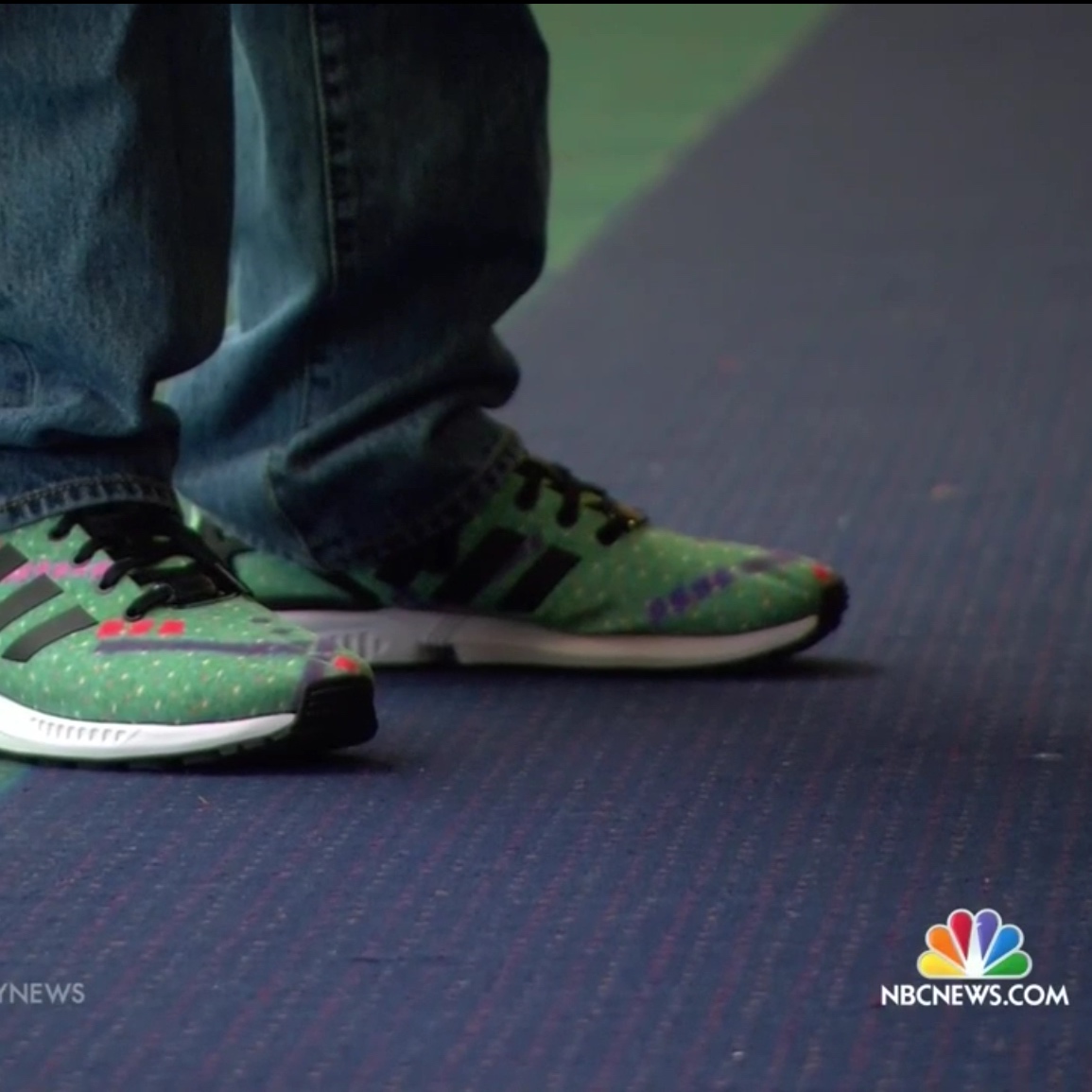
My wife, the lovely and talented pdxknitterati, took a photo of the carpet and used it to custom-design some shoes for my birthday. (You can read about how she did it, using Adidas’ iPad app, here).

On a recent Tuesday afternoon, we went to the airport to take a photo of my new shoes on that old carpet while it was still intact.

Photo by pdxknitterati

After getting the shot, we noticed a television cameraman near the ticket counters. He was on one knee with the camera on his shoulder, panning the carpet. I walked over and stuck my foot in front of his camera. He looked up at me, said, “You’re kidding,” and called his producer over.

The producer, Kristen Powers, introduced me to Harry Smith. Of  NBC News. NBC Nightly News, it turns out, was in town to do a story on our carpet. Harry liked the shoes and interviewed us. You can see the results below.

Only in Portland Would the Airport’s Carpet Reach Cult Status

As Lefty Gomez almost said, sometimes it’s better to be lucky than good.

Sales Skills: The Best Persuasion Tool on the Planet… Why Aren’t You Using It?

Have you ever been stuck in an email argument that won’t end?

radio advertising salesperson yelling at computer
Photo by vladimirfloyd/dpc

 Today’s Sales Skills Lesson: There’s Another Tool That Works Much Better

A friend of mine was recently sucked into one of these endless, frustrating digital exchanges. Here’s how she dealt with it.

My friend designs knitting patterns. Yarn shops around the country buy her patterns and re-sell them to their customers.

Recently a shop owner emailed her saying that there was a mistake in one of her patterns, and asking for a correction. The designer double-checked the pattern (which she’d been teaching for years), and quickly concluded that the pattern was correct — the shop owner preferred a different technique, but the pattern technique worked just fine.

  • Designer emailed shop owner to say that there was no mistake.
  • Shop owner wrote back insisting that there was a mistake.
  • I suggested calling the shop owner on the phone.
  • The designer shot back, “I don’t want to talk to her on the phone.”
  • I backed off.
  • Designer emailed the shop owner that the pattern was fine, explained the difference in approach, and suggested that the shop owner give it a try.
  • Shop owner wrote back saying that she was going to “add a correction” to the pattern instead.

The designer was furious about this, and shared her frustration with me in an extremely animated fashion. I asked,

“Umm…Could you call the shop owner on the phone?”

 phone -- the best radio advertising sales tool

Photo by designsoliman/dpc

Reluctantly, the designer picked up the phone and called. Designer and owner talked at length and found some common ground. The owner agreed to try the pattern as written. A half hour later, the owner emailed back that the pattern worked perfectly.

Shop owner persuaded, designer happy, relationship preserved.

The lesson here:

Phone Beats Keyboard

When it’s time to persuade… when it’s time to sell,  the single best sales tool on the planet is still the good old-fashioned telephone. It’s better than email, it’s better than texting, it’s better than any of the new instant-messaging apps that clutter our smartphones. Develop strong phone sales skills and they’ll pay you back in a hurry.

Three Ways to Apply This Now

1. If the subject matter is complicated, awkward, or a matter of dispute, use the phone instead of the keyboard.

2. Employ the 3-Email Rule: whenever you are about to send your third email in an exchange, pick up the phone instead.

3. Spread the word. Share this post on Facebook, Twitter or LinkedIn.

How to Stop the “Uh Oh!” Email: Tech Tool Tuesday for Salespeople

Have you ever realized, immediately after hitting “Send”, that you have just sent an email to the wrong person?

Radio Advertising Salesperson horrified at computer
Photo by Flashgun/dpc

Not long ago, I wrote an email expressing significant concerns about a particular person – and, due to my own inattention, entered that person’s name as the recipient of the email. Luckily, I caught my mistake and corrected it before the email went out.

It was a very close call.

This prompted me to go to Google to see if there was a way to delay outgoing emails for a few minutes… just to buy myself a little time and prevent some heartache.

It turns out that Outlook, the program I use, offers a “delay” mechanism as an option. I knew that there was a way to delay individual emails, but it turns out that you can create a rule that delays all of your outgoing email.

You can find written instructions for delaying your email messages here. The instructions are a little tough to follow, so I’ve put together a short video to show you how it goes:

Direct link to the video is here.  I have used this method with Outlook 2013 and 2016 — I’m told it also works with Outlook 2010.

Instant gratification has a significant downside. There are many reasons why we might want to add a short delay to our outgoing emails:

  • We’re about to send it to the wrong person by mistake.
  • We’re about to Reply All by mistake (read about another tool, Reply to All Monitor here)
  • We’ve written a message in anger, or without thinking things through.

Making things just a little less instant by adding a short delay to each of our emails can prevent significant heartache.

Three Ways to Apply This Information Now

  1. If you have Outlook 2010, 2013 or 2016, watch the video and then set your own delay rule.
  2. If you use a different email service, Google “How to delay outgoing emails in [name of your service]”.
  3. Share this article on your favorite social media site.

[reminder]What’s the worst email you ever sent — or stopped at the last minute?[/reminder]