“The Ear-Rental Business” — Duncan Interviews Bernstein II

In Part 2 of our online conversation, Brett Duncan and I discuss the keys to a successful radio advertising campaign, what kinds of businesses shouldn’t use radio, and how new tools like text messaging and podcasting are affecting the business.

In case you missed it, Part 1 is here.

And, congratulations to Brett on the new addition to his family.

___________________________________________________________________________________

Click this link to subscribe to Portland’s Finest Advertising and Marketing Blog.

Request your free copy of Phil Bernstein’s white paper, The Seven Deadly Advertising Mistakes and How to Fix Them here.

Got a question? Call Phil Bernstein at 503-323-6553.

Advertising Money Wasted

As 2008 wheezes to a close, every marketing dollar is more precious than ever. And an ad in the front section of the Sunday paper sure ain’t cheap.

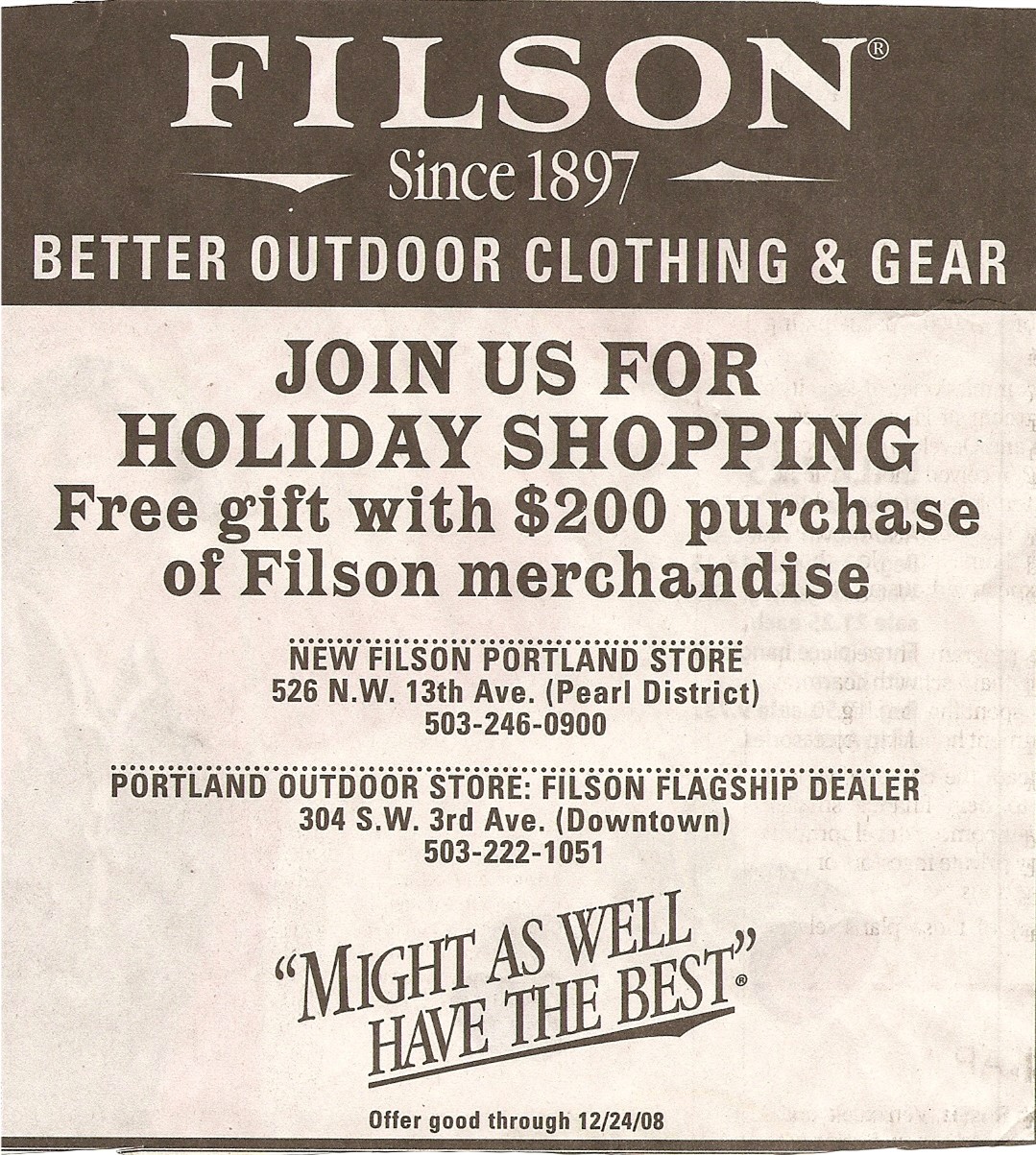
So I was distressed to see how Filson decided to waste a few thousand dollars in Portland on Sunday morning:

filson

If they were hoping to convince me to do my holiday shopping at their stores, here are some questions their ad should have answered:

1. What “outdoor clothing and gear” might I find at a Filson store? The outdoor aficionado might already know, but a huge portion of the general public has no idea. When you advertise in the Sunday newspaper in mid-December, your target is the general public.

2. I have other choices for outdoor gear. I could “join” REI for holiday shopping — why should I spend my money with Filson instead?

3. What’s the free gift? Is it good enough that I’d be willing to schlep downtown and drop $200 or more?

Filson is paying handsomely for a small piece of the public’s attention — once they have it, they could offer some great gift ideas; or sale prices on outerwear; or cool new fishing gear that only Filson has. Or at least give their web address for anyone who wanted to find out more.

In an environment where consumer attention, and money, is in short supply, this ad gives the reader no reason at all to get in the car and drive to a Filson store.

___________________________________________________________________________________

Click this link to subscribe to Portland’s Finest Advertising and Marketing Blog.

Request your free copy of Phil Bernstein’s white paper, The Seven Deadly Advertising Mistakes and How to Fix Them here.

Got a question? Call Phil Bernstein at 503-323-6553.


The Hardest-Working Item in Direct Mail…

… may be the lowly Post-It Note.

According to Roger Dooley’s Neuromarketing Blog, using a Post-It Note to personalize a sales letter can make a huge impact:

In Yes! 50 Scientifically Proven Ways to Be Persuasive, Robert Cialdini describes an interesting twist on the handwritten note. A survey was mailed with three cover letter configurations:
1) A printed letter.
2) A printed letter with a handwritten message.
3) A printed letter with a handwritten message on a Post-It note.

The response rate was a mere 36% for the plain printed cover letter. Adding the handwritten note improved the response rate by one third to 48%. The Post-It more than doubled the response to 75%. A second test to examine the possibility that some magic in the Post-It note itself was responsible for the higher response rate included cover letters with a blank sticky note attached. That approach generated only a slightly higher response rate of 42%.

Dooley’s thoughts as to why the note-on-a- Post-It technique worked so well make for interesting reading. Check out the full post here.

___________________________________________________________________________________

Click this link to subscribe to Portland’s Finest Advertising and Marketing Blog.

Request your free copy of Phil Bernstein’s white paper, The Seven Deadly Advertising Mistakes and How to Fix Them here.

Got a question? Call Phil Bernstein at 503-323-6553.

Layaway Comes to Real Estate

Sometimes innovation means going backwards. And sometimes it means moving an old concept to a new industry.

Much has been made lately about the return of the layaway plan — a long-out-of-fashion retail program in which an item is kept at the store while the customer makes payments on it. Until recently, the layaway had been almost completely replaced by the credit card; customers preferred plastic because they could get instant gratification.

The credit crunch has made layaway popular again — Kmart, which never dropped it, is now putting renewed emphasis on the program. Parent company Sears Holdings recently brought it back to Sears after a 20 year absence.

Now, with mortgages difficult to come by, real estate companies and home builders are marketing the concept. According to Business Week,

K. Hovnanian Homes and Beazer Homes are offering contracts that let purchasers deposit downpayment installments in a no-interest escrow account. (Buyers who back out of such plans will lose whatever they’ve accumulated.)

This is a terrific example of what Dan Kennedy and Bill Glazer call “Swipe-and-Deploy” marketing. As a concept, layaway is nothing new. But by moving the concept from traditional retail to real estate, a couple of enterprising companies are generating publicity, interest, and buyers.

___________________________________________________________________________________

Click this link to subscribe to Portland’s Finest Advertising and Marketing Blog.

Request your free copy of Phil Bernstein’s white paper, The Seven Deadly Advertising Mistakes and How to Fix Them here.

Got a question? Call Phil Bernstein at 503-323-6553.

Oregon Auto Dealers Pitch Risky Strategy

In the midst of the worst sales decline in memory, the Oregon Auto Dealers Association is asking the legislature to make it harder for customers to shop with them.

That was, at least, my initial reaction to the news that the Association wants lawmakers to make it illegal for them to do business on Sunday. Why would an industry desperate for customers tell them that if they want a car on Sunday, they’ll just have to go do business with a dealer across the river in Vancouver, Washington?

There are two significant reasons, it turns out:

1. Closing for a day will cut costs.

2. The guaranteed day off will allow them to attract, and keep, a higher level of employee. As Portland dealer Ron Tonkin put it, “You’d be able to get people who really won’t consider an industry like ours because they don’t like the hours.”

Those are the benefits. The risks are angering potential customers, and losing business to the Washington dealers — they’re just a short drive away, and will be happy to accept the additional Sunday traffic.

These are interesting times — times in which some of the most fiercely independent businessmen in the state feel compelled to ask the government to limit their freedom to compete. Do the benefits of this strategy outweigh the risks?

Please leave answers, opinions, and perspective in the comments below.

___________________________________________________________________________________

Click this link to subscribe to Portland’s Finest Advertising and Marketing Blog.

Request your free copy of Phil Bernstein’s white paper, The Seven Deadly Advertising Mistakes and How to Fix Them here.

Got a question? Call Phil Bernstein at 503-323-6553.