Before The First Meeting: Have You Done Your Homework?

If you’ve spent any time as an advertising salesperson, you’ve learned that our reputation out there isn’t particularly good.

Too many of our colleagues and competitors walk into a prospect’s office with a media kit, a “new advertiser package,” and no knowledge of the client’s business.

The bad news: this makes it tough for everyone. Businesspeople are reluctant to let us in, because they don’t want to waste yet another hour with another unprepared peddler.

The good news: if you can get in the door, it’s not all that hard to set yourself apart from the others.

You just have to do your homework.

Radio television salespeople should do their homework
Photo by jminso679


Hubspot recently compiled a list of 18 Places to Research a Prospect Before a Sales Call.  #18 in particular stood out to me:

18) Yelp

Does your prospect work directly with consumers? If so, browsing their Yelp page is a great way to learn more about their strengths and weaknesses. For example, maybe 40% of their reviews mention their poor customer service. In your initial email, you can give a few suggestions to improve service. Or maybe multiple reviewers praise their reasonable prices. You might offer to share some strategies for directing customers to the most high-margin products.”


My book, Breakthrough Prospecting, has a chapter devoted to pre-call preparation, and a long section on preparing the right questions for a first call. If you don’t already own the book, you should buy it.

If you already own a copy, it’s worth noting that Breakthrough Prospecting makes a great gift.

[button href=”https://philbernstein.com/bernstein-worldwide-breakthrough-prospecting-order-page” primary=”true” centered=”true” newwindow=”true”]Buy Breakthrough Prospecting Here[/button]


Sam Richter, author of Take the Cold Out of Cold Calling, has an interesting method for using LinkedIn on a first meeting. You might call it the “Guess What I Found” method:

Richter searches the prospect’s LinkedIn profile for something interesting and different, and then makes sure to work it into the conversation:

Before I meet with people I like to do a little bit of homework. You’re a busy guy, and I don’t like to waste your time. Guess what I found? I was looking at your LinkedIn profile and I see that you are on the board of directors of the Hochstein School of Music and Dance. That’s really interesting, do you have a family member involved in dance? How did you get into that?’

…It sounds a little bit corny, but I have to tell you it really works because the first part of that: ‘Hey, before I meet with people I like to do a little bit of homework.’ Right there you’ve just differentiated yourself from pretty much every advisor, every accountant, every lawyer, every salesperson this person’s ever met with… The second you say to somebody, ‘I did a little homework on you and guess what I found?’ When you say that phrase, ‘And guess what I found?’ you have the other person’s full attention. ‘What’d you find?

As my boss and mentor Jim Doyle likes to say, the wing-it days are over. The information you need to be prepared is as close as your laptop or your smartphone.

It’ll take you 15 minutes or less to get ready. Those 15 minutes could be the difference between making a sale and getting thrown out of the office.

[reminder]

Should You Promote Prevention Or The Cure?

Why isn’t my service contract campaign working?”

The question came from a television station AE in the Southeast.

His customer was an HVAC contractor who wanted to sell more maintenance service agreements. The TV ad had been on the air for about three months. There had been little response.

Many heating and air dealers and auto repair shops I’ve worked with have are big fans of service plans — they are an excellent source of steady, ongoing revenue.

But the most successful ones have told me new customers aren’t particularly interested in a service agreement. The best candidates for these plans are existing repair customers.

Why?

Perry Marshall, author of 80/20 Sales & Marketing, has this explanation:

People don’t buy prevention, they buy a cure for their existing problem. If you want to sell it, it’s much easier to sell it as part of a cure than trying to convince someone who’s never had the problem in the first place.”

Advertising should sell the cure
Photo by Rasulov

The principle applies to many categories:

  • When are we most likely to sign up for automated computer backup? Right after our laptop crashes.
  • Many of us don’t make the effort to exercise or eat right… but we’ll pay thousands for the crash diet plan to shed the weight we gained through poor nutrition and inactivity.
  • This fall, hundreds of thousands of Americans won’t bother to get a flu shot… but they’ll head right to the doctor and demand antibiotics once they get sick.

As we discussed strategy for the HVAC campaign, I gave the Account Executive some advice a very smart heating-and-air guy once gave me: 

The most reliable trigger for a service contract purchase is an emergency repair.

 The best time to sell a service contract is when we’re in the customer’s home, working on their broken air conditioner.”

Advertise for emergency repair customers, and the service contracts will almost sell themselves.

Promote the cure.

[reminder]

Why You Might Want to Think Twice Before Advertising On Yelp

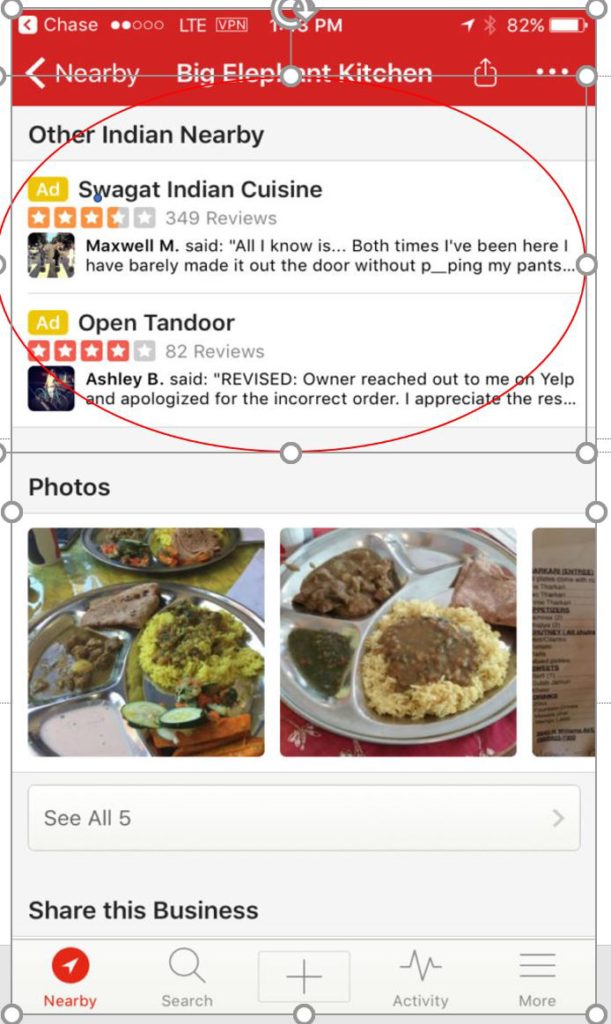
A couple of Indian restaurants in my hometown of Portland are paying to advertise on Yelp. Here’s what appeared on one smartphone over the weekend:

Photo by Tyler Bernstein


The little “Ad” icon next to each review makes it clear — these restaurants paid for this to appear.

If you can’t control the copy, there is danger.

[reminder]

Read Chapters 1 & 2 of Breakthrough Prospecting Free

Do you need to bring your new direct sales numbers up? Breakthrough Prospecting is for you.

Radio TV Advertising Sales Book Beyond ProspectingAny media salesperson — radio, television, digital, print, outdoor — at any level will find real value. The book is chock full of actionable tips that will generate new direct money fast. 

AE’s who’ve been in the business for three years or less will benefit the most. So will the managers who work with them. 

In Breakthrough Prospecting: Jumpstart Your Media Sales Career and Make the Income You Deserve, you’ll learn:

  • 5 places to find great leads right now…including at least one you’ve forgotten, and two you’ve never used before.
  • A battle-tested call opening that will turn “Not interested” into “Tell me more!”
  • A comprehensive list of questions you MUST ask at the first meeting if you want to bring back a plan that’ll make ’em buy.
  • A proven 3-step method to get the client to give you their advertising budget — and tell you where they’re spending it!


Invest just $14.95 to download your copy of Breakthrough Prospecting, and you’ll be in profitable territory fast with the very first sale you make.

[button href=”https://philbernstein.com/bernstein-worldwide-breakthrough-prospecting-order-page” primary=”true” centered=”true” newwindow=”true”]Buy Breakthrough Prospecting Now[/button]

Want to read the first two chapters free? Sign up for my mailing list, and you can have Chapters 1 and 2 for no charge.

[button href=”https://philbernstein.com/read-chapters-1-and-2-fuhnuthin” primary=”true” centered=”true” newwindow=”true”]Click Here to Read Chapters 1 and 2 For Free[/button]

Please Call Your Voice Mail. Now.

Here are three salespeoples’ outgoing voice mail greetings I encountered on Tuesday, June 13. Names and numbers have been changed to protect people who should know better:

salespeople should fix their phone greetings
Photo by Drobot Dean
  • “The person you are trying to reach is not available. Please leave a message after the tone.” Delivered by an automated voice. 
  • “You have reached five, oh, three, four, seven, seven, four, nine, three, three. Please leave a message after the tone.” Delivered by an automated voice. When I tried to leave a message, the attendant informed me that the mail box was full and I would have to call back later.
  • “Hi, this is Bill. Our offices are closed for the Memorial Day holiday weekend. Please leave your name and number and I’ll call you when we reopen on Tuesday, May 30.” I was calling on June 13.

In the first two examples, I had no idea if I had called the right number. For the last one, at least I knew I’d reached good old Bill — but I was calling two weeks after Memorial Day and there was no way of knowing if he was in or out of the office.

I alerted all three of them to the problem (it was a surprise in each case) and strongly urged them to fix their greetings.

Today I strongly urge you to get on your cell phone and call your desk phone. Let it go to voice mail and listen. Try to leave a message.

Then get on your desk phone and call your cell phone. Let it go to voice mail and listen. Try to leave a message.

What did you hear? If you were a client or prospect and heard that greeting, what would you think?

Here’s what Seattle Job Recruiter Lora Poepping thinks:

I will hang up when your voicemail doesn’t give your name.

Please, please have your name mentioned in your outgoing message. Why? Because I don’t want to leave a message about wanting to speak with you about a potential new job if I don’t even know if I’ve reached the right person. If you don’t want to record something, just default to using your name. You may have missed your chance to be considered for a position.

A robotic voice mail message will send your prospects to a competitor. 

Indulge me, longtime readers. I’ve written on this subject before. Experience tells me the problem hasn’t gotten any better — and some of the people I’ve alerted in the past have never bothered to fix the problem.

My advice? Fix it. Now.

  • Record a greeting in your voice, giving your name. Don’t make your customers guess whether they got the right number.  Nothing fancy — just invite callers to leave a message and promise to call them back.
  • If you’re feeling adventurous, you can include a short positioning statement on the greeting. Example: A floor store owner did a great job selling on his voice mail.
  • If you’re going to be out of the office and unavailable, change the greeting to reflect that. But don’t forget to change it back as soon as you return.
  • If you’re one of those people who doesn’t listen to your voice mail messages and prefers to be contacted another way, your greeting should say that clearly.
  • Empty your mailbox. If callers can’t leave a message, they’ll call someone else.

A bad voice mail greeting is a big hole in your sales funnel. Fix the hole, and the money is much more likely to flow to you.

[reminder]