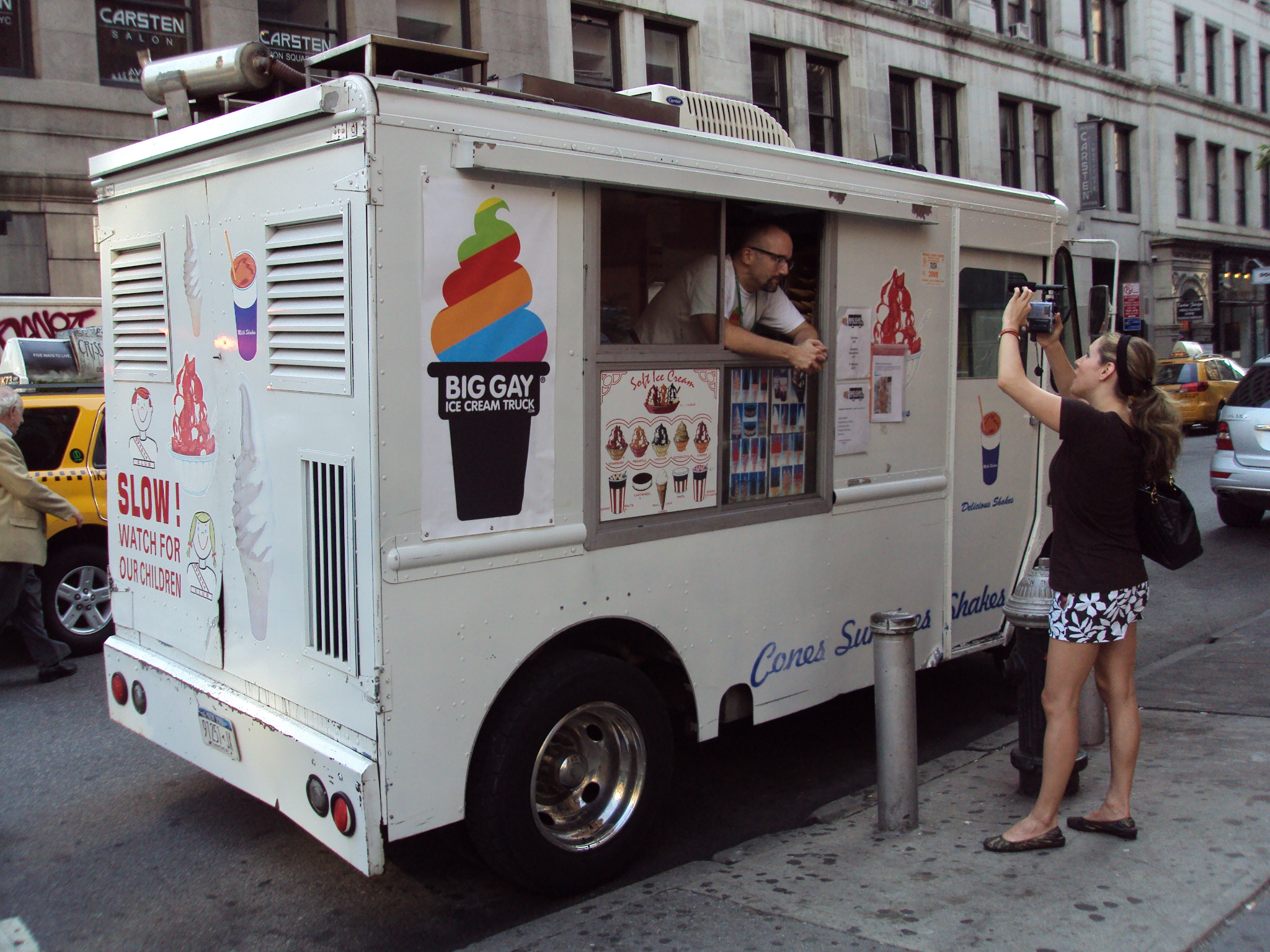
The company began its existence in Manhattan as the Big Gay Ice Cream Truck in 2009, and quickly took off. There are now two shops in Manhattan, along with a “permanent pop-up” at the Ace Hotel in Los Angeles. The web site indicates that more stores are planned for Los Angeles and Philadelphia.
As a marketing tool, the name has three important things going for it:
It is so far from the expected that it forces people (i.e. potential customers) to pay attention.
It establishes a genuine point of differentiation. That differentiation doesn’t have to be the product itself to be significant, which is likely similar to ice cream you can buy elsewhere.
It implicitly accepts the risk that some people will be offended, and will refuse to buy ice cream from this truck because of the name. Owner Doug Quint is willing to sacrifice that business in return for a (presumably larger and more loyal) customer base that will seek him out. (For more on this concept, go here).
[reminder]What’s the most unusual name you’ve seen for a (reasonably mainstream) business? Please keep it PG-13 for a family readership.[/reminder]
Not long ago an ad agency pulled a home improvement commercial off the air in Portland and Seattle because several listeners had called the client to complain about it. The client was concerned that he was offending potential customers, and the agency had to scramble to come up with something else.
So what happens when some people don’t like your advertising?
[bctt tweet=”They don’t have to like your advertising — they just have to buy.”]
Sunny Kobe Cook, whose relentless pitches for Sleep Country USA in the 90’s irritated thousands, once told a seminar audience that she would occasionally work behind the counter at one of her stores.
Customers would walk up to the counter after choosing a bed, hand her their credit card, and then do a double-take. She described the typical encounter like this:
Customer: You’re Sunny Kobe Cook!
Sunny: Yes, I am.
Customer (leaning forward, whispering): I hate your commercials!
“They’re standing in my store,” said Cook, “and making a purchase for a thousand bucks or more. I want everyone to hate my commercials like that!”
Cook annoyed people with her voice and relentlessness. Rob Christensen, by contrast, deliberately pushed the envelope of good taste. Christensen ran Apple Auto Sales of Charlotte, North Carolina. In his TV ads, he played “Reverend Rob”, a televangelist who would “HEAL your credit.” They’re cheesy, poorly-acted, and have the ability to offend on multiple levels.
According to Mike Drummond of the Charlotte Observer, Christensen began running these ads since 1997. Viewers complained, and some stations refused to run the spots.
Christensen aired the commercials on stations who would accept them, and took his money to the bank. “I’ve had people tell me they hate my ads — hate them,” Christensen told Drummond. “And yet they still bought a car from me.”
Ninety-eight point nine percent of all the customers who hate your ads will still come to your store and buy from you when they need what you sell. These customers don’t cost you money; they just complain to the cashier as they’re handing over their cash.
A caution is in order here: An annoying campaign may get you noticed, but you can’t forget to sell within the commercial. The Sleep Country and Apple Auto Sales commercials were more than just exercises in irritation. Each one contained a powerful sales message and a call to action.
Don’t reject an idea simply because some folks might not like it. They don’t have to like it — they just have to buy.
[reminder]If you work in advertising, have you ever had to deal with a client who wanted to bail on a campaign that was generating heat? How did you deal with it?[/reminder]
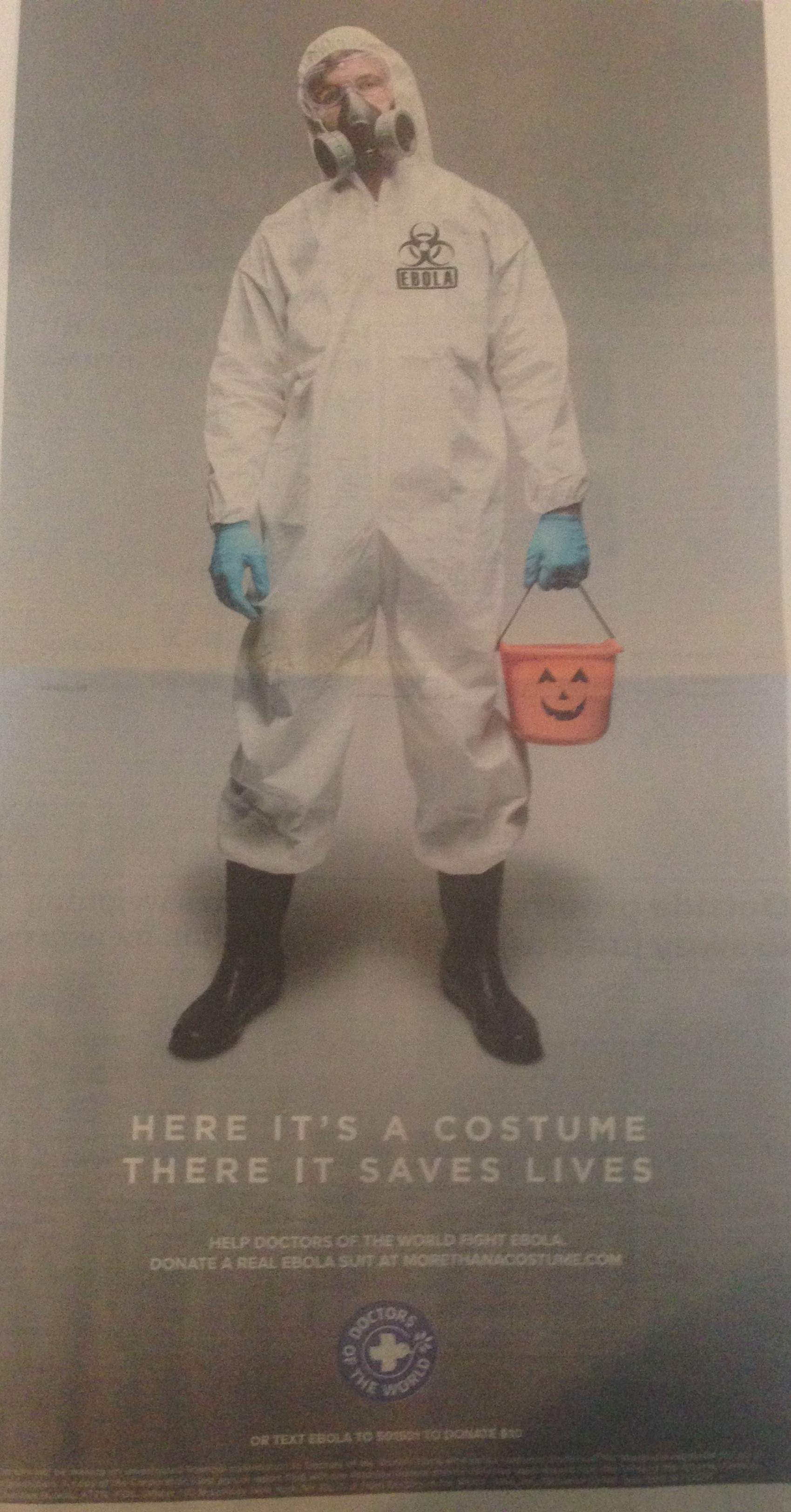
Here is a terrific example of advertising that enters the conversation America is already having in its head.
What are we thinking about on October 30, 2014? Ebola and Halloween, that’s what. Many fine American entrepreneurs are offering “Ebola costumes” this year.
An organization called Doctors of the World* has set up a fundraising landing page at www.MoreThanACostume.com, and is using the current American zeitgiest to raise some money and do some good.
They have cleverly tied donation levels to particular pieces of equipment — you can “donate gloves” for a buck, goggles for $10, etc. At the high end, you can “donate a doctor” for $2500.”
The ad below appeared in USA Today on October 30. It is awesome.
Ad appearing in USA Today October 30, 2014
*I am not familiar with this organization, which claims to be “fighting Ebola in Liberia and Sierra Leone, engaging with local communities to prevent Ebola’s spread, raise awareness and deliver essential protective equipment” and am not endorsing it in any way. Except for their advertising approach, which I endorse as heartily as it is possible to do so.
Whenever we present an advertising plan to a new client, one of the first questions we hear (right after “How much will it cost”?) is “How long will it take to work?”
It’s a difficult question to answer — some products are impulse buys while others require painstaking research… some people need it now while others won’t buy until they’re ready. Roy Williams, The Wizard of Ads, recently tackled an underrated variable: the quality of the marketing message.
Advertisers often ask, “How many times does the average person have to see or hear my message before it will be transferred into the automatic recall part of the mind?” Although this seems like a reasonable question, it’s a little bit like asking, “How many ounces of alcoholic beverage does it take for the average person to get drunk?” We can’t really answer that question until we know whether the “ounces of alcoholic beverage” are beer with 5% alcohol, wine with 14% alcohol, or Scotch with 45% alcohol.
How strong are your ads? The stronger your ads, the fewer times they have to be heard.
Photo by Didriks
Even then, as Williams points out later in the article, mindshare once attained must be maintained. Williams cites Bob Hoffman’s discussion of Pepsi, who cancelled their TV advertising and replaced it with a social media strategy in 2010. According to Hoffman, the strategy got them millions of Facebook likes… and a 5% loss of market share.
The example I often use is McDonald’s. Wherever I am in the country, I can walk down to my hotel lobby and ask the front desk clerk where McDonald’s is. She won’t ask me who McDonald’s is — she knows what it is, where it is, and what I’ll find when I get there. So does everyone else in town.
And yet, if I return to my hotel room and turn on the TV, I’ll soon see a McDonald’s commercial.
In the video below, Bob Hoffman, the Ad Contrarian, tackles the claims of many that traditional advertising is dead.
I’m sorry, you simply cannot kill advertising. On the final day, when the big flaming asteroid bears down on our poor little planet and all is destroyed, there’ll be only two things left: cockroaches, and copywriters.
It’s fair to say that Mr. Hoffman is not much of a fan of social media as a marketing tool. If you have any interest in where advertising is going and what still works, you’ll find him unafraid to dispute pretty much everything you’ve read elsewhere. This speech, from Advertising Week Europe a few months back, is fascinating stuff, and well worth the 44 minutes it’ll take to watch.
What do you think? Is social media worth the time, effort, and expense? Or is it, to use Mr. Hoffman’s vernacular, bullshit? Leave a comment below.