Why This Stat About Internet Leads Should Worry You

“People often mistake activity for outcomes, but they are not the same thing.” — Anthony Iannarino, The Only Sales Guide You’ll Ever Need

Now that traditional media companies are offering a full array of digital advertising products, we (and our clients) benefit from all of the measuring tools available to us.

When the message is online or on mobile, we have lots of metrics to choose from. It’s important to choose wisely when it’s time to keep score.

In sales presentations, I often see Account Executives focus on their ability to generate click-throughs. Sometimes they even guarantee a specific number of clicks as part of the package.

Problem: the desired end result for most advertisers isn’t a click-through — it’s usually a sale. Clicks are an activity, not an outcome.

You can’t eat clicks and likes.”

Mark Hunter, High-Profit Prospecting: Powerful Strategies to Find the Best Leads and Drive Breakthrough Sales Results

A recent study by the SEO firm Straight North demonstrates that all click-throughs are not created equal.

Over 18 months, Straight North analyzed more than 350,000 form submissions and phone calls generated by internet marketing campaigns. What they found is startling:

Only half of them — roughly 178,000 — were genuine sales leads.
Digital salespeople may be shocked by this internet stat
Photo by Brian Jackson

According to Straight North,

Roughly 50 percent of all inquiries are not sales leads, instead made up of things such as:

  • Customer service communication
  • Sales solicitations
  • Job applicants
  • Phone misdials
  • Auto-dialers
  • Full voice mail systems and other phone menu issues
  • Spam form submissions
  • Empty form submissions
  • Form submissions missing contact information such as an email or phone number”

Straight North points out that lead validation is crucial here. When you don’t know what happened after the first click, you don’t know what you’re delivering.

[shareable text=”Clicks are an activity, not an outcome. Focus on the true goal” http://wp.me/p4RXlM-1n4]Clicks are an activity, not an outcome. Focus on the true goal” — Phil Bernstein[/shareable]

If it turns out that half of the click-throughs your campaign delivers are worthless, you may not be delivering the outcome that your advertiser wants.

To generate more sales from the campaign, you’ve got two choices:

  1. Increase the quantity of the clicks with more advertising. If the overall number rises, you can generate more sales even if the ratio of good-to-bad doesn’t change.
  2. If the budget won’t allow more advertising, you need to focus on improving the quality of inquiry, with sharper ad copy, stronger landing pages, and a better sales funnel.

You may think you’re selling click-throughs, but your client wants to buy sales.

Focus on the outcome, not the activity.

Here’s a link to a summary of the study:

How to Make Money on Google’s New Mobile Policy: Opportunity for Media Salespeople

It’s not news that more and more searches are being done on mobile devices. Nor is it news that many of our clients have not gotten around to making their websites mobile-friendly.

The time to do something about that is now — and that creates opportunity for those of in television, radio, or digital sales.

radio sales tip: sell mobile media
photo by tuomaslehtinen/dpc

 In August of 2014, Comscore released a study showing that a majority of US digital consumption now takes place on mobile apps. According to Telecrunch:

U.S. users are now spending the majority of their time consuming digital media within mobile applications, according to a new study released by comScore this morning. That means mobile apps, including the number 1 most popular app Facebook, eat up more of our time than desktop usage or mobile web surfing, accounting for 52% of the time spent using digital media. Combined with mobile web, mobile usage as a whole accounts for 60% of time spent, while desktop-based digital media consumption makes up the remaining 40%.

Here is some news that might give your clients a reason to mobile-optimize their websites now: beginning April 21, 2015, Google’s will start giving extra ranking credit to the websites that it considers mobile-friendly. In other words, even if your client’s site ranked well before, it could drop in the rankings if it doesn’t meet Google’s mobile standards.

This round will only apply to mobile search, so desktop search rankings will not be affected… yet.

How can you find out if a site passes? Google has a free tool that allows you to test any site. You can find the tool here: https://www.google.com/webmasters/tools/mobile-friendly/

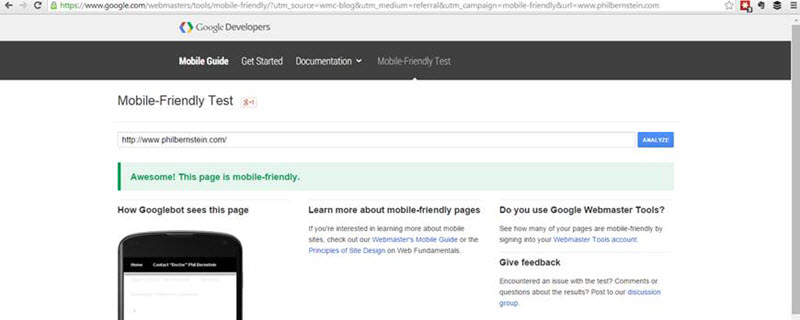
A mobile-friendly page will bring back a result that looks like this:

radio sales tip: sell mobile media
My advertising, marketing and sales training blog passed!

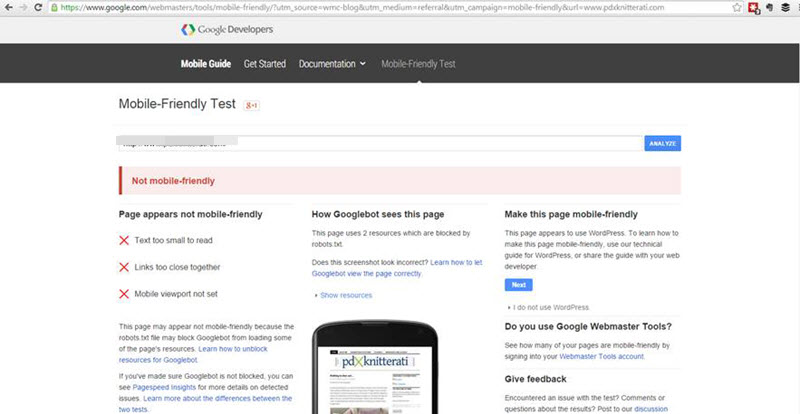
A page that doesn’t pass Google’s test will look like this:

Another tip for radio salespeople: sell mobile media
This blog failed Google’s test

How You Can Make Money On This Right Now

[bctt tweet=”Before every sales call, run the client’s website through Google’s Mobile-Friendly Test.”]

·       If it doesn’t pass, print out a copy of the result in color.

·       Take a screen shot of the client’s site on your mobile phone, email it to yourself, and print the image out in color.

·       Talk to your company’s digital department. Can your station offer help – for money — in making a site mobile-friendly?

·       If so, prepare a proposal. The proposal should include the results of Google’s test and the mobile screen shot of their site.

·       If not, bring the Google results and screen shot out to your client anyway. Doing this will help position you as a true consultant rather than a package peddler.


Keep the conversation going — share this post on Facebook, LinkedIn and Twitter!

Why Isn’t Your Advertising Working? (Don’t Blame The Media)

Some reasons to ponder come courtesy of a Roy Williams’ Monday Morning Memo essay, from way back in 2008. Read the whole thing here. Every point he makes is still valid today. Here are a couple:

 2. reputation.
Consider the people who don’t buy from you. Are they buying elsewhere because they haven’t heard about your company, or is it because they have? I’ve never met a business owner willing to believe their company had a bad reputation…
 

7. media myths.
Are you anxious to find a more effective media? If so, you’ve got really bad ads. I’ve never seen a company fail because they were using the wrong media or reaching the wrong people. But I’ve seen thousands fail because they were saying the wrong things. A powerful message will produce results in any media.

Radio Advertising Sales Tip: Television Works!
Photo by Aurelio/dpc

In my advertising sales/consulting practice, I meet with about 200 local businesses each year.

  • They hear from television advertising salespeople, telling them to get out of radio because radio doesn’t work.
  • They hear from radio advertising salespeople, telling them to get out of newspaper because newspaper doesn’t work.
  • They hear from social media “experts” telling them to get out of radio, newspaper and television because traditional media doesn’t work.

Here’s the dirty little secret I pass along to them:

There are plenty of potential customers who watch television, listen to the radio, read the newspaper, and consume media online every single day. When I hear that the advertising isn’t working, it’s generally one (or more) of three problems:

1. They didn’t get the message right. You’ve got to tell a story your audience cares about, and give them a good reason to do business with you.

2. They aren’t delivering the message often enough, or consistently enough. Customers will buy when they’re ready and not a moment before. You need to keep reminding them.

3. They don’t deliver on the promises their advertising makes, and the audience doesn’t believe them.


If you tackle the issues above, you’ll get the advertising to work. If you don’t, switching media isn’t going to help.

[reminder]


How To Grade a Website: Will It Flunk “The Mom Test”?

Have you ever gone to a client’s website and gotten lost? What did you do about it? If you’re a media advertising salesperson, it’s your responsibility.

radio advertising sales tip: radio salespeople should look at client websites

 Photo by iQoncept/dpc

I spent last week on the West Coast meeting with advertisers in partnership with a television station sales department. Preparing for the week, I spent time looking at each client’s website — 25 in all. Here’s what I found:

  • A lawyer’s site had the wrong address and phone number — she had moved to a different office.
  • A real estate agent’s site had no contact information at all.
  • A sporting good store’s site had drop-down menus for a variety of categories. “Baseball”, for example, had links for gloves, bats, balls, and helmets. But there was no information at any of the links.
  • A pet supply store’s website was down. That’s not the bad part. The bad part was that the station Account Executive had looked at it a week earlier, and it had been down then. The odds are good that it had been down for at least a week, and the client had no idea.

IN THIS NEXT PART, I AM BORROWING A CONCEPT FROM A RECENT ARTICLE AIMED AT BLOGGERS.
UNFORTUNATELY, I CAN’T REMEMBER WHO WROTE IT*

Pretend to be your mom — a generation older than you, able to use the Internet but not all that comfortable with it — and take a look at your blog. Could your mom find your subscription sign-up box? Would she know what to do?

If not, fix it. — Name Not Remembered

If you are an advertising salesperson — radio, television, newspaper, or any other media — you are now expected to have a good working knowledge of digital marketing. If you put together a program that drives traffic to your client’s website, and that traffic never turns into money, you have failed.

Don’t just shrug your shoulders and blame the advertiser. You are an Account Executive. Your job is to execute. If the campaign fails and the client cancels, it’s on you.

So give your client’s website The Mom Test.

If your mom  — a generation older than you, and not all that comfortable with the Internet — saw a television commercial, or heard a radio promotion, or read a newspaper ad, or clicked on a banner, and the ad took her to your client’s website, would she know what to do next? Could she figure it out quickly?

If Mom couldn’t figure out how to give your client her money, the website is a barrier that is driving money away from your client. You need to show your client how to fix it. Now.

Fortunately, your company has developed some great digital tools to help you do that. It’s time to find out what they are.

Three Ways An Advertising Salesperson Can Apply This This Today

1.  Pull up the websites of every client you’ll be meeting with in the next couple of days. Give each one The Mom Test. If any of them flunk, show the sites to the head of your digital department, and develop a strategy to fix it. Attach a price tag to the strategy and build a proposal.

2. Bring the proposal to the client. Explain The Mom Test. Show the client exactly what happened when “Mom” went to the website. Demonstrate how your strategy will fix the problem. Get a signature.

3. Share this post on Facebook, LinkedIn and Twitter. You can find the Share buttons at the top and at the bottom of the post. So can Mom.

* This, or something like it, was in somebody’s content marketing blog within the past month. I could have sworn that I’d saved the quote, but it’s not in my records. I thought it was from Ann Handley, but I searched her blog and couldn’t find it. If you know where it came from, let me know and credit will be willingly and cheerfully given.

5 Great Books Every Advertising Salesperson Must Read (Or Re-read) in 2017

We work in the persuasion industry. As advertising sellers, first we must persuade a prospect to meet with us… and then consider our proposal… and then buy. Then we must design a campaign that persuades our client’s prospects to take action.

Here are five books that will help you develop the sales skills to persuade… and sell.

5 Great Advertising, Marketing and Sales Books

The Accidental Salesperson by Chris Lytle: I read the original version of this book more than a decade ago. It was early in my selling career. I was looking for anything that could teach me the sales skills I needed.  This book taught me enormous amount. When the new edition came out, I took it out of the library — being a cheapskate, I didn’t feel like paying for it a second time. Two chapters in, I returned the library copy and bought my own. I wanted to read it and highlight the hell out if it. For example, this:

If you work on straight commission, you prospect for free. You do a customer needs analysis for free. You do the research for free. Then you write the proposal for free… At least you don’t have to pay to make your presentation to the prospect.

What if you did have to pay to make your presentation? You obviously would put more time and thought into it. You probably would even rehearse it a few times…”

I’ve gone from being a salesperson to a combination salesperson/sales trainer role.  I have read that passage repeatedly to groups of radio and television advertising sellers all over the country. It gets through.

Slow Down, Sell Faster! by Kevin Davis: This is one of the rare sales skills books that has actually given me a new perspective on the process of selling. The author’s contention is that we spend so much time focusing on our needs and our timetable that we forget what’s important to the client. He sums it up this way:”Every sales leader wants fast sales; the trouble is, there aren’t many fast buyers…They are unlikely to change their buying process to match your selling process, so your only option is to be the one who switches.”

Influence: The Science of Persuasion by Robert B. Cialdini A classic in the field — enough science to demonstrate that the author knows what he’s talking about, but accessibly written for salespeople (like yours truly) who didn’t pay attention in science class. Cialdini, who holds professorships in Marketing and Psychology at Arizona State University. The principles he teaches in this book will help you do a better job convincing clients to buy, and can also help make you a better marketer and copywriter.

Advertising Headlines That Make You Rich by David Garfinkel: Although this book is aimed at those who sell with the written word — direct mail, print publications, and web pages — the techniques can help marketers in any medium. However your prospects see or hears your sales message, you have a very short window in which to convince them to pay attention. The headline in a print ad, or the opening five seconds of a radio or TV commercial, will cause your target to either pay attention to the rest of the message or tune you out. Garfinkel gives you a series of headline templates that have worked for selling a wide range of products and services, discusses why each one has been effective, and lists several variations on each headlines. When I’ve hit a wall while writing copy, I’ve gone to this book to help get unstuck.

Dan O’Day’s Guaranteed 5-Step System For Creating 30-Second Radio Commercials That Get Results: Another good cure for (copy)writer’s block, and an excellent companion to the Garfinkel book. I bought this when I was working in radio; now that my primary platforms are television and digital, I still use it regularly. Like Garfinkel, O’Day teaches a headline-based approach to designing a campaign. Besides the headlines, the true benefit of O’Day’s system is in the exercise of settling on a Unique Selling Proposition before starting the script. It’s not a long book, but it’s a powerful one.

[reminder]What’s the best advertising, marketing, or sales book you’ve read in the past 12 months?[/reminder]