Whenever we present an advertising plan to a new client, one of the first questions we hear (right after “How much will it cost”?) is “How long will it take to work?”
It’s a difficult question to answer — some products are impulse buys while others require painstaking research… some people need it now while others won’t buy until they’re ready. Roy Williams, The Wizard of Ads, recently tackled an underrated variable: the quality of the marketing message.
Advertisers often ask, “How many times does the average person have to see or hear my message before it will be transferred into the automatic recall part of the mind?” Although this seems like a reasonable question, it’s a little bit like asking, “How many ounces of alcoholic beverage does it take for the average person to get drunk?” We can’t really answer that question until we know whether the “ounces of alcoholic beverage” are beer with 5% alcohol, wine with 14% alcohol, or Scotch with 45% alcohol.
How strong are your ads? The stronger your ads, the fewer times they have to be heard.
Photo by Didriks
Even then, as Williams points out later in the article, mindshare once attained must be maintained. Williams cites Bob Hoffman’s discussion of Pepsi, who cancelled their TV advertising and replaced it with a social media strategy in 2010. According to Hoffman, the strategy got them millions of Facebook likes… and a 5% loss of market share.
The example I often use is McDonald’s. Wherever I am in the country, I can walk down to my hotel lobby and ask the front desk clerk where McDonald’s is. She won’t ask me who McDonald’s is — she knows what it is, where it is, and what I’ll find when I get there. So does everyone else in town.
And yet, if I return to my hotel room and turn on the TV, I’ll soon see a McDonald’s commercial.
Anyone who has sold television advertising has run into this objection when presenting the schedule: “I never watch that show”. The client, of course, believes that if he or she never watches it, then nobody watches it.
Now that our business has expanded into the online arena, there’s a new variation on the theme: “I never click on the ads”. If your company offers paid search/SEM services, a couple of articles in the EConsultancy Blog will give you some interesting ammunition.
“Google made $10.469bn in revenue from ads on its own sites alone in the first three months of 2014. This means that – assuming all is equal and that 36% of that cash was the result of people clicking without recognising ads – the vague implication here is that Google generated $3.768bn from users who had no idea they were being advertised to in the first place. Quite a scary thought.”
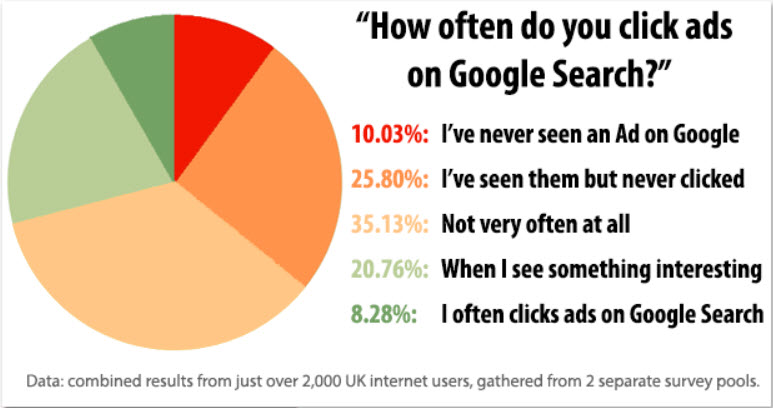
This inspired EConsultancy to run its own studies of 2000 UK Internet users. Below is the chart they published (click on the chart to go to the full article, which goes into much more detail on how the surveys were done and breaks things down by age group).
Click on the chart to see the full EConsultancy article
Slightly more than a quarter of the respondents claim they’ve never clicked on a Google Search ad. The remaining 74% either admitted to clicking on them at least some of the time, or thought they’d never seen one (which could mean they are clicking on ads without realizing it).
$10.4 billion doesn’t lie. Somebody’s clicking on search advertising. Where do you want those clicks to go?
In the video below, Bob Hoffman, the Ad Contrarian, tackles the claims of many that traditional advertising is dead.
I’m sorry, you simply cannot kill advertising. On the final day, when the big flaming asteroid bears down on our poor little planet and all is destroyed, there’ll be only two things left: cockroaches, and copywriters.
It’s fair to say that Mr. Hoffman is not much of a fan of social media as a marketing tool. If you have any interest in where advertising is going and what still works, you’ll find him unafraid to dispute pretty much everything you’ve read elsewhere. This speech, from Advertising Week Europe a few months back, is fascinating stuff, and well worth the 44 minutes it’ll take to watch.
What do you think? Is social media worth the time, effort, and expense? Or is it, to use Mr. Hoffman’s vernacular, bullshit? Leave a comment below.
I was meeting with the owner of an upscale ladies boutique in a southeastern state. Although the store sold all manner of women’s clothing, the largest revenue driver was shoes.
Apparently, ladies love shoes. Who knew?
The conversation had just turned to social media, and I asked the owner how effective the store Facebook page was as a marketing tool. “It’s okay, I guess,” he said. “But I found a much better way to use Facebook.”
He had my attention. I bit. “How do you do that?” I asked.
“My customers all have cell phones, and just about all of them have a camera. Whenever a customer tries on a pair of shoes and decides to buy them, we ask if they’d like us to take their picture — with their phone. Women like to show off their new shoes, so most of them say yes.”
“Do they let you post those pictures on your Facebook page?” I asked.
“Some do, but I don’t really care about that,” he replied. “What makes this work is that as soon as they go home, they post that picture on their own Facebook page. And they usually mention that they got the shoes at my store.
That means that we just got a free Facebook ad, and it gets seen by 500 of my customer’s friends. Two or three times a week, someone will walk into my store and ask to try on a pair of shoes that their friend posted on Facebook.
All of this costs us nothing – we don’t even pay for the camera!”
The store owner has stumbled on a great way to use Facebook in its most effective form – to accelerate word-of-mouth. It’s a technique that can be used in a variety of consumer settings:
A furniture store can take pictures of a customer’s new couch, in the customer’s home.
–
A car dealer can shoot a photo of a happy couple standing next to the new SUV they just bought.
–
A window company can take pictures of a homeowner posing in front of her newly-installed windows.
The key is to take the picture with the customer’s phone, not yours.
Rather than begging people to “like” your Facebook page, you can intersect with existing consumer behavior. Happy customers love the show off the things they just bought… on Facebook.
If you like what you’re reading, there’s more! Sign up for Phil Bernstein’s free advertising and marketing e-newsletter here. As a bonus, I’ll send you a copy of my newly-revised and expanded e-book, The Seven Deadly Mistakes of Advertising and How to Fix Them when you subscribe.
You can become a Facebook Fan of “Doctor” Phil Bernstein, Portland’s Advertising Expert here.
If you like this post, share it — click the “Share” button below.
Here’s a terrific example of a medical practice capitalizing on current events:
A Green Bay Lasik doctor is offering free lasik surgery to the replacement referees who blew the “touchdown” call at the end of the Packers/Seahawks game. Dr. Christopher Smith of Optivision Eye Care in Appleton told WFRV-TV, “The referees obviously had some vision issues, so we decided we could help them with that.”
I’m going to go out on a limb and predict that none of the referees are going to accept the offer. But it will get Optivision an enormous amount of free publicity, both locally and nationally.
If you like what you’re reading, there’s more! Sign up for Phil Bernstein’s free advertising and marketing e-newsletter here. As a bonus, I’ll send you a copy of my newly-revised and expanded e-book, The Seven Deadly Mistakes of Advertising and How to Fix Them when you subscribe.
You can become a Facebook Fan of “Doctor” Phil Bernstein, Portland’s Advertising Expert here.
If you like this post, share it — click the “Share” button below.