Writer of the Life Cereal “Hey Mikey!” Ad is Gone

If you grew up in the 70’s and watched any TV at all, there is probably a space reserved in your head for the “Let’s Get Mikey!” ad. If you, like me, never thought about the fact that someone wrote the thing, take 30 seconds to salute Edie Stevenson, who died recently at the age of 81.

[youtube=http://www.youtube.com/watch?v=vYEXzx-TINc]

My favorite part of the obituary is this line:

In addition to her daughter, she is survived by her longtime partner, Gordon H. Price; two sisters, Daphne Stevenson Penttinen and Adelita Stevenson Moore; three sons, Steven, David and Donald Mann; and five grandchildren.

She also leaves a cat, Mikey.

______________________________________________________________________________________

Email Phil Bernstein here.

Like what you’re reading? There’s more! Sign up for Phil Bernstein’s free advertising and marketing e-newsletter here.

Become a Facebook Fan of “Doctor” Phil Bernstein, Portland’s Advertising Expert  here.

Safeway Print Ad Fail

Today’s lesson: make sure the folks in Marketing and Operations are talking to each other.

This ad was on the front page of today’s Sunday Oregonian:

Safeway Delivery Ad

As an ad professional, they had me at “$15 off plus free delivery”.

A nice, simple offer. Strong call to action, with a reward for taking it. Although the print on the deadline is way too small — they would have been better off making the deadline font every bit as big as the rest of the copy — but there is a deadline.

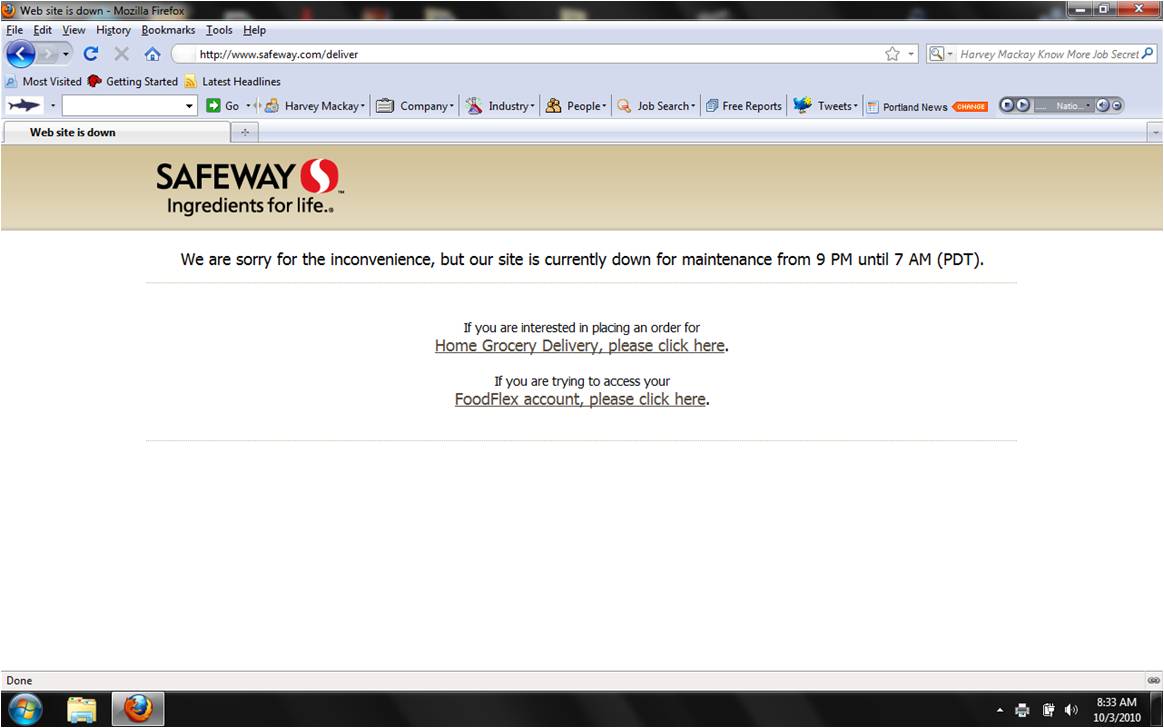
As a person who consumes groceries, I was interested, so I went directly to my computer and logged onto their web site. This is what I found:

We are sorry for the inconvenience, but our site is currently down for maintenance from 9 PM until 7 AM (PDT).

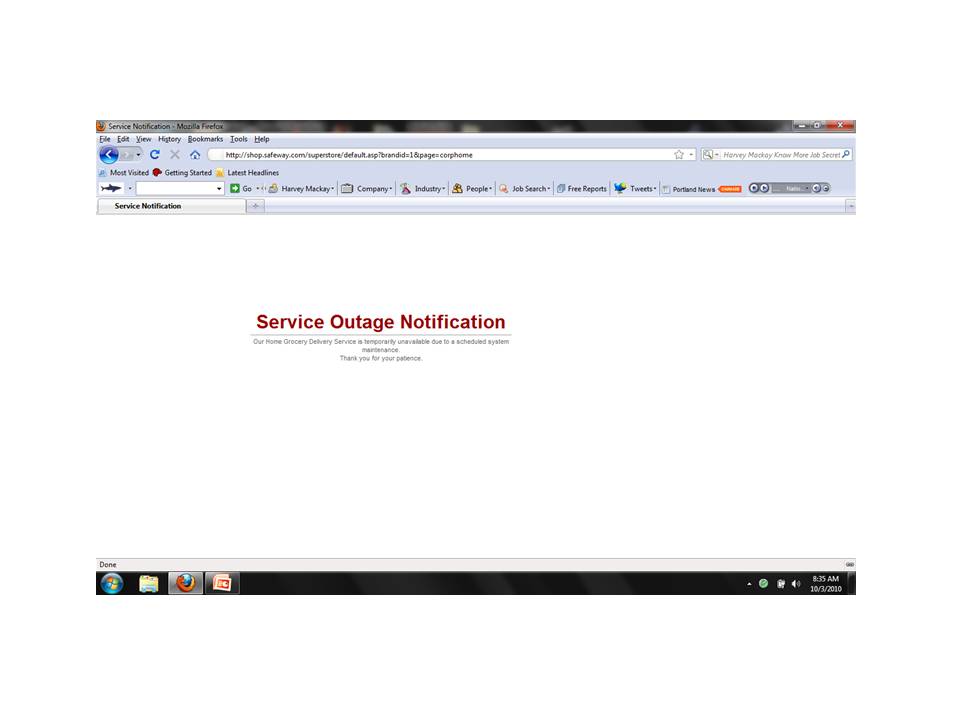
It was 8:35am. In an effort to take care of delivery customers, there was a link, but it went to this:

Our home delivery system is temporarily unavailable due to a scheduled system maintenance. Thank you for your patience.

While the folks in Advertising were arranging to spend thousands of dollars to invite new customers to their web site, somebody in IT was scheduling a maintenance activity that took the site down. And if they figured that the maintenance would be over by the time most Oregonian readers were up and reading the paper, they figured wrong.


___________________________________________________________________________

Email Phil Bernstein here.

Like what you’re reading? Sign up for Phil Bernstein’s free advertising and marketing e-newsletter here.

Become a Phil Bernstein Portland’s Advertising Expert Facebook Fan here.

How Radio Sales and Production Interact

In any organization of significant size, there’s a sales department and an operations department. There are three principles that apply:

  • They need each other.
  • They don’t understand each other.
  • Often, they flat-out hate each other.

So it is with radio stations. When an advertising salesperson sells a commercial schedule, the vision of the client travels from the client through the seller to the Production Director. And although the technology has changed since this was recorded in 1995, the interaction still goes a lot like this:

[youtube=http://www.youtube.com/watch?v=U6PRBvfAVhY&feature=player_embedded]

Hat tip to my ex-colleague Bill Cooper for alerting me to this. And a salute to Clear Channel Production Directors past and present: Matt Jones, Bill Stevens, and Todd Tolces.

___________________________________________________________________________

Email Phil Bernstein here.

Like what you’re reading? Sign up for Phil Bernstein’s free advertising and marketing e-newsletter here.

Become a Phil Bernstein Portland’s Advertising Expert Facebook Fan here.

When You Have Only One Chance to Persuade

There’s been a steady drumbeat for months about media dollars moving from “traditional” media to online. According to a recent report by Outsell, a California company that tracks the information industry, online advertising spending will exceed print advertising for the first time this year.

Here are some predicted numbers from Outsell:

  • $120B  Online/Digital
  • $112B   Print/Magazine
  • $  60B   TV
  • $  24B   Direct Mail

But the stampede to digital only goes so far. Media Blogger Tom Taylor reports that as the General Election approaches, political types are sticking with television:

Six weeks to go, says Borrell Associates, and digital media might get about 1% of the total political ad spend in this election cycle. Just 1%, versus the 65-70% that is funneled into TV. Borrell’s figuring a total commitment to digital this year of about $45 million, which is double 2008, but still a minuscule part of most candidates’ budget. Why so little going that way, after the Obama success with online in 2008 and the Tea Party social networking of the last year? Borrell theorizes that political consultants are sticking with proven techniques, and they know TV works. There’s relatively little research about doing political advertising online.

There are a number of ways to interpret this, including:

1. Some political operatives may just be scared of the unknown. They will continue to do what they’ve always done until someone forces them to do otherwise.

2. In some cases, campaigns have tried to use the “free” side of digital — videos on YouTube, tweets on Twitter, and Facebook “fan pages” — in the hopes that something will go viral. As Alabama Agriculture Commission candidate Dale Peterson found earlier this year, viral doesn’t always translate into votes. He got 1.5 million views on YouTube, but finished third in the Republican primary.

3. The fact that online spending doubled could mean it’s just a matter of time before digital dominates political advertising, too.

But the thing to keep in mind is that political advertisers are in the pure persuasion business. They need to force their way into the consiousness of people who may not be thinking about them, and convince them to take a particular action on a particular day. They only have one chance to get it right — Tuesday, November 2 — and if they fail, they will be unemployed on Wednesday.

With one chance to persuade, these people are still choosing intrusive old media — television wins this election in a landslide, 65 to 1.

______________________________________________________________________________________________________

Got a question? Wanna argue? Email Phil Bernstein here.

Sign up for Phil Bernstein’s free advertising and marketing e-newsletter here.

Become a Phil Bernstein Portland’s Advertising Expert Facebook Fan here

How Much Disclaimer is Too Much?

I’m not a smoker — never have been. So when I saw this ad for Chantix, my reaction was purely academic. This is the longest, scariest disclaimer — after 17 seconds of “testimonial”, the warning language starts, and runs for more than a minute –I’ve ever seen, and my initial thought was that Pfizer was wasting its money.

I’m not disputing the need for the language — the law is the law, and if Pfizer wants to run an ad for the drug, every single word has to be there. My question was whether television is the right medium if the warning is longer than the pitch.

[youtube=http://www.youtube.com/watch?v=Clrkl1mixJw]

Two days after I saw the ad (it’s originally from 2009), I ran into a guy who had quit smoking a month before, and used Chantix to do it. He acknowledged the disclaimer, shook his head, and said, “I knew all about the side effects. But I had to quit smoking, so I was willing to take the risk.”

My sample size on this survey is currently one — one vote for “I know about the side effects, and I’m doing it anyway.” Pfizer may know what it’s doing. Feel free to check in. My only question for this exercise is its effectiveness as advertising — is the need so great, and the testimonial so powerful, that it can outweigh more than sixty seconds of warnings?

Check in below.