Email Marketing That Misses the Mark

I received an email this morning from a woman named Ophelia, who works for an SEO company that offers “professional link building” services.*Excerpts follow:

Hello, my name is Ophelia  and I am an Internet Rankings Engineer. I performed a Google search for the keyword pedicure portland oregon and upon perusing past the first page, i ran across your website philbernstein.com. I see that your website is currently not listed on the first page for this keyword search.

The fact is that your ranking and search engine positioning is easily correctable. There is no reason that your website cannot be ranked in the top three positions for the keyword pedicure portland oregon based on your website’s very quality content and solid structure. You have a very good website that is built to convert when it can be found.

I was baffled as to why an advertising and marketing blog would want to be ranked well in the pedicure category… until I remembered that in 2008, I’d written a facetious  post about the short-lived phenomenon of fish pedicures.

My new friend Ophelia — or more likely, her automated system — had searched for the word “pedicure”, found my post, scraped my email address, and offered me a service I neither wanted nor needed.

Had she bothered to look at my website, she would have realized that I write about advertising and marketing — quite well, I might add.

I don’t mind a well-directed piece of direct mail, whether it’s via the postal service or a digital channel such as email. But online or offline, you need to at least attempt to match the message to the market.

If you don’t, you’re not a savvy online marketer — you’re a spammer.

*I’ve redacted her last name and will not name her firm here, since it would either embarrass her, give her firm a link it doesn’t deserve, or both.

___________________________________________________________________________________

Email Phil Bernstein here.

Like what you’re reading? There’s more! Sign up for Phil Bernstein’s free advertising and marketing e-newsletter here.

Become a Facebook Fan of “Doctor” Phil Bernstein, Portland’s Advertising Expert  here.

If you like this post, share it — click the “Share” button below.
SuperBookDeals and the Limits of Crowd Power

Alternate title: “Some Companies Just Don’t Care”

People in the customer-service advice-giving business love to tell the story of United Airlines and Dave Carroll. It’s a very entertaining tale of a customer who, having felt mistreated, used the power of the internet to do an enormous amount of damage to a large company’s reputation.

It’s an article of faith to many of us that in the age of the internet, poor customer service will result us a huge loss of good will, and money. As Mike Frichol of Marketance put it,

Companies that don’t pay attention to what their customers are saying about their business/brands/products/services/solutions via social media sites pay a serious penalty in bad publicity and lost revenues.

Your business/brands/products/services/solutions reputation is open to positive and negative social media discussion online. This is your reputation – you need to be engaged – you need to monitor what’s going on – you need to respond appropriately.

But then, there’s SuperBookDeals, an online book dealer who sells books  via their own site, along with partners such as Amazon.com and Barnes & Noble. In 2008, I had an extremely bad experience with SuperBookDeals and wrote about it here. I wondered whether SuperBookDeals would see the post — and whether their concern for their online reputation would cause them to reach out to me.

They didn’t.

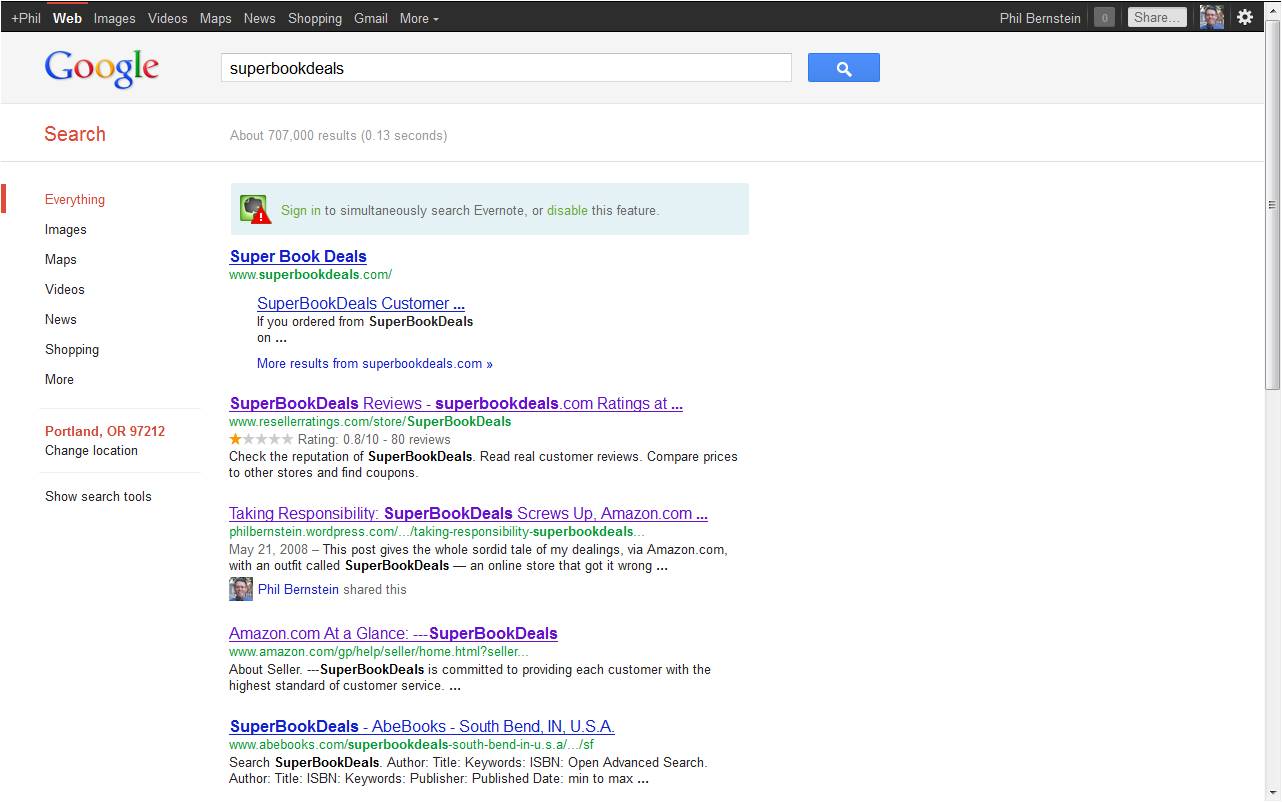
Nearly four years later, a Google search for SuperBookDeals returns this:

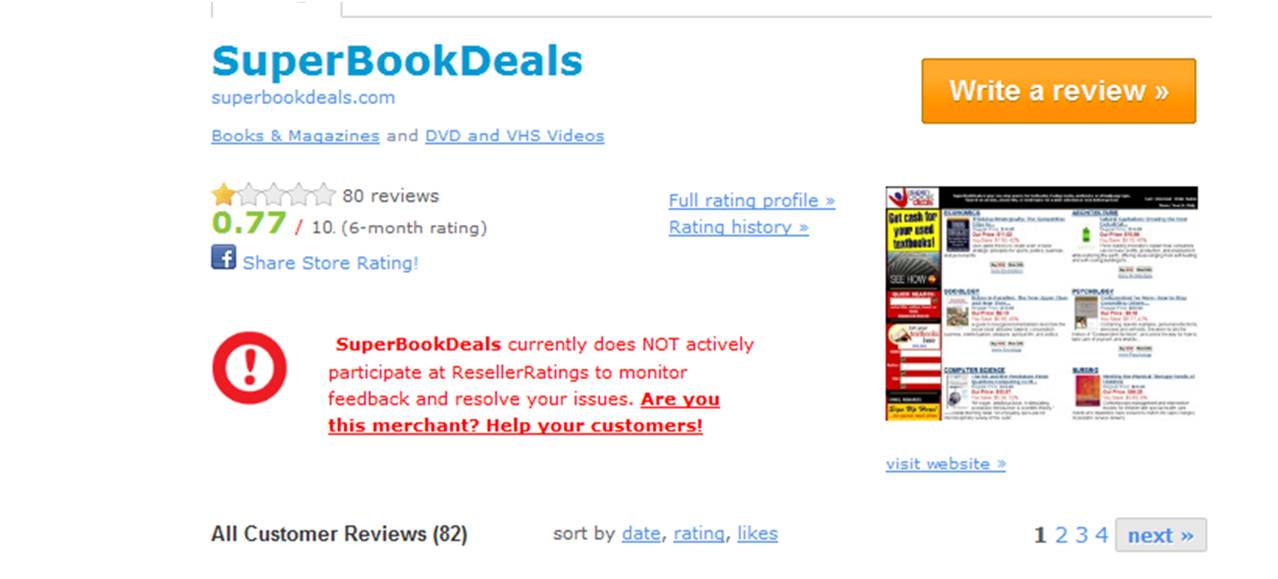
The top listing is the company site, which is fair. But the Number Two listing when you look up the company is a consumer review site, Reseller Ratings. There are 80 reviews on the site, and almost all of them are extremely negative. A quick sampling:

“I will NEVER EVER order from here again!!!!! I order a book for school and was advised i would recv it in 14 days which would have been on the 16th of sept. Did i get it ?? ummmmm.NO!”

“Horrible, horrible horrible.”

“Do not order from this company.”

It goes on for page after page — dozens of angry consumers complaining bitterly about the books they ordered and did not receive… and the complete disdain they did receive when they tried to find out what happened to their merchandise.

More important, perhaps, than the stories themselves is this notation at the top of the review site:

Superbookdeals does NOT actively participate at Reseller Ratings to monitor feedback and resolve your issues. Are you this merchant? Help your customers!

In spite of 82 separate reviews — 81 of them extremely negative… in spite of the fact that this is the second listing on the page when someone Googles the company name… SuperBookDeals ignores it.

Meanwhile, my nearly four-year-old blog posts appear at #3 and #6 on the page. Although both posts get regular traffic and occasional comments, SuperBookDeals has not bothered to contact me, either.

So, this appears to be a case study in a company — an online seller, at that — completely ignoring its online reputation. Anyone wondering whether to do business with them can look them up and easily determine that they should not. Has this cost them anything?

As of this morning, SuperBookDeals still in business, still angering customers on a daily basis, and laughing all the way to the bank.

So the question for the group is this: how important is your online reputation? Leave a comment below.

___________________________________________________________________________________

Email Phil Bernstein here.

Like what you’re reading? There’s more! Sign up for Phil Bernstein’s free advertising and marketing e-newsletter here.

Become a Facebook Fan of “Doctor” Phil Bernstein, Portland’s Advertising Expert  here.

If you like this post, share it — click the “Share” button below.
Why Facts Alone Won’t Always Persuade

“Facts tell, but stories sell” — Jim Doyle

It’s interesting to watch the political left and right — especially those at the extremes — shout past each other. Each has its own set of facts, and each is firmly convinced that if the other side just accepted these facts the argument would be over.

And each believes that the other side’s “facts” are lies.

Seth Godin tackles “The Limits of Evidence-Based Marketing”, using as an example an acquaintance who is firmly convinced that the vaccine for polio is harmful. Stacks of information and studies from the Gates Foundation and the World Health Organization — “evidence-based marketing” — would not change the acquaintance’s mind.

…evidence isn’t the only marketing tactic that is effective. In fact, it’s often not the best tactic. What would change his mind, what would change the mind of many people resistant to evidence is a series of eager testimonials from other tribe members who have changed their minds. When people who are respected in a social or professional circle clearly and loudly proclaim that they’ve changed their minds, a ripple effect starts. First, peer pressure tries to repress these flip-flopping outliers. But if they persist in their new mindset, over time others may come along. Soon, the majority flips. It’s not easy or fast, but it happens.

Which is why testimonial advertising is so powerful, and why I push the television salespeople I coach to replace the charts and graphs with stories of clients who’ve used the station and won.

__________________________________________________________________________________

Email Phil Bernstein here.

Like what you’re reading? Sign up for Phil Bernstein’s free advertising and marketing e-newsletter here.

Become a Facebook Fan of “Doctor” Phil Bernstein, Portland’s Advertising Expert  here.

Reducing Choice, Increasing Revenue

According to the Toronto Globe and Mail, some major retailers and consumer product companies are experimenting* with reducing the choices they offer. The results are often positive:

Several months ago Wal-Mart  Canada Corp. decided to overhaul one of the staples of its grocery business – the peanut butter aisle.

It dropped two of its five lines of peanut butter to free up scarce shelf space for cinnamon spreads. But the decision didn’t cost the retailer a single jar in sales. With fewer selections to browse, customers wound up purchasing more than before.

“Folks can get overwhelmed with too much variety,” said Duncan Mac Naughton, chief merchandising officer at Wal-Mart in Mississauga. “With too many choices, they actually don’t buy.”

… P&G, maker of Tide detergent and Ivory soap, recently reduced the number of its soap and other skin care offerings by about one-third at one retailer, while cutting the array of detergents and other fabric care products by about 20 per cent at another chain.

Following the cutbacks, sales grew in each category. “In the skin care example, shoppers reported they felt that they had more choices because the selection on the shelf was clearer,” spokeswoman Jennifer Chelune said.

* An executive at Costco who read the same article told me this:

Costco has been “experimenting” with limiting the number of items in our warehouses for over 30 years.  We carry no more than 4,000 items in comparison to a Wal-Mart or Fred Meyer, which may carry 120,000.   So when we stop carrying someone’s favorite item (White Cheddar Popcorn or Pickled Asparagus), we aren’t trying to offend them — we are just audacious enough to want to make MORE MONEY.

__________________________________________________________________________________

Email Phil Bernstein here.

Like what you’re reading? Sign up for Phil Bernstein’s “Phil on Advertising” e-newsletter here.

Become a Facebook Fan of Phil Bernstein, Portland’s Advertising Expert  here.

More Choice = Less Action

I recently walked into a McDonald’s in Orlando, Florida carrying a simple set of instructions: return to the hotel with three Egg McMuffins and three orders of hash browns.

I walked up to the counter and placed my order.

Me: Three Egg McMuffins and three orders of hash browns, please.

Woman at counter: Our Egg McMuffins are $2.59 each or two for $3.00.

Me: Okay, give me four.

Woman: How about the hash browns? They’re a dollar each or two for $1.50.

Me (thinking furiously): Umm… okay, I’ll just take two.

A few minutes went by, and then she was back.

Woman: We’re short one round egg, and cooking one will take a few minutes. Or you can have a folded egg now.

Me: I’ll take the folded egg.

When she brought out my food she threw a couple of apple turnovers into the bag at no charge — “for the inconvenience.”

Two thoughts occurred to me as I returned to the hotel:

1. I had just gotten a screamin’ deal: four Egg McMuffins, two orders of hash browns, and two apple turnovers for about nine bucks.

2. The next time I’m in Orlando, I will go out of my way to avoid that particular McDonald’s.

The woman behind the counter probably believed that she was helping me by offering the discounts.

In reality, she was making my life difficult. I wanted a nice, simple transaction, and instead I got something complicated.

The experience stuck in my mind a few days later when I was asked to evaluate a TV commercial for an aesthetic medicine practice. The ad suggested two possible actions: call on the phone for an appointment, or log onto the practice’s web site.

I advised the clinic to simplify the message and just give viewers instructions to call on the phone. Advertisers often find that just making this simple change significantly increases the response from the campaign.

The strategy seems counter-intuitive, but the reasoning is sound: a viewer faced with a phone number and a web address in 30 seconds won’t have the time or mental bandwidth to write down both. Faced with a decision about which one to remember, many people wind up remembering neither.

In “The Paradox of Choice”, Barry Schwartz discussed a series of studies in which car buyers were offered an array of choices:

Even though their decision was purely hypothetical, participants experienced substantial negative emotion when choosing between Cars A and B. And if the experimental procedure gave them the opportunity, they refused to make the decision at all. So the researchers concluded that being forced to confront trade-offs in making decisions makes people unhappy and indecisive.

Participants in these studies showed the pattern of reluctance to make trade-offs whether the stakes were high or low. Confronting any trade-off, it seems, is incredibly unsettling. And as the available alternatives increase, the extent to which choices will require trade-offs will increase as well.

What, then, do people do if virtually all decisions involve trade-offs and people resist making them? One option is to postpone or avoid the decision.

The last thing you want when you advertise is for your prospect to postpone or avoid a decision. Paradoxical though it may seem, offering one choice instead of two will increase the likelihood that your prospect will actually take action.

__________________________________________________________________________________

Email Phil Bernstein here.

Like what you’re reading? Sign up for Phil Bernstein’s free advertising and marketing e-newsletter here.

Become a Facebook Fan of Phil Bernstein, Portland’s Advertising Expert  here.