Opportunity Missed

The cover story in the current Business Week contains a powerful photograph of a man in New York’s Times Square. I don’t know him or anything about his situation, and hope he finds a job soon. But I can’t help but lament the opportunity he may have missed.

Within that missed opportunity is a copywriting lesson for all advertisers.
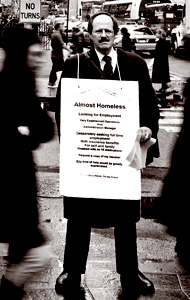
0851_jobless1

In case the text is too small to read, here’s what the sign said:

Almost Homeless

Looking for Employment

Very Experienced Operations
and
Administration Manager

Desperately seeking full time
employment
with insurance benefits
for self and family
Disabled wife on 15 medications

Request a copy of my resume!

Any kind of help would be greatly appreciated

That sign was seen by hundreds, if not thousands, of people walking by as he stood on the street. This week, it will be seen by hundreds of thousands of business people who read the magazine. Some of those people might be in a position to hire him.

If only the sign had given those hiring managers a reason to interview him, and a way to get in touch.

The man has something of value to sell — his time and labor. He’s the advertiser, his sign is his advertising medium, and hiring managers are his prospects. Unfortunately, the copy is all about him, and not about his prospects.

That same sign could have contained some basic information about his experience and skills. It could have talked about the value he could deliver, and the problems he could solve, for a potential employer. It could have contained a phone number or email address — that contact information would now be in the hands of every Business Week reader.

I don’t mean to make light of his situation — I feel awful for him and his family, and sincerely hope that as I write this post, he’s getting ready for his first day at a new job.

Copywriting guru Dan O’Day puts it this way: “Don’t tell me about your grass seed. Tell me about my lawn.”

Your odds of success will increase when you make the message about your prospect, not about you.

___________________________________________________________________________________

Click this link to subscribe to Portland’s Finest Advertising and Marketing Blog.

Request your free copy of Phil Bernstein’s white paper, The Seven Deadly Advertising Mistakes and How to Fix Them here.

Got a question? Call Phil Bernstein at 503-323-6553.

Bad News For Portland Advertisers

I just finished Day 2 of Dan O’Day’s Copywriting Master Class. Just Dan and ten students. Two flew in from Australia, one from Canada, and one from Fiji.

Although there are lots of people writing and producing radio commercials in Oregon and Washington, I’m the only person from the Pacific Northwest at this seminar.

So if you’re a Portland-area businessperson, and you’re working with anyone other than Phil Bernstein, your media rep isn’t here. If you’re working with an ad agency, your account executive isn’t here. Neither is the agency creative director, or any of the copywriters. I guess Los Angeles was just too far to travel.

That’s the bad news.

The good news is for those people who work with Phil Bernstein. Because I’m here, and have spent 14 hours so far — with another 7 to go tomorrow learning the most effective techniques for writing and producing effective radio commercials.

Want to find out what I’ve learned, and how it can help you tell your story, find more customers, and make more sales? Call me at 503-323-6553, or email me here.

____________________________________________________________________________________

Click this link to subscribe to Portland’s Finest Advertising Blog.

Request your free copy of my white paper, The Seven Deadly Advertising Mistakes and How to Fix Them here.

How Language Affects Real Estate Prices

For those in any industry who agonize over their media choices and then have someone “just bang some copy out”, here’s more evidence that every word can be precious. 

Interesting article on msn.com about how the choice of words in a listing can increase — or lower — the perceived value of the house.  

“In real-estate listings, what’s the difference between describing your home as “beautiful” versus “move-in condition”? About $12,500 on a $250,000 home. Professor Paul Anglin, a real-estate economist in Guelph, Ontario, says that homes described as “beautiful” in real-estate listings sell for 5% more while “move-in condition” has no effect on sale price.”

Word choices can also affect the time it takes to sell.

“Listings with the words “beautiful” or “gorgeous” sold 15% faster. “Landscaping” in a listing hastened a sale by 20%. Describing a property as in “move-in condition” quickened the sale by 12%. Calling a home a “handyman special” cut sale time by half (researchers excluded listings that used the term to describe a workshop or hobby area). “

The article’s especially valuable for the chart that matches individual words up with their effect on listing price, sale price, and speed of sale.

____________________________________________________________________________________

Click this link to subscribe.

____________________________________________________________________________________

I’ve written a white paper called The Seven Deadly Advertising Mistakes and How to Fix Them. It’s a study of some of the most common ways that companies waste their advertising dollars — along with suggestions to make those dollars work harder and smarter. Request your free copy here.

Of Hot Chicks and Peak Oil

My former colleague Randy White is an activist in the Peak Oil movement. On his Lawns to Gardens Blog he’s posted a split-screen video.

On the right side, a very attractive young woman, dressed for extremely warm weather, does a dance that would melt a glacier. On the left side, the same woman (I think), in much more subdued clothing, gives her views on what’s going to happen when all the oil runs out.

In addition to being an ironic commentary on the advertising business, it illustrates the attractions and pitfalls of using sex to sell:

1. I watched the video from beginning to end — nearly four minutes in all. This would not have happened in the absence of the hot dancing chick.

2. On the other hand, the speaker’s message did not register with me at all. I was too busy watching the hot dancing chick. 

We’ve all seen TV commercials that made us laugh, only to realize later that we can’t remember what the ad was for. Sex, like humor, can be an effective way of holding your prospect’s attention long enough to deliver the sales message. In order for the sales message register with the prospect, the sex or humor needs to be integrated into the pitch. Without that integration, your prospect won’t remember what you are trying to say.

Direct Mail Goes On a Diet?

It’ll be interesting to see next year’s version of Ben McConnell’s weigh-in : RRW’s Direct Marketing Blog reports that the Direct Marketing Association has eliminated the $1 fee it had been charging consumers to be part of its opt-out service, the DMA Mail Preference Service.

 ____________________________________________________________________________________

I’ve written a white paper called The Seven Deadly Advertising Mistakes and How to Fix Them. It’s a study of some of the most common ways that companies waste their advertising dollars — along with suggestions to make those dollars work harder and smarter. Request your free copy here.