
5 Great Books Every Advertising Salesperson Must Read (Or Re-read) in 2017

We work in the persuasion industry. As advertising sellers, first we must persuade a prospect to meet with us… and then consider our proposal… and then buy. Then we must design a campaign that persuades our client’s prospects to take action.

Here are five books that will help you develop the sales skills to persuade… and sell.
5 Great Advertising, Marketing and Sales Books

The Accidental Salesperson by Chris Lytle: I read the original version of this book more than a decade ago. It was early in my selling career. I was looking for anything that could teach me the sales skills I needed.  This book taught me enormous amount. When the new edition came out, I took it out of the library — being a cheapskate, I didn’t feel like paying for it a second time. Two chapters in, I returned the library copy and bought my own. I wanted to read it and highlight the hell out if it. For example, this:

If you work on straight commission, you prospect for free. You do a customer needs analysis for free. You do the research for free. Then you write the proposal for free… At least you don’t have to pay to make your presentation to the prospect.

What if you did have to pay to make your presentation? You obviously would put more time and thought into it. You probably would even rehearse it a few times…”

I’ve gone from being a salesperson to a combination salesperson/sales trainer role.  I have read that passage repeatedly to groups of radio and television advertising sellers all over the country. It gets through.

Slow Down, Sell Faster! by Kevin Davis: This is one of the rare sales skills books that has actually given me a new perspective on the process of selling. The author’s contention is that we spend so much time focusing on our needs and our timetable that we forget what’s important to the client. He sums it up this way:”Every sales leader wants fast sales; the trouble is, there aren’t many fast buyers…They are unlikely to change their buying process to match your selling process, so your only option is to be the one who switches.”

Influence: The Science of Persuasion by Robert B. Cialdini A classic in the field — enough science to demonstrate that the author knows what he’s talking about, but accessibly written for salespeople (like yours truly) who didn’t pay attention in science class. Cialdini, who holds professorships in Marketing and Psychology at Arizona State University. The principles he teaches in this book will help you do a better job convincing clients to buy, and can also help make you a better marketer and copywriter.

Advertising Headlines That Make You Rich by David Garfinkel: Although this book is aimed at those who sell with the written word — direct mail, print publications, and web pages — the techniques can help marketers in any medium. However your prospects see or hears your sales message, you have a very short window in which to convince them to pay attention. The headline in a print ad, or the opening five seconds of a radio or TV commercial, will cause your target to either pay attention to the rest of the message or tune you out. Garfinkel gives you a series of headline templates that have worked for selling a wide range of products and services, discusses why each one has been effective, and lists several variations on each headlines. When I’ve hit a wall while writing copy, I’ve gone to this book to help get unstuck.

Dan O’Day’s Guaranteed 5-Step System For Creating 30-Second Radio Commercials That Get Results: Another good cure for (copy)writer’s block, and an excellent companion to the Garfinkel book. I bought this when I was working in radio; now that my primary platforms are television and digital, I still use it regularly. Like Garfinkel, O’Day teaches a headline-based approach to designing a campaign. Besides the headlines, the true benefit of O’Day’s system is in the exercise of settling on a Unique Selling Proposition before starting the script. It’s not a long book, but it’s a powerful one.

[reminder]What’s the best advertising, marketing, or sales book you’ve read in the past 12 months?[/reminder]
Why Subtlety Doesn’t Work Anymore

A couple of years ago, author/public speaker/comedian Andy Nulman wrote a blog post discussing his challenges as he gets up in front of an audience:

“The Internet has changed everything. It has contracted attention spans to an almost ridiculously-microscopic measure, and has sung the swan song for the concept of subtlety. For example, the old ‘speaker’s adage’ used to be:

  • Tell ’em what you’re gonna tell ’em
  • Tell ’em
  • Tell ’em what you told ’em

These days, the audience fidgets through the preamble, tweets during the middle and are out the door before the recap.”

Nulman wrote this in 2010. A recent article on emarketer.com details how, two years later, the rise of the smart phone has affected what your customers do while you’re commercial plays:

A May 2012 report authored by the IAB and Ipsos MediaCT, which drew on data from three surveys of US consumers, found that internet-enabled devices were not displacing other media-related activities, but adding to them. According to the Ipsos MediaCT LMX survey, the average amount of time that respondents spent engaging with media each day climbed to 9.6 hours in 2011, from 9 hours in 2009.

Time spent online or on a computer jumped to 3.1 hours from 2.5 hours over the same period. But the amount of time respondents spent watching TV held steady, at 3.4 hours. eMarketer estimates that US adults spent an average of about 11.5 hours per day consuming media content in 2011…

Here’s what this means to you: no matter what medium you are using to deliver your sales message to potential customers —  this applies to radio and newspaper in addition to TV — your customers now have a smartphone, and a choice. They can pay attention to your message, or:

  • They can check their e-mail, or send a text,
  • They can update their status on Facebook, or send a tweet.
  • They can watch a cat video on YouTube.

In fact, it is likely that they are doing one of these things as they are watching, listening to, or reading your ad. This means you have got to get to the point in a hurry. You need to deliver a benefit statement and capture attention immediately. Nulman put it this way: “No salad, just the main course”.

If, instead, you decide to “ease into it” you may find that the only thing your prospects remember later is Baby Monkey Riding on a Pig.

Are You Making These 7 Deadly Advertising Mistakes?

The short version: subscribe to the Phil Bernstein on Advertising Newsletter here, and I’ll send you a copy of my newly-revised-and-expanded report, The Seven Deadly Advertising Mistakes and How to Fix Them.

The newsletter is free, it comes out by email twice a month, and you can unsubscribe any time you want to.

Here’s the long version:

There are seven common mistakes that companies make when they advertise. If you’re making any of them – and many businesses make more than one – the odds of success plummet, and your marketing dollars are wasted.

Correct these mistakes and your advertising could become 30 to 60 percent more effective – in many cases, without spending any more money.

I’ve spent thousands of dollars of my own money, and tens of thousands of hours, studying the work of the smartest and most successful copywriters, marketing gurus, and salespeople. Claude Hopkins, Dan O’Day, John Carlton, Perry Marshall, Dan Kennedy, Jim Doyle… I’ve bought their books, listened to their CD’s, and attended their seminars.

For the past eighteen years, I’ve put their theories and methods to work on behalf of hundreds of local businesses. From car dealers and real estate agents to window retailers to a school for troubled adolescents, I’ve designed campaigns to bring them new customers.

Has every campaign been a huge success? No. Some had just okay results, and a few were outright bombs.

But I discovered that the bombs had elements in common, and so did the home runs. And that it was possible to take a floundering campaign and make it successful by fixing some very simple and common mistakes.

Among them:

  • Too much information
  • No call-to-action
  • Flunking the “So What” test

If you want the whole list, plus actionable advice about what to do, here’s a free way to get it:

I’ve written a white paper called The Seven Deadly Advertising Mistakes and How to Fix Them. If you want it, I’ll send it to you at no charge. All you need to do is subscribe to the Phil Bernstein on Advertising eNewsletter, which is also free.

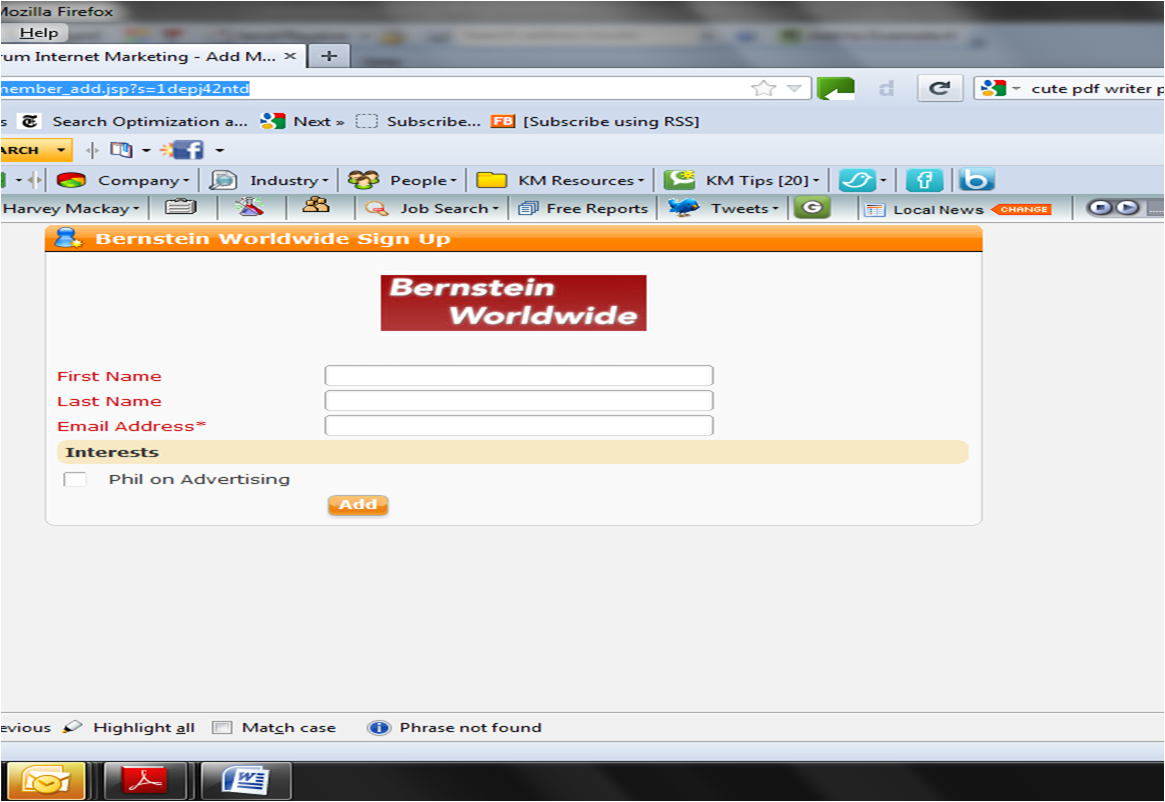
Click this link to subscribe, and I’ll send you the white paper. The link will take you to something that looks like this:

You’ll automatically get a copy of the current newsletter, and as soon as I see your name in the subscriber list I’ll email you a copy of the report.

__________________________________________________________________________

Email Phil Bernstein here.

Like what you’re reading? There’s more! Sign up for Phil Bernstein’s free advertising and marketing e-newsletter here.

Become a Facebook Fan of “Doctor” Phil Bernstein, Portland’s Advertising Expert  here.

If you like this post, share it — click the “Share” button below.

Phil Bernstein on the Radio — Find Out How to Fix Your Advertising Mistakes

Find out tomorrow, right here.

On Thursday, January 12, I’ll be appearing on Susan Rich’s internet radio show, Your Marketing Plan. I’ll discuss the seven most common mistakes companies make when they advertise, why those mistakes will hurt your results, and ways to fix them.

I’ll also tell you how you can get a free copy of my newly-revised-and-expanded report, The Seven Deadly Advertising Mistakes and How to Fix Them.

  • The Show: Susan Rich Talks — Your Marketing Plan
  • Date: Thursday, January 12
  • Time: 11am Eastern/ 8am Pacific
  • How to find it: Go here and  hit the play button at the top.

__________________________________________________________________________

Email Phil Bernstein here.

Like what you’re reading? There’s more! Sign up for Phil Bernstein’s free advertising and marketing e-newsletter here.

Become a Facebook Fan of “Doctor” Phil Bernstein, Portland’s Advertising Expert  here.

If you like this post, share it — click the “Share” button below.

Making a Funny Commercial Work

“Oh… and make it funny.”

For nearly a decade, my biggest Portland radio advertising client was a car dealer who appeared in his own commercials. I wrote the copy — more than 500 separate scripts over that time. And whenever he gave me the copy points, “Make it funny” was one of them.

He wanted the commercials to sell cars. But more important to him, I learned over time, he wanted his employees, customers, and friends to tell him what a funny guy he was.

In the interest of getting the copy approved, and preserving my commission, my first objective became to make him laugh when he read the script. My second objective for the script was to make it sell cars.

I’m not necessarily proud that my objectives were in that order, but there you go.

I’m reminded of that struggle every time I see the Volkswagen “The Force” commercial. This ad debuted on the Super Bowl, and two things happened:

1. Everybody loved it. Loved it. LOVED it.

2. When it was over, nobody could remember what car was featured in the ad.

It entertained, but it forgot to sell.

Pretty much everyone who owns a TV has seen it, but if you haven’t, here it is:

[youtube=http://www.youtube.com/watch?v=R55e-uHQna0]

It was Radio Copywriting Guru Dan O’Day, at a seminar in Los Angeles, who taught me how to do both. His rule: the sales message must be part of the comedy.

On Dan’s blog, he’s begun an extended discussion of why humor, used properly, works in advertising. Here’s a short excerpt:

When an advertisement comes on the radio, the listener’s guard is up. Even though my saying this will offend a few radio sales chauvinists, people do not turn on the radio for the commercials….

If the commercial makes you laugh, however, then while you’re laughing your guard is down. Your filter is in the “pause” mode.

The full discussion is well worth reading, and there’s more to come. You’ll find the full post here.

__________________________________________________________________________

Email Phil Bernstein here.

Like what you’re reading? There’s more! Sign up for Phil Bernstein’s free advertising and marketing e-newsletter here.

Become a Facebook Fan of “Doctor” Phil Bernstein, Portland’s Advertising Expert  here.

If you like this post, share it — click the “Share” button below.