Turning a Negative into a Selling Point

In the past couple of days, I’ve encountered two pharmaceutical companies who are dealing with the same issue — the taste of medicine — in two different ways.

 Nicorette is running radio commercials announcing “a revolution in quitting smoking… a stop-smoking gum that actually tastes good!” Apparently a common objection of Nicorette users up until now was that they hated the taste; Cinnamon Surge is a new product designed to get past that hurdle.

A day after hearing the Nicorette ad, I walked by a drug store display for Buckley’s Cough Mixture, featuring the tag line “It tastes awful. And It Works.” In contrast to Nicorette, Buckley’s has taken the bad taste and made it the centerpiece of their campaign for their “disgustingly effective products.” Their Myspace page (yes, cough syrup has a Myspace page, and I don’t) features the winners of the Buckley’s Bad Taste Face contest, along with a TV ad in which a blindfolded consumer is unable to tell the difference between Buckley’s and trash bag leakage.

In a previous post, I quoted from Influence: The Psychology of Persuasion, in which Robert Cialdini discusses the ways people make decisions with incomplete information:

To deal with it, we need shortcuts. We can’t be expected to recognize and analyze all the aspects in each person, event and situation we encounter in even one day. We haven’t the time, energy or capacity for it. Instead, we must very often use our stereotypes, our rules of thumb, to classify things according to a few key features and then to respond without thinking when one or another these trigger features is present…

The example Cialdini cited involved tourists shopping for jewelry — a price rise actually increased demand, because the shoppers figured that a higher price denoted higher quality. Buckley’s is tapping into a similar psychological shortcut that cough syrup buyers might use: bad taste = effective medicine.

Nicorette is trying to change its prospects’ minds about their product. Buckley’s, by contrast, has accepted the consumer’s mindset and used it to the company’s benefit.

One problem, two opposite approaches. I like Buckley’s chances.

_____________________________________________________________________________________

Click this link to subscribe to Portland’s Finest Advertising Blog.

Request your free copy of my white paper, The Seven Deadly Advertising Mistakes and How to Fix Them here.
Direct Mail By The Pound

Ben McConnell of Church of the Customer has made a yearly tradition of keeping all of the direct mail he receives during the holiday season — and putting it on a scale.

 This year: 21.5 pounds. Up over two pounds from last year, and a more-than-50 percent increase from 2005. His post gives some examples of other things that weigh about that much:

  • 9.75 kilograms
  • About the equivalent weight of three newborn babies (or quintuplets for one couple)
  • Two bowling balls and a tray of white russians
  • A bit more than the average weight of the handbags of some women (contributing to a 30% rise in purse-related injuries)
  • The weight of a scarily large catfish caught in Missouri last summer
  • And the comments section has a very interesting dialog about the subject, with intelligent arguments on both sides.

    My question, for those of you who’ve been using direct mail for years: 

    With an increase in postage costs and (at least anectdotally) a significant increase in mail volume, how did your direct mail efforts pencil out in 2007? Is it still working as well as it did?

     ____________________________________________________________________________________

    I’ve written a white paper called The Seven Deadly Advertising Mistakes and How to Fix Them. It’s a study of some of the most common ways that companies waste their advertising dollars — along with suggestions to make those dollars work harder and smarter. Request your free copy here.

    A Missed Opportunity

    brooks-brothers.gif

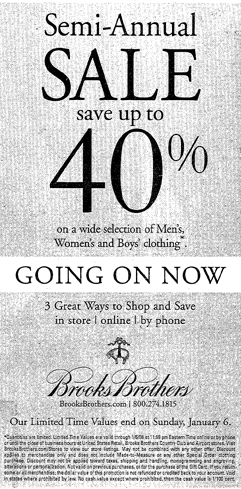
    Over the holiday break, this ad ran in the Oregonian at least twice. My guess is that it ran all over the country, and the people who designed it didn’t feel like customizing the ad for specific markets.


    Which means they blew it. 


    Brooks Brothers wants their prospects to respond in one of three ways: ordering online, calling their 800-number, or visiting their store. Logically, the retail store is where people would go if they wanted to try on a suit and get it altered. But Brooks Brothers doesn’t tell you where the store is.


    The downtown Portland Brooks Brothers store has only been open a few months, in a mall that’s seen some hard times, and a lot of their target customers don’t even know it’s there. This would have been a perfect opportunity to tell them about the new store, lure them in to save money on shirts — and measure them for a suit or two.


    It would not have been hard to leave room for store addresses in each market that had a retail store. But someone at Brooks Brothers couldn’t be bothered, and they’ll never know how much money they lost.


    Today’s lesson is: if you want your prospects to do business with you, make yourself easy to find.


    By the way, you can find me at 503-323-6553.

    When People Complain About Your Advertising

    “Most ads aren’t written to persuade, they’re written not to offend.” — Roy Williams

    Not long ago an ad agency pulled a home improvement commercial off the air in Portland and Seattle because several listeners had called the client to complain about it. The client was concerned that he was offending potential customers, and the agency is now scrambling to come up with something else.

    So what happens when some people don’t like your advertising?

    Sunny Kobe Cook, whose relentless pitches for Sleep Country USA in the 90’s irritated thousands, once told a seminar audience that she would occasionally work behind the counter at one of her stores.

    Customers would walk up to the counter after choosing a bed, hand her their credit card, and then do a double-take. She described the typical encounter like this:

    Customer: You’re Sunny Kobe Cook!

    Sunny: Yes, I am.

    Customer (leaning forward, whispering): I hate your commercials!

    “They’re standing in my store,” said Cook, “and making a purchase for a thousand bucks or more. I want everyone to hate my commercials like that!”

    Cook annoyed people with her voice and relentlessness. Rob Christensen, by contrast, deliberately pushes the envelope of good taste. Christensen runs Apple Auto Sales of Charlotte, North Carolina. In his TV ads, he plays “Reverend Rob”, a televangelist who will “HEAL your credit.” They’re cheesy, poorly-acted, and have the ability to offend on multiple levels.

    They also sell cars. You can watch one here.

    According to Mike Drummond of the Charlotte Observer, Christensen has been running these ads since 1997. Viewers have complained, and some stations have refused to run the spots.

    Christensen airs the commercials on stations who will accept them, and takes his money to the bank. “I’ve had people tell me they hate my ads — hate them,” Christensen told Drummond. “And yet they still bought a car from me.”

    Roy Williams echoes the sentiment:

    Ninety-eight point nine percent of all the customers who hate your ads will still come to your store and buy from you when they need what you sell. These customers don’t cost you money; they just complain to the cashier as they’re handing over their cash.

    A caution is in order here: An annoying campaign may get you noticed, but you can’t forget to sell within the commercial. The Sleep Country and Apple Auto Sales commercials were more than just exercises in irritation. Each one contained a powerful sales message and a call to action.

    But you shouldn’t reject an idea simply because some folks might not like it. They don’t have to like it — they just have to buy.

    ______________________________________________________________________________________________________

    Got a question? Wanna argue? Email Phil Bernstein here.

    Sign up for Phil Bernstein’s free advertising and marketing e-newsletter here.

    Become a Phil Bernstein Portland’s Advertising Expert Facebook Fan here

    Free Book Alert

    If your business involves sales of any kind, the Internet is your best friend. You can now walk into an initial call armed with a remarkable amount of information on your prospect — industry trends, personnel moves, product lines, and more.

    The Internet can be an even better friend if you know some tricks and shortcuts to get to the data you need. Sam Richter, President of the James J. Hill Reference Library in St. Paul, MN, makes his living helping people find this information. He’s working on a book called Take the Cold Out of Cold Calling — Web Search Secrets for The Inside Scoop on Companies, Industries and People.

    Near as I can tell, the book hasn’t been published yet (Chris Lytle’s newsletter tipped me off to its existence without mentioning how to get it, and a search of Amazon, Powell’s and Barnes & Noble came up empty), but a little digging got me to a web site where you can download a working draft.

    The site says that the draft contains about 50% of the tips that will be in the final version, so you’ll still have to reach into your wallet to get the whole thing when it’s done. But there’s a lot of really useful information in the draft.

    For example, I’d never heard of Yahoo’s Site Explorer feature, which breaks up your target’s site into subdomains and lists any sites that link to it. Go to https://siteexplorer.search.yahoo.com, plug in a URL you want to research, and watch it go to work.

    Free is a very good price for the draft version, and I’ll be shelling out for the real thing when it’s ready.

    One note before you hit the “Print” button, though — it’s 127 pages. Go easy.

    Like what you’re reading? Download my free white paper, The Seven Deadly Advertising Mistakes and How To Fix Them.