When Should You Change Your Ad Campaign? Here’s How to Tell

The medical practice director was bored with her ad campaign, and wanted to start something new.
radio advertising sales training tip: leave it alone if it works
photo by Karin & Uwe Annas/dpc

She told me she had stumbled onto an ad for a particular procedure that worked better than anything else she had ever tried. Her television station salesperson measured click-throughs from the station website to the clinic’s site. The practice director measured response response by phone traffic, appointments, and revenue.

By any measure, this ad pulled better than anything else she’d ever run. She’d been running it steadily for the past three months.

I asked her if there’d been any drop-off in calls, appointments, or patient count. No, she said — response and sales were all as strong as they’d ever been. She was just “feeling like it was time to change it up.”

“Leave it alone,” I said. “Your patients will tell you when it’s time to change — when they stop coming in.”

Today’s Advertising Sales Tip:
Clients Will Get Bored Long Before The Public Will

The advertiser will be watching or listening closer than anyone in the general public — it’s their business, their campaign, their money.

The public? They’re doing this:

radio sellers: let it run
photo by Vladimir Jovanovic/dpc


[bctt tweet=”Advertising Reality 101 for Salespeople: The target isn’t paying attention.”]

Advertisers will get bored much faster than the target. The best advice you can give your clients is to leave the campaign alone as long as it’s working.

A ringing cash register is never boring.

How to Make Money on Google’s New Mobile Policy: Opportunity for Media Salespeople

It’s not news that more and more searches are being done on mobile devices. Nor is it news that many of our clients have not gotten around to making their websites mobile-friendly.

The time to do something about that is now — and that creates opportunity for those of in television, radio, or digital sales.

radio sales tip: sell mobile media
photo by tuomaslehtinen/dpc

 In August of 2014, Comscore released a study showing that a majority of US digital consumption now takes place on mobile apps. According to Telecrunch:

U.S. users are now spending the majority of their time consuming digital media within mobile applications, according to a new study released by comScore this morning. That means mobile apps, including the number 1 most popular app Facebook, eat up more of our time than desktop usage or mobile web surfing, accounting for 52% of the time spent using digital media. Combined with mobile web, mobile usage as a whole accounts for 60% of time spent, while desktop-based digital media consumption makes up the remaining 40%.

Here is some news that might give your clients a reason to mobile-optimize their websites now: beginning April 21, 2015, Google’s will start giving extra ranking credit to the websites that it considers mobile-friendly. In other words, even if your client’s site ranked well before, it could drop in the rankings if it doesn’t meet Google’s mobile standards.

This round will only apply to mobile search, so desktop search rankings will not be affected… yet.

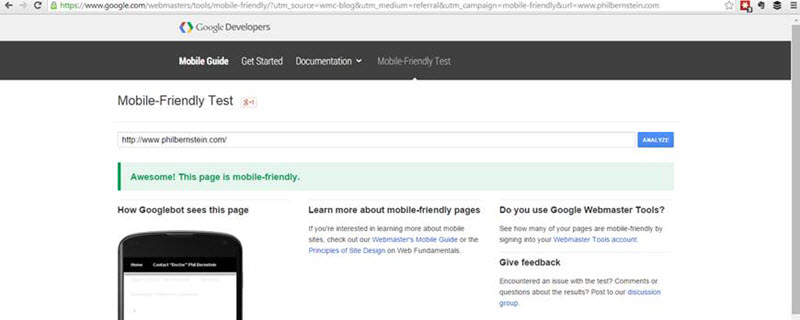
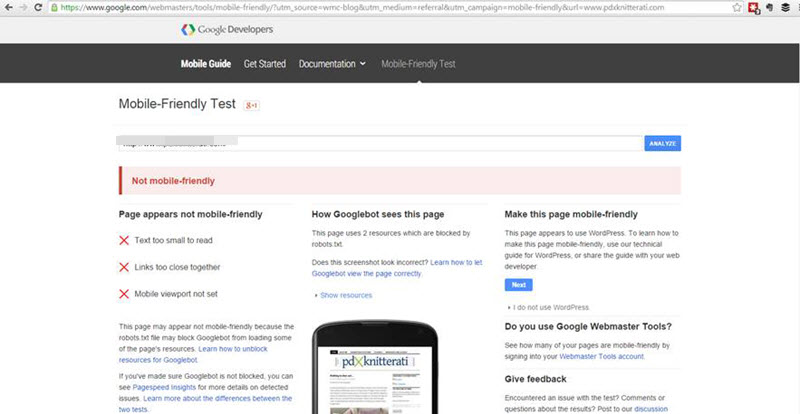
How can you find out if a site passes? Google has a free tool that allows you to test any site. You can find the tool here: https://www.google.com/webmasters/tools/mobile-friendly/

A mobile-friendly page will bring back a result that looks like this:

radio sales tip: sell mobile media
My advertising, marketing and sales training blog passed!

A page that doesn’t pass Google’s test will look like this:

Another tip for radio salespeople: sell mobile media
This blog failed Google’s test

How You Can Make Money On This Right Now

[bctt tweet=”Before every sales call, run the client’s website through Google’s Mobile-Friendly Test.”]

·       If it doesn’t pass, print out a copy of the result in color.

·       Take a screen shot of the client’s site on your mobile phone, email it to yourself, and print the image out in color.

·       Talk to your company’s digital department. Can your station offer help – for money — in making a site mobile-friendly?

·       If so, prepare a proposal. The proposal should include the results of Google’s test and the mobile screen shot of their site.

·       If not, bring the Google results and screen shot out to your client anyway. Doing this will help position you as a true consultant rather than a package peddler.


Keep the conversation going — share this post on Facebook, LinkedIn and Twitter!

How Customer-Focused Are You… Really?

Everyone says they’re customer-focused. The stark reality is that most of us aren’t.

radio sales tip: be customer-focused
photo by uismolinero/dpc

Sales coach Gavin Ingham recently expressed a frustration common to those of us in the sales training business — our clients want advice on how to close sales, but don’t seem interested in earning the right to make the sale in the first place:

As a sales speaker, I often get asked by sales directors what they should do to make more sales. How do we convince the client? How do we demonstrate value over price? How do we negotiate a better deal? How do we shorten buying cycles? Etc etc. All of these have one thing in common and that is that they are all about you. They are not all about the client.

I rarely (for rarely read never) get asked for help that is client focused. People do not call me and ask how they can better understand their clients, they call me and ask how they can close more sales. People do not call me to understand why their clients went elsewhere, they call me to ask how they can convince their clients to buy from them. People do not call me to ask me help them understand why they did not engage their clients, they call me to ask how they can persuade and influence more effectively.

This may sound like semantics but it is a BIG deal.”

 It is a big deal. Salespeople already know what they want to sell, and why they want to sell it. What many of them never bother to find out is what their customer wants to buy, and why they would want to buy it.

Two Easy Customer-Focus Tests For Salespeople

 1. Look at the last couple times a customer turned you down and went to the competition. Do you know why — from their perspective, not yours — they did it? (Advice on what to do about that is here.)

2. Think about the last couple of times a customer cancelled an order in mid-campaign. Do you know why — from their perspective, not yours — they cancelled?

I often hear from salespeople who just took a big cancellation and want advice on how to change the client’s mind. Unfortunately, it’s too late by then.

The best time to reverse a cancellation is before the cancellation happens. Click To Tweet This  

Cancellation prevention requires knowing what the customer’s goals are for the campaign. Knowing about challenges to implementing the campaign, and working with the client to address those challenges. Constantly checking in to make sure that results are meeting expectation.

In short, cancellation prevention requires true focus on the customer

If you don’t know why the client cancelled, or went with the competitor, you may not be as customer-focused as you think you are.

What did you miss, and how can you do better next time?

___

Keep the conversation going — share this post on Facebook, LinkedIn, and Twitter!

[reminder]

A Free Tool To Make it Easier For People to Tweet Your Content

This is particularly good for bloggers, but can work for other online platforms as well. And you can’t beat the price — it’s free!

radio sales tip: get people to tweet your wisdom
phot by luismolinero

Tech Tool Tuesday for Salespeople

ClickToTweet is a website that makes it easy for readers to tweet sentences from your blog or web post. It does so by generating a link that you can add to the post. You need to choose the sentence — keep it to 120 characters or less to enable retweeting.

I learned about ClickToTweet from a recent Heinz Marketing blog post, and have had occasion to use the feature on my blog and also a couple of LinkedIn posts. I don’t know how Matt Heinz uses it, but I’ve found that the “Basic Link” feature is the easiest way to go.

Here’s a video of me producing a “Tweet This” link.

https://www.youtube.com/watch?v=kOkz_kJgH90


The tweet: From the @philbernstein Sales Blog, a free tool to make your content tweetable.   Tweet This!

If you want to see if it worked, click the “Tweet This!” above. You’ll need to be logged into Twitter to see it in action. Go ahead, Tweet It!  I’ll wait here.

Of course, in order for it to work, the message needs to be something that your readers want to tweet. 

Try it for yourself and let me know how it worked for you. Then keep the conversation going — share this post on LinkedIn!


How To Handle Losing a Sale to a Competitor

You thought the sale was yours. From the initial contact through the proposal stage, the customer was engaged, interested, and open to your suggestions. The contract seemed to be just a formality.

Instead, client gave the business to a competitor.

radio advertising sales tip: don't beg
Photo by Minerva Studio/dpc

Sales Tip: What’s your next move?

 Never blame your customers when they don’t buy from you. Tweet This.

It’s your responsibility to convince them. Learn something. What can you do differently next time? 

Resist the urge to argue, even if you think the customer’s making a mistake. You won’t win the argument; going into attack mode guarantees that you’ll never have a chance to win the account back.

You need to ask some questions, starting with this one: Is the decision final?

If it’s final, accept that you’ve lost this round. Your job now is to gather enough information so you know what went wrong, and can position yourself more effectively when the opportunity next arises. What can you change to generate a different result?

Say this:

“Thanks for considering us. I’m sorry it didn’t work out, but my competitor’s going to do a great job for you. [It may be painful to say this. Say it anyway.] I respect your decision, and I won’t try to change your mind. Could I ask you a couple of questions?”

Asking permission first lowers resistance. Tweet This.

Once permission is granted, the client is obligated to answer. Here are your questions:

1. “What made you decide to go with the other guys?”

2. “If we had offered the same thing, would you have gone with us?”

No matter what the answer is, resist the urge to try to reopen the sale—you promised.

Back at the office, review the whole sales process in your mind. What did you miss? What questions can you add to your process to make sure you won’t miss it again?

A lost sale hurts. Make sure you learn something from each one. Turn lost income into tuition on your sales education.

[reminder]What’s the toughest sales defeat you’ve faced? How did you handle it?[/reminder]


A version of this article originally appeared in The Paint Contractor, where I write the Sales Doctor column.