Direct Mail By The Pound

Ben McConnell of Church of the Customer has made a yearly tradition of keeping all of the direct mail he receives during the holiday season — and putting it on a scale.

 This year: 21.5 pounds. Up over two pounds from last year, and a more-than-50 percent increase from 2005. His post gives some examples of other things that weigh about that much:

  • 9.75 kilograms
  • About the equivalent weight of three newborn babies (or quintuplets for one couple)
  • Two bowling balls and a tray of white russians
  • A bit more than the average weight of the handbags of some women (contributing to a 30% rise in purse-related injuries)
  • The weight of a scarily large catfish caught in Missouri last summer
  • And the comments section has a very interesting dialog about the subject, with intelligent arguments on both sides.

    My question, for those of you who’ve been using direct mail for years: 

    With an increase in postage costs and (at least anectdotally) a significant increase in mail volume, how did your direct mail efforts pencil out in 2007? Is it still working as well as it did?

     ____________________________________________________________________________________

    I’ve written a white paper called The Seven Deadly Advertising Mistakes and How to Fix Them. It’s a study of some of the most common ways that companies waste their advertising dollars — along with suggestions to make those dollars work harder and smarter. Request your free copy here.

    Response is Not the Same as Results

    If you work with clients on their advertising, you’ll eventually encounter the business person who confuses response with results. Response is when the guys at the country club tell you how funny your commercials are. Results is when your commercials cause a whole bunch of good prospects to become good customers.

    Last month, I probably received ten “Elf Yourself” emails, and watched a bunch more. And yet, until I read Ron Shevlin’s smackdown on OfficeMax, it didn’t even really occur to me that OfficeMax wanted me to shop with them.

    OfficeMax definitely got response — according to Advertising Age, the campaign was watched by 110 million visitors. But it’s less clear whether the “Elf Yourself” campaign caused many of the visitors to go to an Office Max store and buy something.

    Shevlin does a terrific job reminding us what marketing is supposed to do, and how Office Max forgot what really matters. His jumping-off point is the Advertising Age article that calls the campaign “a winner”:

    My take: This is the stuff that drives CEOs/CFOs crazy. Nowhere in the article does it mention metrics like incremental awareness, improved brand affinity, or [heaven forbid] incremental sales as measures of success. According to the article, Alexa ranked Elf Yourself as a top 1000 site in 50 countries. OfficeMax does business in five.

    You want rules of viral web success? A viral web effort succeeds when it… [read the rest of the post here.]

    ___________________________________________________________________________

    I’ve written a white paper called The Seven Deadly Advertising Mistakes and How to Fix Them. It’s a study of some of the most common ways that companies waste their advertising dollars — along with suggestions to make those dollars work harder and smarter. Request your free copy here.

    A Missed Opportunity

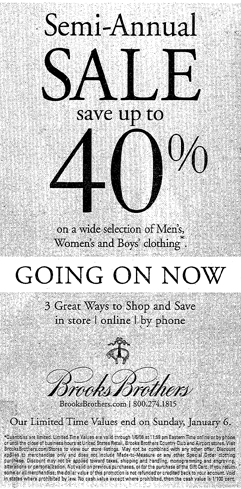
    brooks-brothers.gif

    Over the holiday break, this ad ran in the Oregonian at least twice. My guess is that it ran all over the country, and the people who designed it didn’t feel like customizing the ad for specific markets.


    Which means they blew it. 


    Brooks Brothers wants their prospects to respond in one of three ways: ordering online, calling their 800-number, or visiting their store. Logically, the retail store is where people would go if they wanted to try on a suit and get it altered. But Brooks Brothers doesn’t tell you where the store is.


    The downtown Portland Brooks Brothers store has only been open a few months, in a mall that’s seen some hard times, and a lot of their target customers don’t even know it’s there. This would have been a perfect opportunity to tell them about the new store, lure them in to save money on shirts — and measure them for a suit or two.


    It would not have been hard to leave room for store addresses in each market that had a retail store. But someone at Brooks Brothers couldn’t be bothered, and they’ll never know how much money they lost.


    Today’s lesson is: if you want your prospects to do business with you, make yourself easy to find.


    By the way, you can find me at 503-323-6553.

    The Anti-Cliche Movement Strikes

    Each year, the folks at Lake Superior State University ask the public to submit expressions that have become cliches. And on New Year’s Day, they issue a list of those expressions that are heretofore banned. More than 2000 cliches were nominated, and they’ve been whittled down to 23 used-up words and phrases.

    Smart move on the part of their Public Relations staff — there must be thousands of college-bound students (and their parents), who only know that Lake Superior State University exists is because of this list.

    Although most of the expressions on the list aren’t likely to be used in advertising, it acts as a timely reminder that “friendly and knowlegeable staff” should never be in your copy.

    You can see the whole list here.

    ___________________________________________________________________________

    I’ve written a white paper called The Seven Deadly Advertising Mistakes and How to Fix Them. It’s a study of some of the most common ways that companies waste their advertising dollars — along with suggestions to make those dollars work harder and smarter. Request your free copy here.

    When People Complain About Your Advertising

    “Most ads aren’t written to persuade, they’re written not to offend.” — Roy Williams

    Not long ago an ad agency pulled a home improvement commercial off the air in Portland and Seattle because several listeners had called the client to complain about it. The client was concerned that he was offending potential customers, and the agency is now scrambling to come up with something else.

    So what happens when some people don’t like your advertising?

    Sunny Kobe Cook, whose relentless pitches for Sleep Country USA in the 90’s irritated thousands, once told a seminar audience that she would occasionally work behind the counter at one of her stores.

    Customers would walk up to the counter after choosing a bed, hand her their credit card, and then do a double-take. She described the typical encounter like this:

    Customer: You’re Sunny Kobe Cook!

    Sunny: Yes, I am.

    Customer (leaning forward, whispering): I hate your commercials!

    “They’re standing in my store,” said Cook, “and making a purchase for a thousand bucks or more. I want everyone to hate my commercials like that!”

    Cook annoyed people with her voice and relentlessness. Rob Christensen, by contrast, deliberately pushes the envelope of good taste. Christensen runs Apple Auto Sales of Charlotte, North Carolina. In his TV ads, he plays “Reverend Rob”, a televangelist who will “HEAL your credit.” They’re cheesy, poorly-acted, and have the ability to offend on multiple levels.

    They also sell cars. You can watch one here.

    According to Mike Drummond of the Charlotte Observer, Christensen has been running these ads since 1997. Viewers have complained, and some stations have refused to run the spots.

    Christensen airs the commercials on stations who will accept them, and takes his money to the bank. “I’ve had people tell me they hate my ads — hate them,” Christensen told Drummond. “And yet they still bought a car from me.”

    Roy Williams echoes the sentiment:

    Ninety-eight point nine percent of all the customers who hate your ads will still come to your store and buy from you when they need what you sell. These customers don’t cost you money; they just complain to the cashier as they’re handing over their cash.

    A caution is in order here: An annoying campaign may get you noticed, but you can’t forget to sell within the commercial. The Sleep Country and Apple Auto Sales commercials were more than just exercises in irritation. Each one contained a powerful sales message and a call to action.

    But you shouldn’t reject an idea simply because some folks might not like it. They don’t have to like it — they just have to buy.

    ______________________________________________________________________________________________________

    Got a question? Wanna argue? Email Phil Bernstein here.

    Sign up for Phil Bernstein’s free advertising and marketing e-newsletter here.

    Become a Phil Bernstein Portland’s Advertising Expert Facebook Fan here