Southern Auto Dealer Shares His Opinions

In case you were thinking that the recent Presidential election signals a new, color-blind United States of America, there’s some evidence that we may not be there yet.

A Savannah, GA auto dealer named O. C. Welch was in a foul mood one day recently, and happened to be near a microphone. You can hear the resulting hairball of a radio commercial here, on my colleague Mike Copeland’s blog.

Factually dubious (many of the Toyotas he’s complaining about are built by Americans in Alabama, Kentucky, Texas, West Virginia, and Indiana) and downright racist (“rice-ready”???), the ad acts as a sixty-second test for Savannah:

How many angry bigots are in the market for a new car this weekend?

___________________________________________________________________________________

Click this link to subscribe to Portland’s Finest Advertising and Marketing Blog.

Request your free copy of Phil Bernstein’s white paper, The Seven Deadly Advertising Mistakes and How to Fix Them here.

Got a question? Call Phil Bernstein at 503-323-6553.

Opportunity Missed

The cover story in the current Business Week contains a powerful photograph of a man in New York’s Times Square. I don’t know him or anything about his situation, and hope he finds a job soon. But I can’t help but lament the opportunity he may have missed.

Within that missed opportunity is a copywriting lesson for all advertisers.
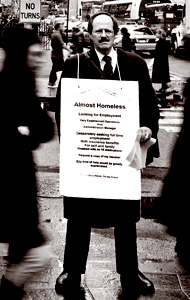
0851_jobless1

In case the text is too small to read, here’s what the sign said:

Almost Homeless

Looking for Employment

Very Experienced Operations
and
Administration Manager

Desperately seeking full time
employment
with insurance benefits
for self and family
Disabled wife on 15 medications

Request a copy of my resume!

Any kind of help would be greatly appreciated

That sign was seen by hundreds, if not thousands, of people walking by as he stood on the street. This week, it will be seen by hundreds of thousands of business people who read the magazine. Some of those people might be in a position to hire him.

If only the sign had given those hiring managers a reason to interview him, and a way to get in touch.

The man has something of value to sell — his time and labor. He’s the advertiser, his sign is his advertising medium, and hiring managers are his prospects. Unfortunately, the copy is all about him, and not about his prospects.

That same sign could have contained some basic information about his experience and skills. It could have talked about the value he could deliver, and the problems he could solve, for a potential employer. It could have contained a phone number or email address — that contact information would now be in the hands of every Business Week reader.

I don’t mean to make light of his situation — I feel awful for him and his family, and sincerely hope that as I write this post, he’s getting ready for his first day at a new job.

Copywriting guru Dan O’Day puts it this way: “Don’t tell me about your grass seed. Tell me about my lawn.”

Your odds of success will increase when you make the message about your prospect, not about you.

___________________________________________________________________________________

Click this link to subscribe to Portland’s Finest Advertising and Marketing Blog.

Request your free copy of Phil Bernstein’s white paper, The Seven Deadly Advertising Mistakes and How to Fix Them here.

Got a question? Call Phil Bernstein at 503-323-6553.

The Hardest-Working Item in Direct Mail…

… may be the lowly Post-It Note.

According to Roger Dooley’s Neuromarketing Blog, using a Post-It Note to personalize a sales letter can make a huge impact:

In Yes! 50 Scientifically Proven Ways to Be Persuasive, Robert Cialdini describes an interesting twist on the handwritten note. A survey was mailed with three cover letter configurations:
1) A printed letter.
2) A printed letter with a handwritten message.
3) A printed letter with a handwritten message on a Post-It note.

The response rate was a mere 36% for the plain printed cover letter. Adding the handwritten note improved the response rate by one third to 48%. The Post-It more than doubled the response to 75%. A second test to examine the possibility that some magic in the Post-It note itself was responsible for the higher response rate included cover letters with a blank sticky note attached. That approach generated only a slightly higher response rate of 42%.

Dooley’s thoughts as to why the note-on-a- Post-It technique worked so well make for interesting reading. Check out the full post here.

___________________________________________________________________________________

Click this link to subscribe to Portland’s Finest Advertising and Marketing Blog.

Request your free copy of Phil Bernstein’s white paper, The Seven Deadly Advertising Mistakes and How to Fix Them here.

Got a question? Call Phil Bernstein at 503-323-6553.

Layaway Comes to Real Estate

Sometimes innovation means going backwards. And sometimes it means moving an old concept to a new industry.

Much has been made lately about the return of the layaway plan — a long-out-of-fashion retail program in which an item is kept at the store while the customer makes payments on it. Until recently, the layaway had been almost completely replaced by the credit card; customers preferred plastic because they could get instant gratification.

The credit crunch has made layaway popular again — Kmart, which never dropped it, is now putting renewed emphasis on the program. Parent company Sears Holdings recently brought it back to Sears after a 20 year absence.

Now, with mortgages difficult to come by, real estate companies and home builders are marketing the concept. According to Business Week,

K. Hovnanian Homes and Beazer Homes are offering contracts that let purchasers deposit downpayment installments in a no-interest escrow account. (Buyers who back out of such plans will lose whatever they’ve accumulated.)

This is a terrific example of what Dan Kennedy and Bill Glazer call “Swipe-and-Deploy” marketing. As a concept, layaway is nothing new. But by moving the concept from traditional retail to real estate, a couple of enterprising companies are generating publicity, interest, and buyers.

___________________________________________________________________________________

Click this link to subscribe to Portland’s Finest Advertising and Marketing Blog.

Request your free copy of Phil Bernstein’s white paper, The Seven Deadly Advertising Mistakes and How to Fix Them here.

Got a question? Call Phil Bernstein at 503-323-6553.

Marketing in Progress Interviews Phil Bernstein

Brett Duncan of Dallas writes an eclectic blog called “Marketing in Progress”. I check in often to find out what’s on his mind, and, occasionally, steal an idea or two.

Not long ago Brett and I had an extended email conversation. You’ll find Part 1 here. Among other topics, we cover personal branding, where radio fits in a, “Advertising 2.0” world, and the value of shorter messages. Click on the link, enjoy the conversation, and then check out some of Brett’s other posts.

___________________________________________________________________________________

Click this link to subscribe to Portland’s Finest Advertising and Marketing Blog.

Request your free copy of Phil Bernstein’s white paper, The Seven Deadly Advertising Mistakes and How to Fix Them here.

Got a question? Call Phil Bernstein at 503-323-6553.