How Language Affects Real Estate Prices

For those in any industry who agonize over their media choices and then have someone “just bang some copy out”, here’s more evidence that every word can be precious. 

Interesting article on msn.com about how the choice of words in a listing can increase — or lower — the perceived value of the house.  

“In real-estate listings, what’s the difference between describing your home as “beautiful” versus “move-in condition”? About $12,500 on a $250,000 home. Professor Paul Anglin, a real-estate economist in Guelph, Ontario, says that homes described as “beautiful” in real-estate listings sell for 5% more while “move-in condition” has no effect on sale price.”

Word choices can also affect the time it takes to sell.

“Listings with the words “beautiful” or “gorgeous” sold 15% faster. “Landscaping” in a listing hastened a sale by 20%. Describing a property as in “move-in condition” quickened the sale by 12%. Calling a home a “handyman special” cut sale time by half (researchers excluded listings that used the term to describe a workshop or hobby area). “

The article’s especially valuable for the chart that matches individual words up with their effect on listing price, sale price, and speed of sale.

____________________________________________________________________________________

Click this link to subscribe.

____________________________________________________________________________________

I’ve written a white paper called The Seven Deadly Advertising Mistakes and How to Fix Them. It’s a study of some of the most common ways that companies waste their advertising dollars — along with suggestions to make those dollars work harder and smarter. Request your free copy here.
Of Hot Chicks and Peak Oil

My former colleague Randy White is an activist in the Peak Oil movement. On his Lawns to Gardens Blog he’s posted a split-screen video.

On the right side, a very attractive young woman, dressed for extremely warm weather, does a dance that would melt a glacier. On the left side, the same woman (I think), in much more subdued clothing, gives her views on what’s going to happen when all the oil runs out.

In addition to being an ironic commentary on the advertising business, it illustrates the attractions and pitfalls of using sex to sell:

1. I watched the video from beginning to end — nearly four minutes in all. This would not have happened in the absence of the hot dancing chick.

2. On the other hand, the speaker’s message did not register with me at all. I was too busy watching the hot dancing chick. 

We’ve all seen TV commercials that made us laugh, only to realize later that we can’t remember what the ad was for. Sex, like humor, can be an effective way of holding your prospect’s attention long enough to deliver the sales message. In order for the sales message register with the prospect, the sex or humor needs to be integrated into the pitch. Without that integration, your prospect won’t remember what you are trying to say.

Response is Not the Same as Results

If you work with clients on their advertising, you’ll eventually encounter the business person who confuses response with results. Response is when the guys at the country club tell you how funny your commercials are. Results is when your commercials cause a whole bunch of good prospects to become good customers.

Last month, I probably received ten “Elf Yourself” emails, and watched a bunch more. And yet, until I read Ron Shevlin’s smackdown on OfficeMax, it didn’t even really occur to me that OfficeMax wanted me to shop with them.

OfficeMax definitely got response — according to Advertising Age, the campaign was watched by 110 million visitors. But it’s less clear whether the “Elf Yourself” campaign caused many of the visitors to go to an Office Max store and buy something.

Shevlin does a terrific job reminding us what marketing is supposed to do, and how Office Max forgot what really matters. His jumping-off point is the Advertising Age article that calls the campaign “a winner”:

My take: This is the stuff that drives CEOs/CFOs crazy. Nowhere in the article does it mention metrics like incremental awareness, improved brand affinity, or [heaven forbid] incremental sales as measures of success. According to the article, Alexa ranked Elf Yourself as a top 1000 site in 50 countries. OfficeMax does business in five.

You want rules of viral web success? A viral web effort succeeds when it… [read the rest of the post here.]

___________________________________________________________________________

I’ve written a white paper called The Seven Deadly Advertising Mistakes and How to Fix Them. It’s a study of some of the most common ways that companies waste their advertising dollars — along with suggestions to make those dollars work harder and smarter. Request your free copy here.

Marketing to Boomers as They Age

Very interesting article in the New York Times on how marketers are dealing with the aging of the Baby Boomer generation. The generation still has huge purchasing power, but the messages they respond to are different from those that succeeded with the previous generation of seniors.

According to the Times, this is in part because “they don’t want to believe they fall into any niche at all.”

That leaves marketers grouping older consumers into categories that give the illusion of individuality, they hope, while still encompassing millions of people.

For example, Age Wave, a consulting firm, has settled on four essential categories for post-retirement consumers. There are “Ageless Explorers,” or rich retirees who respond to images of silver-haired scuba divers reinventing themselves in their waning years. The “Comfortably Contents” are also wealthy, but more attracted to scenes of fishermen, friendly dogs and rocking chairs. They want to spend their final years free from the responsibilities of work, social obligations and worrying about anyone else. The “Live for Todays” wish they could relax, but didn’t save much, so their financial anxieties make them easy targets for Costa Rican retirement communities and thrifty insurance plans. And then there are the “Sick and Tireds,” basically ready to die, who are attracted to anything that makes the waiting less painful, particularly if it costs less than $19.95.

Charles Duhigg, who wrote the article, details some of the advantages and pitfalls of the approach. You can read the full article here.

___________________________________________________________________________

I’ve written a white paper called The Seven Deadly Advertising Mistakes and How to Fix Them. It’s a study of some of the most common ways that companies waste their advertising dollars — along with suggestions to make those dollars work harder and smarter. Request your free copy here.

A Missed Opportunity

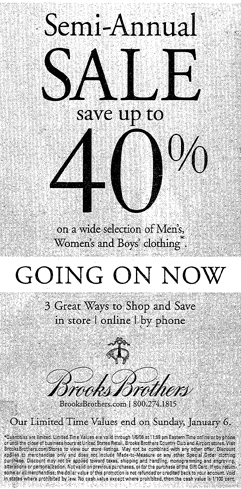
brooks-brothers.gif

Over the holiday break, this ad ran in the Oregonian at least twice. My guess is that it ran all over the country, and the people who designed it didn’t feel like customizing the ad for specific markets.


Which means they blew it. 


Brooks Brothers wants their prospects to respond in one of three ways: ordering online, calling their 800-number, or visiting their store. Logically, the retail store is where people would go if they wanted to try on a suit and get it altered. But Brooks Brothers doesn’t tell you where the store is.


The downtown Portland Brooks Brothers store has only been open a few months, in a mall that’s seen some hard times, and a lot of their target customers don’t even know it’s there. This would have been a perfect opportunity to tell them about the new store, lure them in to save money on shirts — and measure them for a suit or two.


It would not have been hard to leave room for store addresses in each market that had a retail store. But someone at Brooks Brothers couldn’t be bothered, and they’ll never know how much money they lost.


Today’s lesson is: if you want your prospects to do business with you, make yourself easy to find.


By the way, you can find me at 503-323-6553.