Seth Godin Helps Me Get Over Myself

I took a “no” yesterday from a client who should have said “yes.”

Spent a good part of my Saturday fuming about the considerable effort I’d put in, the difficulty of communicating with the decision-maker through a third party, and my firm belief that if he’d gone ahead with what I’d proposed, it would have been a profitable investment for him.

The income I lost when he turned me down may have also entered my thinking.

So Seth Godin’s post on “Two Ways to Deal With No” was both timely and beneficial. Shortened, fair-use versions of the options he presented are:

You could contact the organization that turned you down and explain that they had made a terrible mistake, the wrong choice and a grave error…

or

You could be more gracious than if you’d won the work. You could send a thank you note for the time invested, you could sing the praises of the vendor chosen in your stead and you could congratulate the buyer, “based on the criteria you set out, it’s clear that you made exactly the right choice for your organization right now.”

Seth expands significantly in his post, which you can read in its entirety here. I’ll add one other thought — advice I’ve given many times to newer salespeople, and which I’d forgotten in my own frustration yesterday:

Never blame the customer for not buying. Most of the time you’re wrong — in the course of the sales process, you have choices in how you present your proposal.

There’s always a way you could have done it differently. If the choices you made didn’t result in a sale, your mental energy is much better invested in thinking about what adjustments you’ll make in your presentation the next time you get a chance.

Seth’s second option will go a long way toward ensuring that the chance will come again.

________________________________________________________________________________________

Click this link to subscribe to Portland’s Finest Advertising and Marketing Blog.

Request your free copy of Phil Bernstein’s white paper, The Seven Deadly Advertising Mistakes and How to Fix Them here.

Got a question? Call Phil Bernstein at 503-323-6553.
Using Keywords to Compete Online

Among the information available to me as WordPress blogger is a list of search terms that readers use to get to my blog. Every so often I learn something interesting — for example, by accidentally mis-spelling Sarah Palin’s name (as “Sarah Pailin”), I picked up a bunch of traffic from political junkies who made the same mistake in their searches.

This evening, the term “KXL Radio Advertising” turned up on the list. I couldn’t figure out why — 750 KXL Radio is a competitor of 1190 KEX, which is one of my stations in Portland. So I plugged it into Google, and discovered that because I once complimented KXL in a post, Portland’s Finest Advertising and Marketing Blog now shows up in the #2 position.

Inadvertent, but potentially beneficial. A couple of thoughts come to mind:

  • If you have a blog of your own, mention one of your competitors in a post. You might attract a few of their customers.
  • As long as I’m engaged in this exercise, I’d like to say hello to potential advertisers of the following fine Portland radio stations: K103, Z100, KPOJ, KOOL 105.9, KUPL, KINK, K-Hits, Jammin’ 107.5, KWJJ The Wolf, KGON, Charlie, KNRK 94.7, KFXX The Fan, 95.5 The Game, 105.1 The Buzz, KPAM, and The Fish.
  • If you were the person who was interested in advertising on KXL Radio in Portland, I hope you’re enjoying my blog. And by all means, feel free to call me at 503-323-6553.

________________________________________________________________________________________

Click this link to subscribe to Portland’s Finest Advertising and Marketing Blog.

Request your free copy of Phil Bernstein’s white paper, The Seven Deadly Advertising Mistakes and How to Fix Them here.

Got a question? Call Phil Bernstein at 503-323-6553.

Could Newspapers Go Web-Only?

My dad was for many years a highly-respected law professor at Washington University in St. Louis. He also had a thriving side business as an arbitrator. At one point in his career, he took a leave of absence from the university to see if he could arbitrate full-time.

A year or so later, he went back to teaching. He later told me that arbitration jobs became much harder to get when he was no longer a university professor. Once he was back on campus, the demand for his arbitration services went right back up.

It turned out that in the arbitration community, “Professor Bernstein of Washington University” was a powerful brand. It gave him a significant competitive advantage in the marketplace.

I thought of that story today when I read Jeff Jarvis’ suggestion on Huffington Post that it may be time for the Los Angeles Times to turn off its printing presses and go online-only.

His reasoning is that the Times’ web revenue is apparently now greater than its newsroom payroll costs. Eliminate all the costs of printing and distributing a physical product, outsource the national and international reporting to the big national papers, (Wall Street Journal, New York Times, etc), focus all of your efforts and resources on local news, and you’ve got a profitable digital news operation.

As an advertising guy, I see some big questions:

1. How much of that online revenue will disappear when it’s not part of a print advertising package?

2. How important would the LA Times website be, as an advertising vehicle, if it’s not tied to LA Times, the paper? Will readers still go to that website if there’s no physical product to remind them? Will merchants still pay to advertise there if they’re not in the paper, too?

In my radio-and-online world, our websites are becoming increasingly important, to listeners and advertisers. But at least right now, it’s the “on-air” that drives traffic to our sites online. Much of the value advertisers see in being on www.1190kex.com is tied to the reputation and reach of KEX Radio, 1190 on the AM dial; and most of our online advertising is purchased in conjunction with an on-air radio campaign.

If you take away the physical paper, does “LA Times Dot Com” become a thriving online source of local news? Or is it just another web site?

______________________________________________________________________________________

Click this link to subscribe to Portland’s Finest Advertising and Marketing Blog.

Request your free copy of Phil Bernstein’s white paper, The Seven Deadly Advertising Mistakes and How to Fix Them here.

Got a question? Call Phil Bernstein at 503-323-6553.

Southern Auto Dealer Shares His Opinions

In case you were thinking that the recent Presidential election signals a new, color-blind United States of America, there’s some evidence that we may not be there yet.

A Savannah, GA auto dealer named O. C. Welch was in a foul mood one day recently, and happened to be near a microphone. You can hear the resulting hairball of a radio commercial here, on my colleague Mike Copeland’s blog.

Factually dubious (many of the Toyotas he’s complaining about are built by Americans in Alabama, Kentucky, Texas, West Virginia, and Indiana) and downright racist (“rice-ready”???), the ad acts as a sixty-second test for Savannah:

How many angry bigots are in the market for a new car this weekend?

___________________________________________________________________________________

Click this link to subscribe to Portland’s Finest Advertising and Marketing Blog.

Request your free copy of Phil Bernstein’s white paper, The Seven Deadly Advertising Mistakes and How to Fix Them here.

Got a question? Call Phil Bernstein at 503-323-6553.

Opportunity Missed

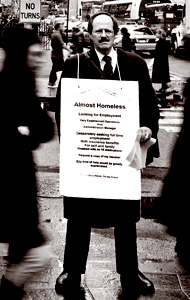
The cover story in the current Business Week contains a powerful photograph of a man in New York’s Times Square. I don’t know him or anything about his situation, and hope he finds a job soon. But I can’t help but lament the opportunity he may have missed.

Within that missed opportunity is a copywriting lesson for all advertisers.

0851_jobless1

In case the text is too small to read, here’s what the sign said:

Almost Homeless

Looking for Employment

Very Experienced Operations
and
Administration Manager

Desperately seeking full time
employment
with insurance benefits
for self and family
Disabled wife on 15 medications

Request a copy of my resume!

Any kind of help would be greatly appreciated

That sign was seen by hundreds, if not thousands, of people walking by as he stood on the street. This week, it will be seen by hundreds of thousands of business people who read the magazine. Some of those people might be in a position to hire him.

If only the sign had given those hiring managers a reason to interview him, and a way to get in touch.

The man has something of value to sell — his time and labor. He’s the advertiser, his sign is his advertising medium, and hiring managers are his prospects. Unfortunately, the copy is all about him, and not about his prospects.

That same sign could have contained some basic information about his experience and skills. It could have talked about the value he could deliver, and the problems he could solve, for a potential employer. It could have contained a phone number or email address — that contact information would now be in the hands of every Business Week reader.

I don’t mean to make light of his situation — I feel awful for him and his family, and sincerely hope that as I write this post, he’s getting ready for his first day at a new job.

Copywriting guru Dan O’Day puts it this way: “Don’t tell me about your grass seed. Tell me about my lawn.”

Your odds of success will increase when you make the message about your prospect, not about you.

___________________________________________________________________________________

Click this link to subscribe to Portland’s Finest Advertising and Marketing Blog.

Request your free copy of Phil Bernstein’s white paper, The Seven Deadly Advertising Mistakes and How to Fix Them here.

Got a question? Call Phil Bernstein at 503-323-6553.