Marketing to Boomers as They Age

Very interesting article in the New York Times on how marketers are dealing with the aging of the Baby Boomer generation. The generation still has huge purchasing power, but the messages they respond to are different from those that succeeded with the previous generation of seniors.

According to the Times, this is in part because “they don’t want to believe they fall into any niche at all.”

That leaves marketers grouping older consumers into categories that give the illusion of individuality, they hope, while still encompassing millions of people.

For example, Age Wave, a consulting firm, has settled on four essential categories for post-retirement consumers. There are “Ageless Explorers,” or rich retirees who respond to images of silver-haired scuba divers reinventing themselves in their waning years. The “Comfortably Contents” are also wealthy, but more attracted to scenes of fishermen, friendly dogs and rocking chairs. They want to spend their final years free from the responsibilities of work, social obligations and worrying about anyone else. The “Live for Todays” wish they could relax, but didn’t save much, so their financial anxieties make them easy targets for Costa Rican retirement communities and thrifty insurance plans. And then there are the “Sick and Tireds,” basically ready to die, who are attracted to anything that makes the waiting less painful, particularly if it costs less than $19.95.

Charles Duhigg, who wrote the article, details some of the advantages and pitfalls of the approach. You can read the full article here.

___________________________________________________________________________

I’ve written a white paper called The Seven Deadly Advertising Mistakes and How to Fix Them. It’s a study of some of the most common ways that companies waste their advertising dollars — along with suggestions to make those dollars work harder and smarter. Request your free copy here.
A Missed Opportunity

brooks-brothers.gif

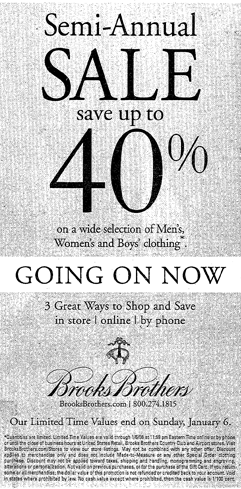
Over the holiday break, this ad ran in the Oregonian at least twice. My guess is that it ran all over the country, and the people who designed it didn’t feel like customizing the ad for specific markets.


Which means they blew it. 


Brooks Brothers wants their prospects to respond in one of three ways: ordering online, calling their 800-number, or visiting their store. Logically, the retail store is where people would go if they wanted to try on a suit and get it altered. But Brooks Brothers doesn’t tell you where the store is.


The downtown Portland Brooks Brothers store has only been open a few months, in a mall that’s seen some hard times, and a lot of their target customers don’t even know it’s there. This would have been a perfect opportunity to tell them about the new store, lure them in to save money on shirts — and measure them for a suit or two.


It would not have been hard to leave room for store addresses in each market that had a retail store. But someone at Brooks Brothers couldn’t be bothered, and they’ll never know how much money they lost.


Today’s lesson is: if you want your prospects to do business with you, make yourself easy to find.


By the way, you can find me at 503-323-6553.

How to Find Me on Google

A while back, I did a post on great headlines, which I titled after my favorite example: “Headless Body in Topless Bar”. WordPress, the company that manages this blog, lists the search engine terms that people have used to get to it — and yesterday, someone found me by typing the term “Topless Bars, Portland OR” into Google.

I just checked this myself, and I’m #7 the page — the other six are actual strip clubs. And if you Google “Headless Body Portland OR”, I show up at #2.

Not sure quite what to make of this, but my mother would be proud.

Cute Elevator Speeches

One of the mainstays of sales training is the “Elevator Pitch” — a 30-second summation of what we do that we’d give a prospect if we had the prospect trapped in an elevator. The idea is that when someone at a cocktail party asks what you do, you can respond with a succinct value proposition rather than just a job title. Which, in theory anyway, will pique the interest of anyone who might be a prospect.

For example, if a business owner asks what I do and I say I sell advertising, the conversation might be over very quickly. He probably hasn’t been dreaming about buying advertising. If, on the other hand, I say that I help local businesses find tell their stories, find more customers and make more sales, there may be something to talk about.

 Over at the SW Washington and Portland Small Business Blog, Michael Thompson of Market Accelerators wonders if cute elevator pitches work. 

 No one in our group had a particularly cute one but we all could remember someone who did. You know the “I’m Rachel the Realtor and I’m Really Reliable” or “Harry the Healthy Heart Alternative or whatever. Some folks even dress the part with a particularly impressive hat or big flashing button — you know who you are.

It was interesting because we all could remember someone like that and often it turned out to be the same person. So obviously it works from a remembering point of view but none of us felt particularly like we would buy from someone like that. There was a hesitation for some reason.

I’m all for a memorable hook (I use “Portland’s Finest Media Rep”), but the problem with a cutesy rhyme is that it smacks of trying too hard. And the folks I’ve encountered who use handles like that are so pleased with the alliteration that they forget the rest of the value proposition. The best elevator speeches are like any other form of advertising — they tell potential buyers how the seller can solve a problem. Skip that part, and a rhyme isn’t going to save you.

 ___________________________________________________________________________

Like what you’re reading? Download my free white paper, The Seven Deadly Advertising Mistakes and How To Fix Them.

What Other Problems Do Your Customers Have?

In the wine department of the Hollywood West Fred Meyer store is a device that looks kind of like a clothes hamper full of slowly circulating ice water. A sign on the device says,

“Free Chilling Service — 25 Times Faster Than a Refrigerator”

You just put the bottle in the water and come back in a little while. 3 minutes for “cool”, 5 minutes for “cold”, 7 minutes for “ice cold”.

Somebody at Fred Meyer realized that for some of their shoppers, a good wine selection solves one problem — what to serve at the party — but leaves another potential issue — the guests are arriving in less than an hour and the white wine’s warm.

By offering to solve this second problem at no extra charge, Fred Meyer’s positioned itself as the first option for this segment of customers.

We’re all in the problem-solving business.

  • People with transportation problems go to car dealers.
  • Homeowners who need to find a buyer hire a real estate agent.
  • People who believe they look old or unattractive go to a clinic for botox or lipodissolve.

In many cases your customers are consciously aware of the primary problem they need to solve, but may need to address other issues as well.

Sometimes these issues are a barrier to doing business. The Red Cross, recognizing that many people feel they’re too busy to give blood in December, recently announced a program called “You Give, We Wrap.” Donors bring their holiday gifts to the center, and Red Cross volunteers will wrap the packages while the donors are giving blood.

Sometimes these secondary problems can even be an opportunity for extra profit. When you buy a gift from Amazon.com, they’re happy to wrap it — for an additional $3.99 per package.

Whether you’re trying to generate extra revenue or just position yourself as the first choice for your clients, it makes sense to ask — what other problems can I solve?

_________________________________________________________________________

Like what you’re reading? Download my free white paper, The Seven Deadly Advertising Mistakes and How To Fix Them.